
Stop using portrait mode: Middents discusses Alfonso Cuarón’s wandering camera
October 30, 2026
 Abigail Hebert
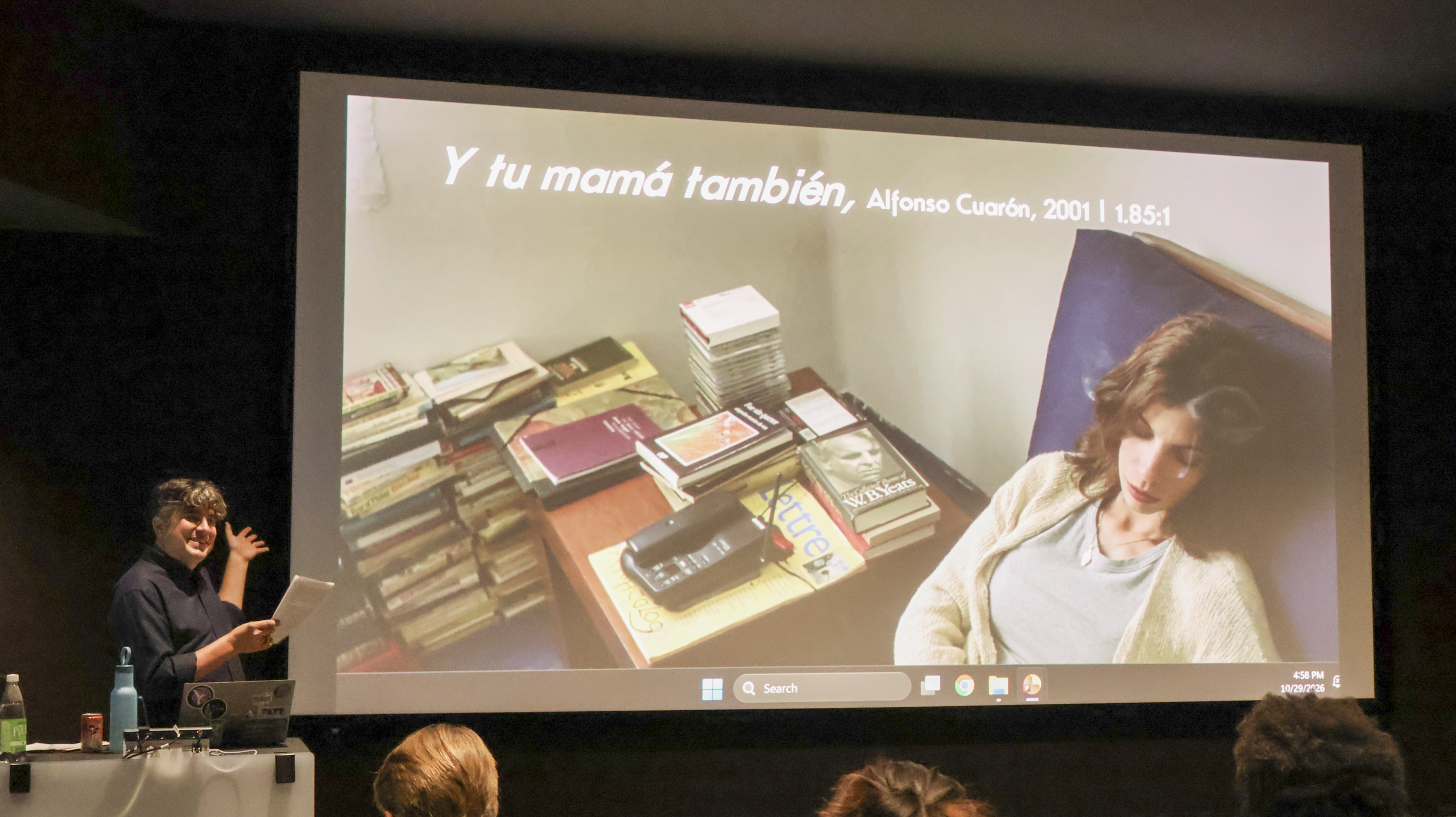
On Thursday, the Mills Jewel Box Cinema hosted Jeffrey Romero Middents, professor of film and world literature at American University. Middents examined the 21st century filmography of Mexican-born director Alfonso Cuarón in his lecture titled, “Don’t Hold the Center: Framing, Widescreen and the Films of Alfonso Cuarón.” Resonating with a wide range of campus groups, Middents’ talk was co-sponsored by the Cinema Studies program, Hispanic Studies program and the Bowdoin Film Society.
Associate Professor of Romance Languages and Literatures and Cinema Studies Allison Cooper was the faculty sponsor who brought Middents to campus. Cooper reflected on her previous collaboration with Middents in Middlebury’s Workshop on Videographic Criticism.
“Among film studies scholars, it is affectionately known as video camp,” Cooper said. “You go to Middlebury for two weeks… [and] you are in the lab about eight hours a day learning how to make video essays. Professor Middents was in the same cohort… that I was in. It is a really intense bonding experience because you are really working hard.”
Analyzing Cuarón’s films, both Cooper and Middents expressed an interest in the director’s extensive technical know-how and unique storytelling capabilities, especially in “Y tu mamá también.”
“This is a director who has a completely original view of how he can use this medium, that I love so much, to tell stories in a completely novel way,” Cooper said.
Cuarón, a highly decorated Mexican filmmaker, has an extensive filmography recognized with four Academy Awards, three Golden Globe Awards and seven BAFTA Awards. From “Y tu mamá también” to “Harry Potter and the Prisoner of Azkaban,” Cuarón has experienced success across genres. Whether they are set in 1990s Mexico City or the wondrous wizarding world, for Middents, these films showcase Cuarón’s fascination with a particular concept: a sense of place.
“I do think that all of these movies are about a sense of place,” Middents said. “‘Y tu mamá también’ is a really fascinating movie, in that it begins in Mexico City… and goes to the unfamiliar [through] this road trip that they do. It’s even true of Harry Potter and the Prisoner of Azkaban. It’s the movie that’s the most outside…. What does Hogwarts actually mean as a place that’s beyond the castle of walls?”
Middents dove deeper into “Y tu mamá también” in his lecture. Through both the luxuriously wide screen and long takes, Cuarón allows the audience to linger in the world he creates. Beyond just still composition, camera movement also plays an effect. Middents explored how Cuarón creates this sense of place through the diverted camera, revealing to the audience the parts of the environment the main characters never get to see.
“The camera is showing us what they will never see…. The camera is actually telling us, ‘The story you think this is, is not the important part. It is actually the environment that is more interesting,’” Middents said.
This wandering camera continues into “Children of Men.” To illustrate how Cuarón uses the technique, Middents showed his own video essay, a supercut of every instance in the film where the main character, Theo, exits the shot as the camera lingers on the background.
“What Cuarón is interested in is not Theo, it’s all these different elements about the world that are making up ‘Children of Men,’” Middents said.
Cuarón’s most recent film, “Roma,” tells a different story. While the long takes and grand wide screens remain, “Roma” centers the main character.
“Here, the story that we otherwise might find in a Mexican movie, should be about this middle- class white family. And instead, the story quite literally centers around their maid,” Middents said.
Attendee and Bowdoin Research Librarian Linnea Minich reflected on how the lecture drew her attention to the intentionality of cinematography.
“This made me think a lot more about the intentional framing in movies and how the director and the cinematographer are making choices based on what you can see,” Minich said.
Finding value in these intentional choices about what lingers on screen, Middents has grown increasingly alarmed by what he sees as the tyranny of the center. Whether it is the portrait mode feature on iPhones that centers the subject, or artificial intelligence rotoscoping technology that centers the face, these technological advancements affect how we see the world.
“We are training ourselves to be orientated by the center. By doing that we are losing the periphery. We are losing the context,” Middents said.
Comments
Before submitting a comment, please review our comment policy. Some key points from the policy: