
Masque & Gown presents love letter to theater in production “The Book of Will”
October 30, 2026
 Abigail Hebert
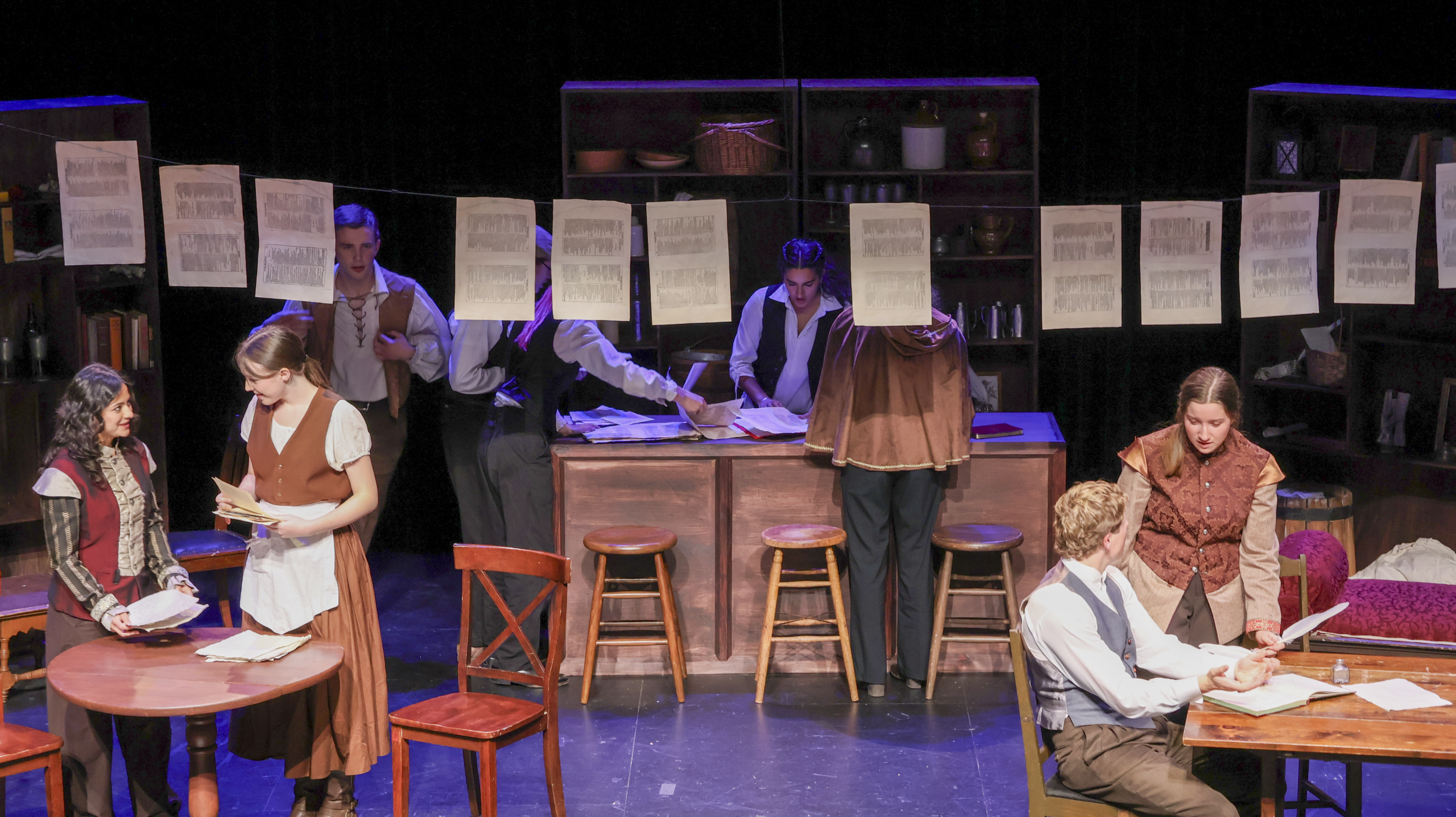
Last weekend, Masque & Gown transported audiences back in time to the making of Shakespeare’s first folio with a production of Lauren Gunderson’s “The Book of Will.” Directed by Lindsay Golan ’27, the play took place in Wish Theater.
“The Book of Will” follows Shakespeare’s friends in the years after his death as they attempt to compile his plays into a collection. Throughout the play’s two acts, the characters experience a multitude of triumphs and losses, always returning to the theater as a place of connection and emotional release.
Golan highlighted the play’s celebration of theater and storytelling as a reason she proposed “The Book of Will” for this fall’s mainstage production.
“[The play] felt very human and grounded [in] why I love theater, and why I love storytelling, and how we generally as a population and world continue moving forward or striving to achieve certain things,” Golan said.
The production used Wish’s intimate environment to break the boundary between the performers and the audience. Simultaneous scenes took place across the theater’s balconies and the stage, while actors came through the aisles to sell fruit to playgoers.
“I think the intimacy of Wish was very important for my show,” Golan said. “I wanted it to feel like the audience was sort of swallowed by the world that we were building.… And I think that allowed the show to be a lot more grounded and for people to feel a lot more [of] a connection to the story that was going on.”
Lyra Legawiec ’30, who portrays Henry Condell, the Elizabethan actor who first proposes publishing a folio, explained how performing for an audience altered the emotional impact of one of the play’s pivotal scenes in Act 2, when a significant character dies.
“I knew that [the scene] was going to land differently with a group of people watching us, but there were some lines that really didn’t hit me a certain way until we did them in the moment for the people before us,” Legawiec said.
While the play is based on historical figures and set in 17th-century London, the humanity at its heart transcends a single historical period. Golan explained that her decision to let actors keep personal jewelry on and not age them with makeup spoke to the merging of past and present in Gunderson’s script.
“I felt like it was the idea that we were all bringing a little bit of ourselves,” Golan said. “That was the present part of the show, and then the past was the actual historical aspects of it.”
Masque & Gown president Anna Monaghan ’27, who portrayed Rebecca Heminges, a driving force behind the folio’s publication, highlighted how seeing herself in the script allowed her to portray the character with full complexity.
“I loved [that] you can tell how driven she is, but she’s also still has this very loving, caring presence,” Monaghan said. “It was very easy for me to see and identify with this woman, who clearly just really loves the people around her, and has a lot of passion for this project, and for making sure that things get done.”
The show took audience members on an emotional journey, eliciting both tears and laughs from the crowd. Golan highlighted how the play’s duality spoke to the complexities of real life.
“One of my favorite things about this play is that I think it has a very feel-good ending, regardless of how emotional it can make you feel watching the entire trajectory,” Golan said. “It was super important for me… that the comedy within the show isn’t just a distraction from the drama, and that it’s also a representation of how we, in life, will have these moments that are serious, and then [moments that] come with some levity.”
Monaghan also emphasized how building relationships between characters was crucial to creating the emotional impact of the show’s heavier moments.
“Something that we talked about as a cast is hitting those moments when it’s really fun and beautiful on stage… and making sure you understand how wonderful and meaningful that friendship is, and then hitting the familial relationships, and how beautiful those are,” Monaghan said.
In the show’s final scene, all the production’s actors came out on stage, moving through the theater’s stage, balconies and aisles, reciting their favorite Shakespearean monologues in a showcase of the playwright’s far-reaching influence.
“Not only is [the scene] a bunch of Shakespeare,… and how it’s continued throughout time and all of these different things, but it’s also very true and dear to many of the actors themselves,” Golan said.
Comments
Before submitting a comment, please review our comment policy. Some key points from the policy: