
MENA studies program opens Fall Film Series with screening of “Palestine ’36”
October 23, 2026
 Daniel Galindo Orellana
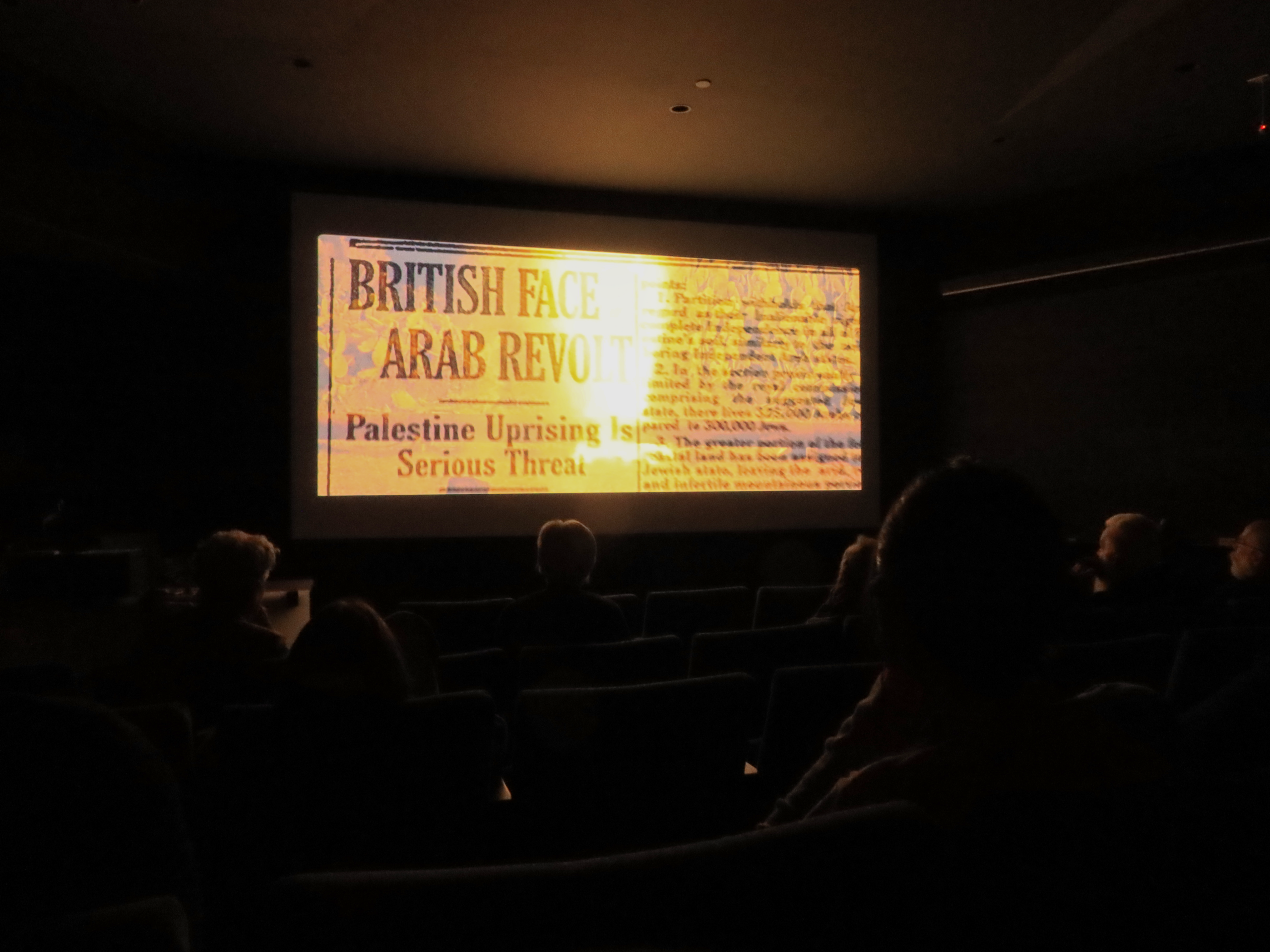
Last Monday, students and community members gathered for a screening of the historical epic “Palestine ’36” (2025) in Mills Hall. The screening was hosted by the Middle Eastern and North African studies program as part of its Fall Film Series, which will spotlight films from a different country each semester, beginning with Palestine. A collaborative effort between students and faculty, the screening was co-sponsored by the cinema studies program, Bowdoin Film Society and Amnesty Bowdoin.
Associate Professor of Humanities, Romance Languages and Literatures Meryem Belkaïd opened the screening by thanking students for their contributions to the series and spotlighting upcoming student-organized events on Palestine. Introducing the film, Belkaïd emphasized the importance of bringing attention to an overlooked period in Palestinian history.
“‘Palestine ’36,’ I would say, is [Annemarie Jacir’s] most ambitious film to date,” Belkaïd said. “It turns to a time period rarely depicted on screen, and certainly not depicted often from within a Palestinian imagination.”
The film recounts the 1936–1939 Palestinian revolt against British colonial rule, following its protagonist Yusuf as he moves between his home village, al-Basma, and Jerusalem, where he worked for a wealthy Palestinian family. The fictional village was based on al Bassa, the site of a 1938 massacre where British Army soldiers forced Palestinian villagers onto a bus and forced them to drive over a land mine.
In an interview with the Orient, Belkaïd expanded on how the film’s approach to historical documentation helped illustrate Palestine’s long colonial history. She underscored the necessity of grounding discussions on Palestine in this historical context.
“There are two things that we have to hold and they are not contradictory,” Belkaïd said. “I think we have to spark as much conversation as possible and draw attention to what is happening today in Gaza.… But at the same time, I think we have to keep talking about Palestine in other terms … to give some historical depth to current events.”
Beyond simply providing a depersonalized account of events, ‘Palestine ’36’ offers insight into the lived experiences of Palestinians under British occupation. Belkaïd explained that she chose to display works of fiction for the series in order to harness storytelling’s unique ability to create emotional connection.
“I think one of the challenges for the region in general, and also specifically, when we talk about Palestine, is the number of misrepresentations that we have … especially if we are only tuned to media coverage,” Belkaïd said. “So, the idea is to broaden our imaginations, to bring images of the place, stories [and] narratives that challenge the hegemonic discourse on the region and also provide an understanding of the daily life of people who live in a certain region.”
Attendee Sarah Mohamed Ali ’29 reflected on how the film expanded her understanding of the Palestinian resistance movement, particularly in its use of music and depiction of women.
“I really enjoyed hearing a lot of the traditional songs and seeing how … music was a big form of resilience throughout the film, and I thought that was really powerful,” Mohamed Ali said. “I also really liked seeing how women played a big part in resistance.”
The film’s heavy subject matter left the audience speechless once credits rolled. Belkaïd highlighted the value of sitting with the emotional impact of a film while also recognizing the significance of conversation as a tool to process a work of art.
“When the film is heavy or when it brings the audience to feel very important, strong emotions, I think it’s nice to sit with this emotion and not try to intellectualize it right away,” Belkaïd said. “But at the same time … I value the conversation that we can have with students and it can be a learning moment for all of us. I don’t consider myself as a teacher when I’m screening a film. We are sharing the same experience.”
Despite the difficult emotions generated by the film, Belkaïd reiterated the importance of considering the humanity of those affected by historical tragedies.
“Edward Said says that we often cover the region when it’s in crisis. We only speak of the region when there is turmoil and it’s important to do so…. But it’s also important to remind people that we are talking about human beings with lives, houses, dreams, hopes, disappointment, love stories and so forth,” Belkaïd said.
The Fall Film Series will continue with a screening of “All That’s Left of You” (2025) on Monday, November 16 and a screening of “Gaza mon amour” (2020) on Friday December 4, which will be followed by a meal and conversation.
Comments
Before submitting a comment, please review our comment policy. Some key points from the policy: