
Meghan Cox Gurdon ’86 and Hugo Gurdon talk journalism and conservative politics
November 13, 2026
 Abigail Hebert
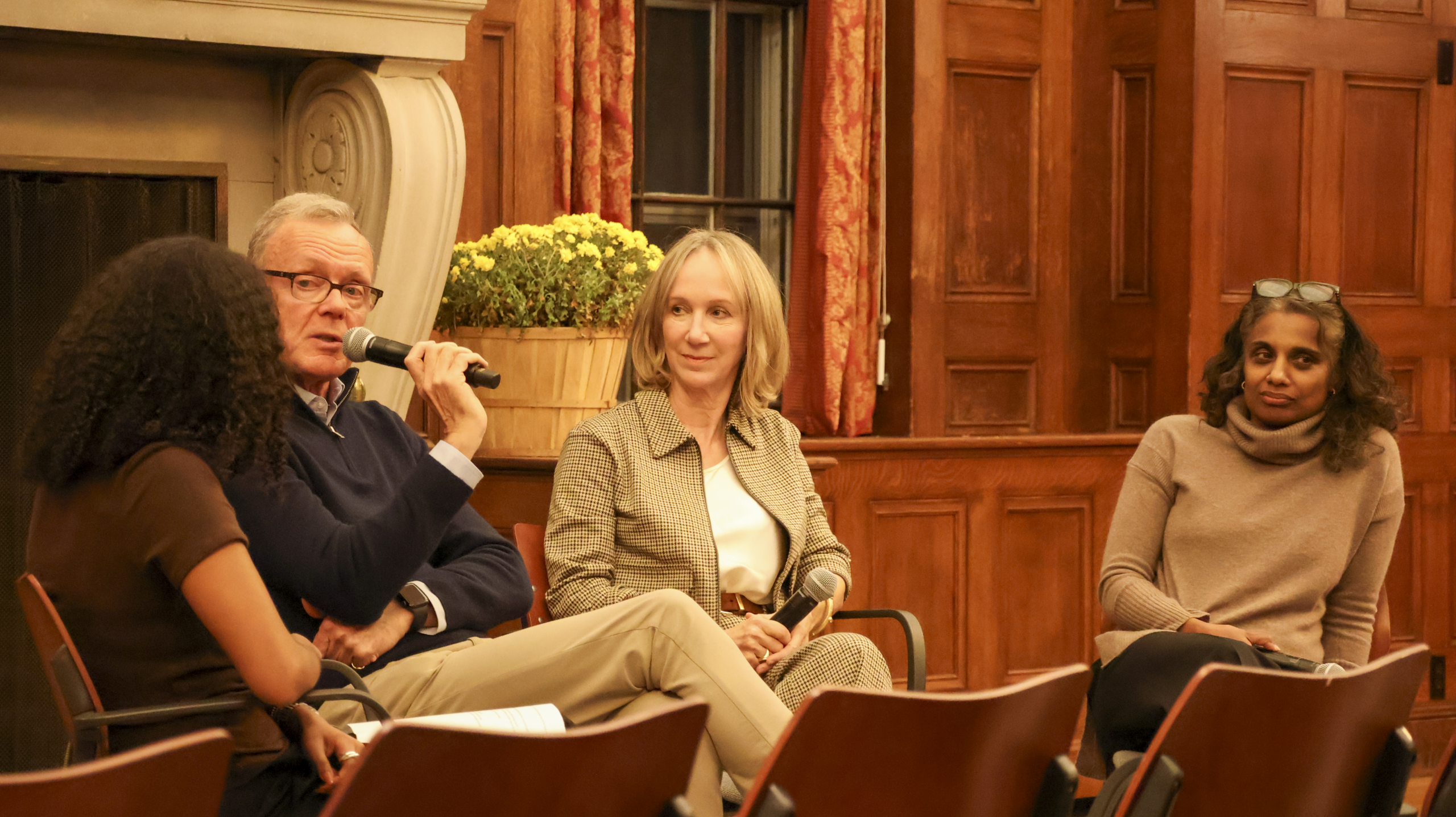
On Wednesday evening, students, faculty and community members convened in the Main Lounge of Moulton Union to hear from journalists and married couple Meghan Cox Gurdon ’86 and Hugo Gurdon in a discussion moderated by Professor of Africana Studies and English Tess Chakkalakal and Leah Kiros ’28.
Meghan Cox Gurdon is a weekly contributor to the Wall Street Journal (WSJ) book pages and a columnist for the WSJ’s opinion newsletter, “Free Expression.” She is also the author of the books “Free Range Girl” and “The Enchanted Hour: The Miraculous Power of Reading Aloud in the Age of Distraction.” Hugo Gurdon is editorial director of the Washington Examiner.
Prior to Bowdoin, Meghan Cox Gurdon envisioned college as a knowledgeable world of “art, beauty, meaning and purpose” which professors would invite her into. She conceded that she was an “ignorant and not political” high school student, but her emerging politics soon became apparent in college.
In a course exploring the history of South Africa, she was perturbed by the professor’s disparaging depiction of white South Africans and selective Marxist perception of the nation’s history. Upon vocalizing her opposition, Meghan Cox Gurdon was redirected to an independent study with the only openly conservative professor on campus.
“This kind of disgraceful ostracism was my introduction to the possibility that … maybe I was one of those odious people, those conservatives,” Meghan Cox Gurdon said. “It was my political awakening, realizing through the behavior of other people that there were some questions you couldn’t ask, some things that you weren’t allowed to wonder about, and this did not accord at all with my idea of the garden of knowledge.”
A post-graduate position at an investor relations firm led Meghan Cox Gurdon to the WSJ, a client of her firm, where she began writing her column.
Meghan Cox Gurdon explained that while her sensibility and tendencies are conservative, she does not consider herself a conservative journalist.
“I think that some of what I’m doing is norm creation, and by putting my conservative sensibility into the world, I’m making it possible for other people to see themselves in that,” Meghan Cox Gurdon said.
While Hugo Gurdon said there will be an endless appetite for news among curious, intellectual readers, he expressed concern for contemporary journalism and the profitability of media outlets.
“We’re moving, unfortunately, into what I think is a somewhat post-literate society,” Hugo Gurdon said. “I think a lot of people don’t want to read, and they … want their news delivered by video and/or a rather pleasing way of hearing news discussed on podcasts.”
Hugo Gurdon transitioned from studying English and poetry at the University of Bristol to working for local newspapers in England and the Financial Times in Khartoum, Sudan. His career has culminated in his current editorial position at the Examiner.
Considering bias in journalism, Meghan Cox Gurdon shared that she once considered objectivity impossible, believing that humans cannot be purified of their inherent biases. Now, she reflected that her younger self’s conviction has evolved.
“It’s important for reporters to be aware of strands of thinking. One of the things that I notice … is that oftentimes reporters will not even know that there is a conservative idea that differs from their own,” she said. “The water that they swim in is so thoroughly tinged with assumptions … that they don’t even know that there might be a principled and perfectly reasonable and humane explanation for phenomena on the right.”
Hugo Gurdon emphasized that confirmation bias often inhibits unbiased journalism.
“I don’t know if that can be fixed,” he said. “There’s a very strong taste for having one’s own biases confirmed and it’s inexpensive but not rewarding financially to spread those around.”
The couple concluded by discussing the more personal effects of their politics. Meghan Cox Gurdon recommended refraining from political arguments to preserve interpersonal relationships, referencing tense disagreements with her late parents, who held left-leaning beliefs. Ultimately, she argued, respecting loved ones as citizens and family members takes precedence over winning political disputes.
“In a strange way, I regard it as an achievement of us as parents that our five children are very different people with very different orientations,” Meghan Cox Gurdon said. “Yet you can see there are points of overlap, a fundamental loving thing at the center, and I’m proud that we have allowed them to grow up to be their own people.”
Attendee Matt Brayer ’28 appreciated the viewpoints that the speakers brought to campus.
“I thought it was very interesting how one of the speakers brought up John Stuart Mill,” Brayer said. “It shows the importance of bringing a variety of views to campus to force students, regardless of where you come from, to reflect on where you get your views, compare them and see what else is out there.”
Leah Kiros ’28 is a member of the Bowdoin Orient.
Comments
Before submitting a comment, please review our comment policy. Some key points from the policy: