
Unlikely co-authors discuss the future of Palestine and Israel in semester’s last Viewpoint Exchange
October 23, 2026
 HJ Yun
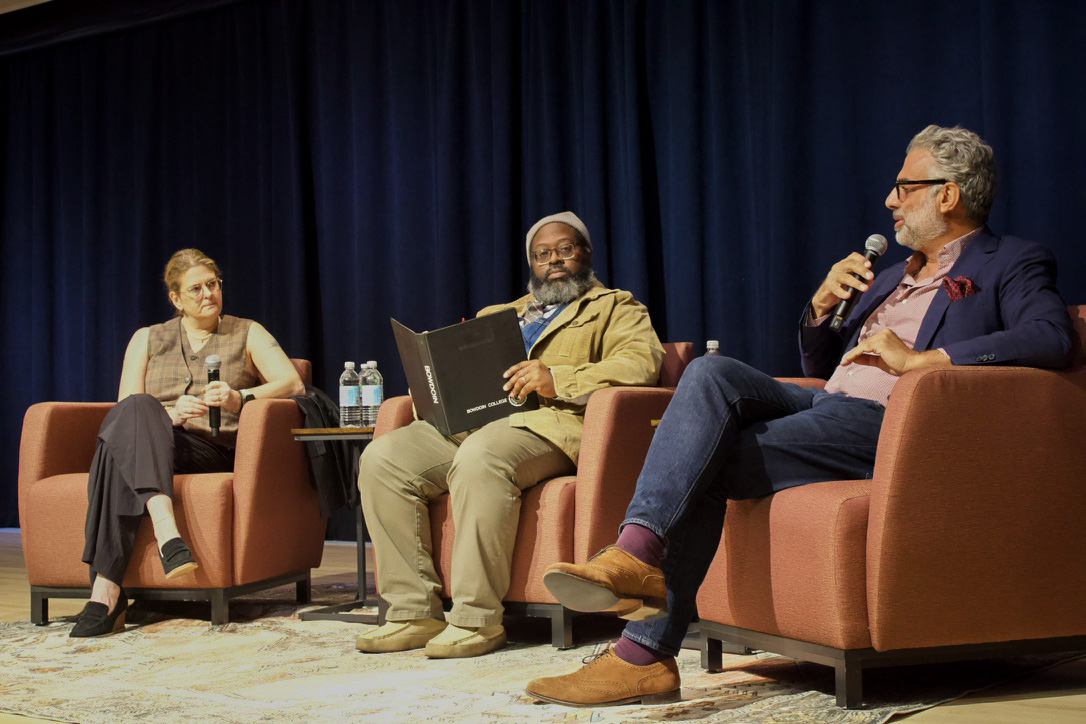
In a conclusion to this semester’s Viewpoint Exchange Series, students, professors and community members gathered in Kresge Auditorium on Tuesday afternoon for a conversation between Mira Sucharov and Omar M. Dajani, co-authors of the upcoming dual memoir “Vacant Lot: Journeys to the Heart of Israel-Palestine.” Sucharov is a Jewish-Canadian professor of political science at Carleton University in Ottawa, Canada, while Dajani is a Palestinian-American professor of international law at the University of the Pacific in California.
The two companions began their talk by explaining how they first got to know each other—unexpectedly, through Facebook. In May of 2021, Dajani posted a short essay on the context of the Israel-Palestine conflict, which Sucharov shared and went on to defend against critics. The early Zoom conversations that followed put their respective positionalities into focus.
“It became clear that following the divorce and her parents’ marriages to non-Jewish people, that for [Sucharov] in those early days as a young person, Israel emerged as a way for her to not only connect to a Jewish community and identity, but to capture something that had been lost as a consequence of her parents’ divorce,” Dajani said. “These long conversations with each other started to reveal to us that the sides are not only reached by rational argument, but also are a consequence of deeply personal internal landscapes.”
Despite their differences, there were also core ideas that united Sucharov and Dajani.
“Knowing that both of us believed that equality was a crucial value, that both of us thought that the idea of self-determination was one that both peoples—Palestinians, Israeli Jews—could legitimately claim, that both of us were embracing an idea that partnership was a better framework for dealing with the situation in Palestine-Israel than either supremacy or separation, all of those broad ideas were broached between us in those early days—I think was important,” Dajani said.
However, as time went on, the pair’s dynamic shifted, especially after October 7, 2023.
“I think what started to arise increasingly is that our emotional reactions to things were different,” Dajani said. “I think one of the things that was hardest for us is that increasingly over that time … both of us felt the tug of our communities on the one end, and of each other and a set of values on the other.”
Some of these differences were highlighted when the two visited a Palestinian-Jewish cafe in Jaffa, Israel together. Sucharov ordered Bulgarian cheese with the Hebrew words, “gvina bulgarit.” As she did so, Sucharov recalls that Dajani flinched and later asked why she had to say the name in Hebrew, instead of the more “neutral” English.
“In a way, it was a fight about nothing. But in a way, it was a fight about something. It was about claiming space and deploying the language of domination. For me, Hebrew has never been a language of domination. For me, Hebrew has represented a minority language, a tiny language,” Sucharov said. “It really took me some time to be with [Dajani] in Israel-Palestine to absorb [how] Hebrew is understood by the Palestinian minority.… It’s viewed as a language of domination.”
The two speakers also touched upon the issue of colleges’ treatment of pro-Palestinian and Zionist speech on campus. Sucharov explained the administrative dilemma of balancing donor dynamics with the spirit of intellectual inquiry, and Dajani expressed frustration with the discourse on many campuses.
“I’ve been really disappointed. I think that universities in the [United States] have backed away from commitments that they had made previously … I’ve been frustrated by how many students have found themselves expelled for expressive activity, have found themselves doxxed or found themselves facing very concrete consequences in terms of employment as a result of their speech,” Dajani said. “I think there’s also something on the converse that’s been hurtful, which is that the discourse has become polarized in ways that I think have torn a lot of university communities apart.”
Sucharov and Dajani are both part of the political initiative “A Land for All,” which supports a two-state solution based on a confederal government much like the United Kingdom and Ireland. This framework proposes an alternative to the Oslo model, which Dajani and Sucharov argued presumes the possibility of completely disentangling Palestinians’ and Israelis’ lives.
“We do need two states, but two states within a single homeland. What does that mean in practical terms? It means this: that a Palestinian state would emerge, would be established alongside Israel, with a border based upon the 1967 line,” Dajani said. “There would be two constitutional orders, two [United Nations] missions, two national governments, each with authority in important areas, but the difference from the longstanding two-state solution… [is] a recognition not only that the entire land is a place that we are all attached to… but [one] where you have freedom of movement and freedom of residence for all Palestinians and all Israeli Jews … by delinking citizenship and residencies.”
Ultimately, Sucharov called for the use of standard international humanitarian law in discussing the ongoing genocide and broader Israel-Palestine conflict.
“I would say keep the single standard, be very clear and transparent in your metrics and [we] can start to have a common conversation that … attunes [us] to what people are worried about, what their fears are [and] what they care about,” Sucharov said.
Comments
Before submitting a comment, please review our comment policy. Some key points from the policy: