
Edward Djerejian considers America’s future in Middle East
October 16, 2026
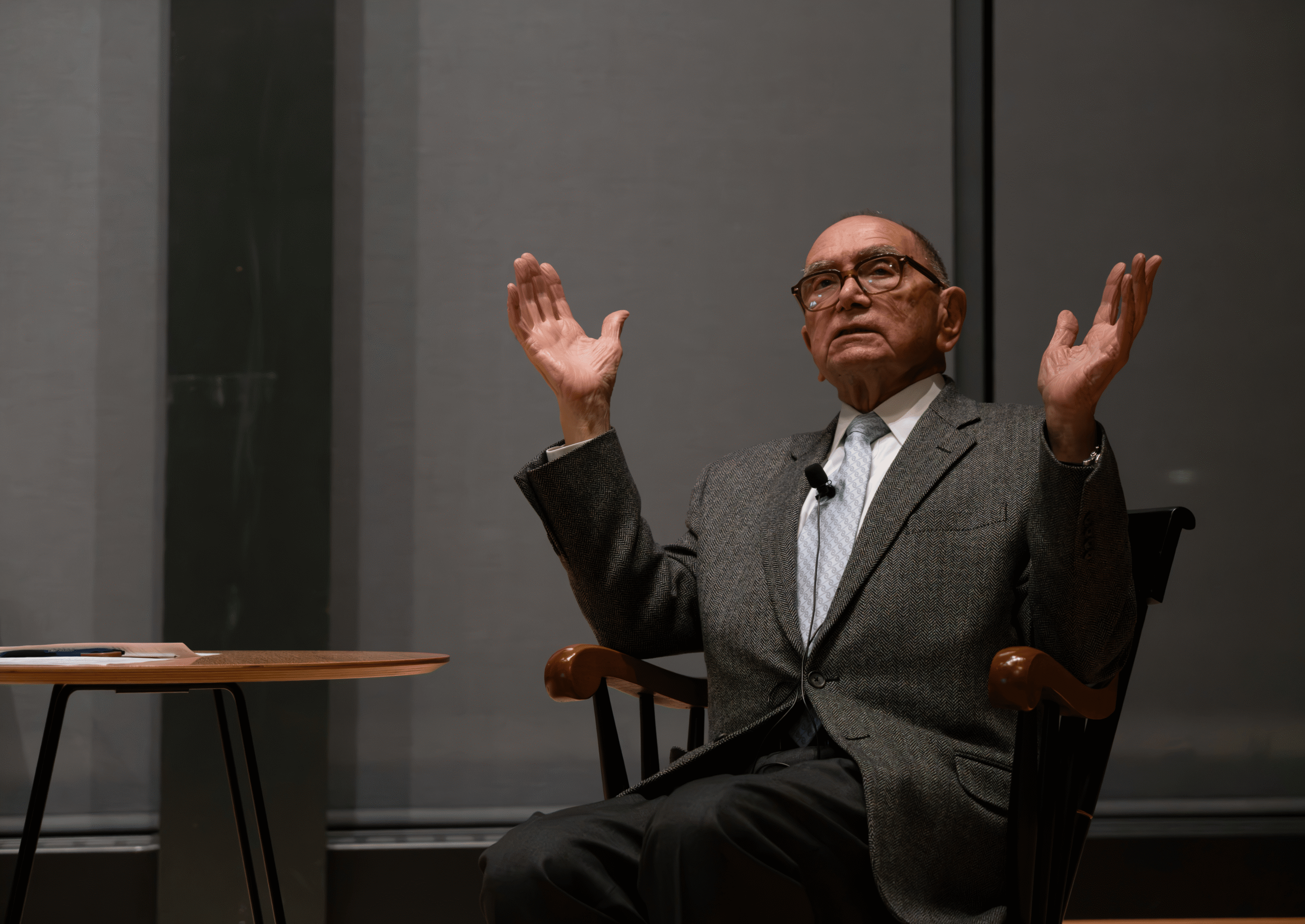 Andrew Shi
On October 8, students, faculty and community members gathered in the Roux Lantern to listen to Visiting Assistant Professor of Government Peyman Asazade interview Edward Djerejian, former United States ambassador to Israel and Syria.
Djerejian’s diplomatic career spanned 32 years, from the presidential administration of John F. Kennedy to Bill Clinton. He currently serves as a residential Senior Fellow at the Harvard Kennedy School’s Middle East Initiative. Last week, his conversation at Bowdoin examined America’s role in the geopolitical future of the Middle East.
Djerejian began by discussing the United States’ historical involvement in the region.
“The core interests haven’t changed that much, but the historical context has changed,” Djerejian said.
These core interests included oil, regional security and Palestine, priorities that Djerejian asserts have been central to American involvement in the Middle East since 1948.
The ongoing war in Iran provided recent context for the talk. Djerejian expressed his disapproval of Trump and Netanyahu’s decision to launch joint military action against Iran, calling it a “major miscalculation.”
Using the Iraq War and Suddam Hussein’s overthrow as historical examples, Djerejian warned against the American government attempting to rebuild a country “in our own image.” He argued that American politicians need to learn from our government’s failures—the United States should not attempt to hold the weight of other countries’ governments on its back.
“Nation building is really a bridge too far, even for the most powerful countries in the world,” Djerejian said.
Djerejian went on to address the current state of affairs in Palestine and Israel. Citing his perspective as a former Ambassador to Israel, Djerejian criticized the Netanhayu administration as an aggressive expansionist coalition.
“The Netanyahu administration, his coalition, has weaponized Israel’s foreign policy,” Djerejian said.
Djerejian then emphasized his view on the importance of compromise between Israelis and Palestinians.
“In this narrow strip of land, there are 7.2 million Palestinians, and approximately the same number of Israeli Jews. Neither one is going anywhere,” Djerejian said.
Djerejian delved into two options for the future of Israel-Palestine: a single-state solution and a two-state solution. Djerejian stated that the single-state solution would likely continue an ongoing pattern in Israel and Palestine of occupation, tenuous truces and upheavals like the October 7 attacks. He hopes that a two-state solution, which would present a more democratic future, is possible.
“The only solution, and this is the now much aligned two-state solution, that would satisfy most Israelis’ definition of what they want, and this is very important: a democratic Jewish state,” Djerejian said.
According to Djerejian, a single-state solution contains problems. The solution has two forms, one being a democratic one with equal rights for all. Noting that Palestinians would outnumber Jewish people in a decade or two, Djerejian said the democratic form would not be a Jewish state, as most Israelis want.
He explained another possibility for the one-state solution which subordinates the Palestinians.
“The other definition of a one-state solution is unequal rights,” Djerejian said. “The Jews would have superior rights. The Arabs would have secondary rights, which is akin to what was in South Africa, which is called apartheid.”
Djerejian suggested that there are other ways to achieve equality in the Middle East.
“Get to the core issue of the Israelis recognizing the self-determination of the Palestinian people and the Palestinians recognizing the self-determination of Israel,” Djerejian said. “You solve that, and I think you are on your way to much more conflict resolution in the Middle East.”
Djerejian continued to preach the importance of negotiation between hostile countries when asked how America can resolve political and military tension with Iran.
“In international affairs, you don’t make peace with your friends. You make peace with your enemies,” Djerejian said.
And yet, Djerejian believes diplomacy is lacking in American politics today, specifically in the Trump administration.
“I’m very critical of this administration. You’re talking to someone who’s again served Democratic and Republican administrations, but what really disturbs me is that the art of statecraft is nonexistent in this administration,” Djerejian said.
Djerejian also criticized how Trump’s accumulation of loyalists in his cabinet has impacted the President’s decisions and the fate of the Middle East. He emphasized how one individual can impact geopolitics on a large scale.
“I’m a great believer in the role of individuals in geopolitics,” Djerejian said. “The role of institutions and organizations is critical, but the role of individuals can define history in ways that sometimes trump the organizational, institutional things.”
Rayan Naraqi Farhoumand ’30, an attendee, spoke highly of the former ambassador’s insights.
“I think that the ambassador had a lot of insights on the multifaceted dynamics and the interplay of different states,” Farhoumand said. “Foreign policy is more than just our morals, but our responsibility and the way that we interact with other nations and what is actually realistic for us going forward.”
Comments
Before submitting a comment, please review our comment policy. Some key points from the policy: