
Patrick deWitt reads excerpt from new novel “Dodge City,” discusses writing process
October 16, 2026
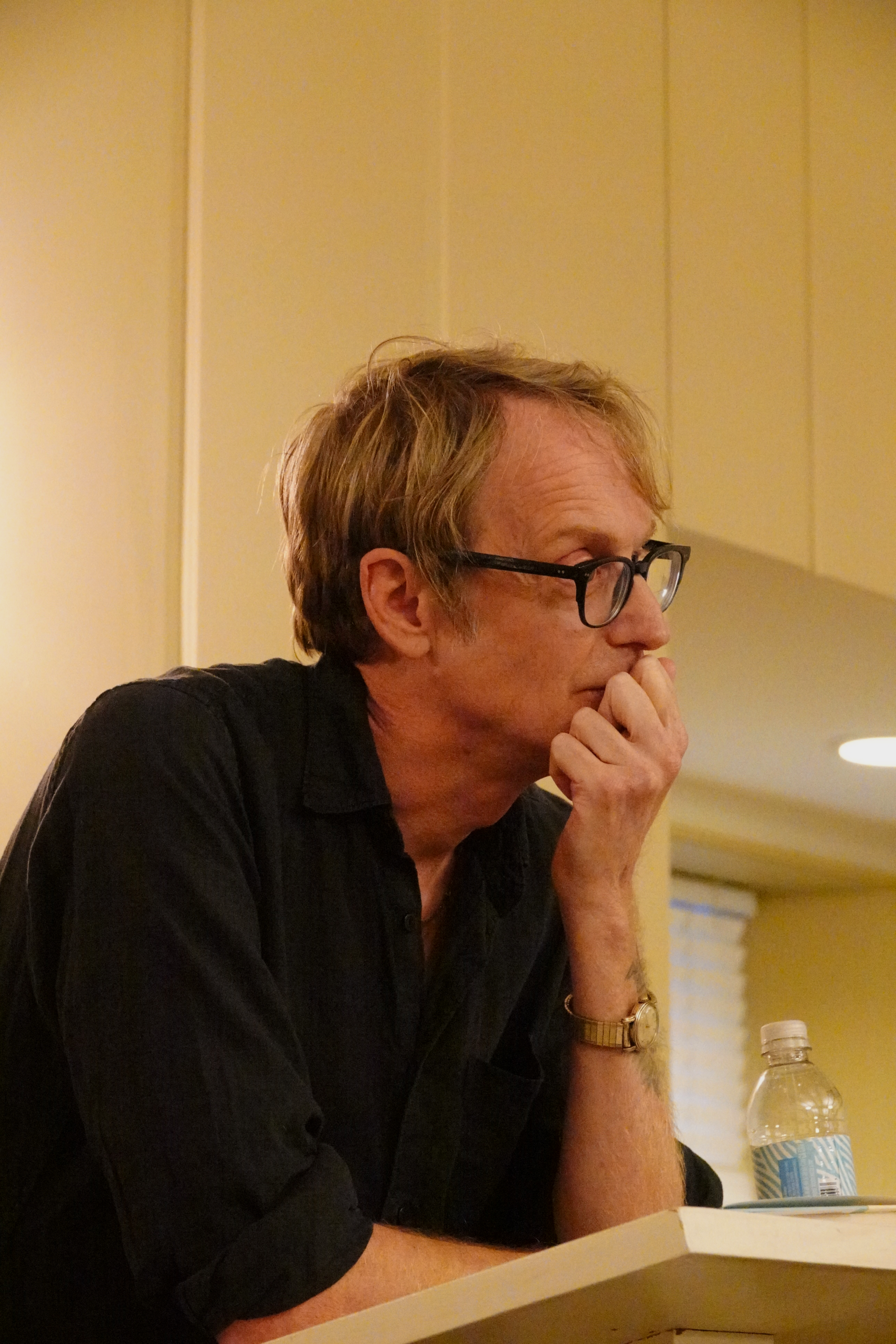 Anneke Wittink
On the evening of October 8, students, faculty and community members gathered in the Massachusetts Hall Faculty Room to hear acclaimed author Patrick deWitt read an excerpt from his recently published novel, “Dodge City,” and discuss his writing process following an introduction from Professor of English Brock Clarke.
In his characteristically satirical tone, deWitt’s sixth novel follows Leland “Lee” Clarke, who is expelled from the University of California, Los Angeles, in 1967, after a fistfight with another student. No longer enrolled as a college student, Clarke receives a draft notice for the Vietnam War and begins an amphetamine-addled road trip in a Jaguar E-Type toward the East Coast, intending to evade conscription by fleeing to Canada.
The chapter deWitt read depicts Clarke’s return to his alcoholic father in Concrete, Wash., who has adopted the unusual profession of dog-catching. Despite intermittent efforts to contact him, Clarke had been estranged from his father since his parents’ abrupt divorce during his adolescence. Their unconventional reunion explores the intricacies of family dynamics, including Clarke’s relationships with his manic mother and his twin sister Grace.
The passage also considers personal freedom and the morality of military service.
“I meant this to be much more of a big-question, big-answer book relating to agency and freedom and all the things one would think about when drafted into a war he doesn’t believe in,” deWitt said.
In deWitt’s excerpt, Clarke attests that the Vietnam War is a “hard war to get behind.” His father agrees but contrasts Clarke’s predicament with his own voluntary enlistment in World War II following Pearl Harbor, describing war as an honorable yet inescapable “part of the male American experience.”
“We don’t get to pick our wars, Lee,” his father says. “The war they give you, that’s your war … and if you leave your country, that’s your business, but as soon as you step over that line, you’ll be losing a piece of yourself you will not get back.”
The novel draws inspiration from deWitt’s father, a Canadian with dual citizenship who drove for two interrupted days to Ontario to avoid conscription before fatefully meeting deWitt’s mother in Vancouver. “Dodge City,” deWitt said, reflects the tension between national duty and autonomy with which his father contended.
DeWitt’s curiosity about the Vietnam War and his father’s “draft-dodging” experience allowed him to develop realistic characters.
“I think curiosity is helpful to have protagonists, not just that you have empathy for or sympathy for, but protagonists that you want to know, you want to live their experience through the writing of the book because you suspect it might be passing,” deWitt said.
Elaborating on his writing process, deWitt emphasized the importance of emotion in finding the themes within his writing.
“I don’t verbalize to myself why I’m doing what I’m doing while I’m doing it. It’s rooted in a feeling, an emotion, an intuition,” deWitt said. “The why of it all is oftentimes mysterious to me.”
DeWitt described his work as reflecting the complexity of life.
“The conundrum of just being alive and having friends or a romantic partner, or parents, or having any sort of human relationship is what all my work’s about. People often try to find the throughline [through all of my books], but my work is about whatever life is about,” deWitt said. “If I get stuck in a place of what should happen next, I do ask myself sometimes what would happen in real life if these are real characters, and there’s something about that exercise which tends to make the story more approachable [and] less grand, which I like. I have a preference for smaller stories, realistic stories.”
DeWitt concluded the talk by describing the common pitfall of overwriting scenes.
“When is enough enough? It’s not something like eating. You know when to stop eating because you’re full,” deWitt said. “[But] if you’re really enamored of the world of the book, that can be really heady and intoxicating … especially if you fall madly in love with your characters, as I invariably do.”
Attendee Austen Temple ’29 appreciated deWitt’s unique perspective.
“I wish that Bowdoin would bring more authors to campus because [deWitt] had a lot of really interesting things to say and he offered a perspective that I think is pretty unique,” Temple said. “[He brought] the perspective of someone that dropped out of high school, didn’t go to college and became an incredibly successful writer and I think that is unfortunately a perspective that we don’t hear a lot of the time.”
Comments
Before submitting a comment, please review our comment policy. Some key points from the policy: