
Page Herrlinger gives inaugural lecture on religion in Bolshevik Russia
October 16, 2026
 Abigail Hebert
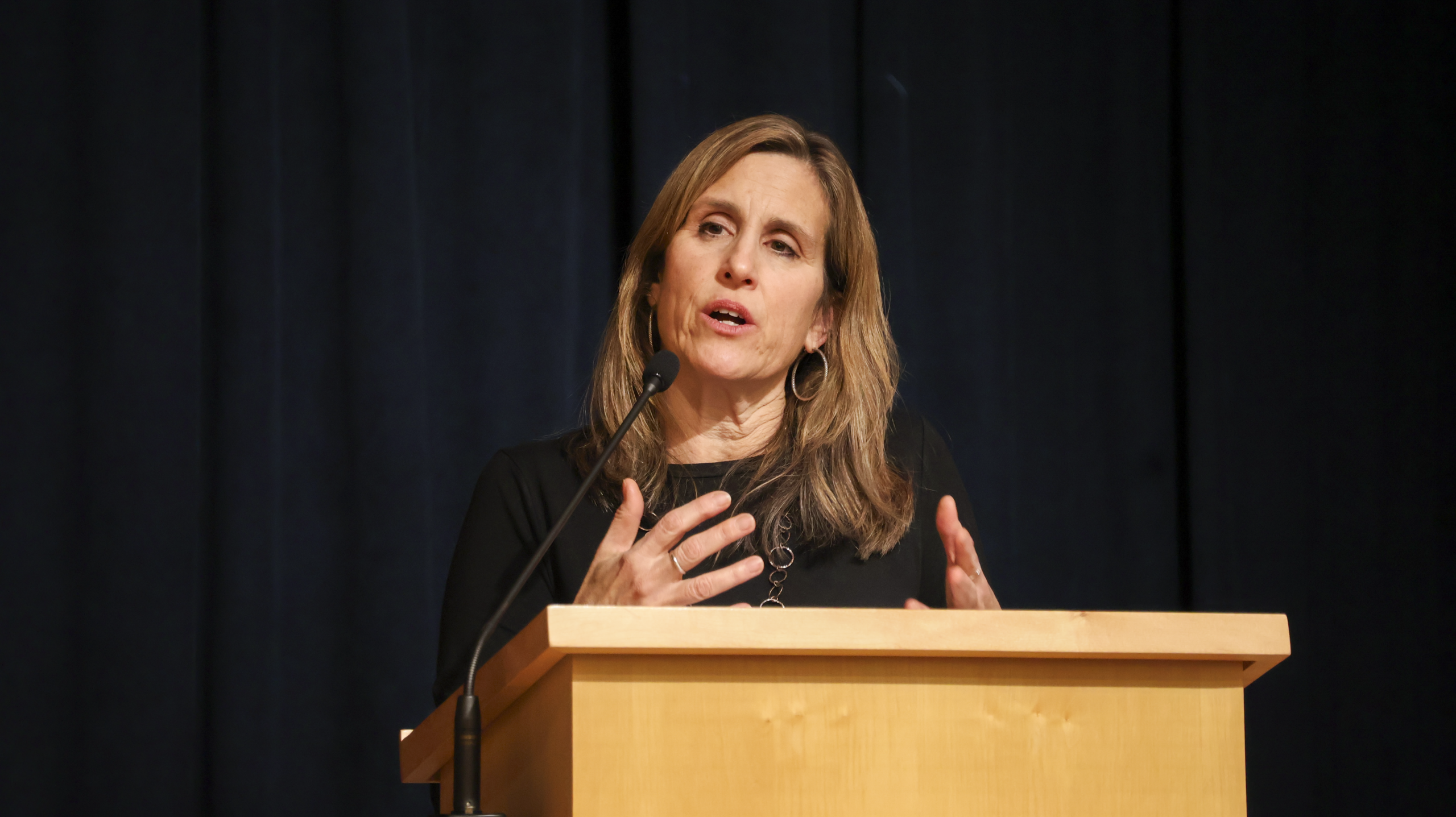
In Kresge Auditorium on the evening of October 7, Professor of History Page Herrlinger presented her inaugural lecture as the sixth Frank A. Munsey Professor of History on Soviet citizens who practiced religion amid the militant atheism of Bolshevik Russia.
The first woman to hold the endowed chair, Herrlinger has taught at Bowdoin since 1998 and chairs the Department of Russian, East European and Eurasian Studies. Her work, which focuses on ordinary Russian citizens, spans Imperial Russia, Nazi Germany and the Soviet Union.
“Rather than the church as an institution, I’m mostly interested in what we like to call people’s lived experience of the Orthodox faith,” Herrlinger said.
In 1931, the Soviet government publicly demolished Moscow’s Cathedral of Christ the Savior as part of its campaign against religion, stripping the building of valuable materials and making plans to replace it with the “Palace of Soviets.”
The Orthodox Church was a significant landowner, a friend of the fallen czarist regime and promised the working class justice in the next life—all of which were obstacles to Soviet power.
“Now, ideologically, the Bolsheviks sought not only to weaken the church, but to discredit the religious worldview it represented and spread,” Herrlinger said.
The Soviets also promoted their “scientific materialism” through lectures and exhibitions, aiming not only to weaken the church but to replace its worldview with science.
“One of their most effective tactics was to open up saints’ tombs and to pull out the relics to reveal the decomposing bodies of the so-called saints,” Herrlinger said. “By explaining how physical decomposition worked, they aimed both to undermine belief in the saintliness of the individual while also promoting scientific thinking.”
Herrlinger’s research has focused on what the spiritual revolution meant to individuals living at the time, using a methodology that involves inverting the questions she asks of history. Rather than asking “How did religious people fit into the revolutionary narrative?” Herrlinger asked how the Russian Revolution fit into the lives of religious people.
“The revolution was not only a period of social and political change,” Herrlinger said. “It was every bit as much an era of spiritual revolution.”
Herrlinger illustrated this argument through case studies, beginning with a 1921 famine in the Volga region that claimed an estimated five million lives.
“The need for hope was intense, and in the summer and fall of 1921, Bolsheviks and clergy alike reported a massive upswing in religious life,” Herrlinger said.
The situation became so dire that peasants began to view it as divine punishment for the country’s turmoil and the destruction of the old order by the Soviets.
“They accepted what they saw as their fate because it served as a powerful source of hope,” Herrlinger said. “It was a path back to God, but it was also a path back to some semblance of normal life.”
Herrlinger’s second example was Brother Ioann Churikov, a preacher whose popularity allowed him to form a religious commune with his followers. The commune was dedicated to Churikov’s doctrine of “holy sobriety,” a prayer and scripture-centered lifestyle that required abstinence from alcohol, violence and leisure.
“For those who stayed, it became a safe refuge from the violence, the moral disorder and the spiritual chaos they experienced on the outside,” Herrlinger said. “It was a place to work on their souls, to reclaim their dignity and to heal themselves morally and spiritually within a community of other believers.”
Her final example was the diary of an Orthodox woman named Sofia Dryzhakhova, who recorded her personal and spiritual struggles for over 40 years. While the Soviets demanded godlessness, Dryzhakhova’s faith strengthened and developed, eventually pleading that God place the sins and suffering of her four sons, two of whom served in the Red Army, upon her so that they might be forgiven.
In one passage from Dryzhakhova’s diary, she wrote: “Just as I silently allow [the Soviets] the right not to have God, I want to maintain my habit, my belief in Him.”
Herrlinger viewed her role as a historian as complicating the familiar image of the Soviet project.
“The task of historians, especially in the West, is to insist on a fuller, more complex understanding of Russia’s past,” Herrlinger said.
Sadie Palmer ’30, who attended the lecture out of a personal interest in Russian history, was drawn to discussions of how religion behaves in contemporary Russian society.
“When religion is so restricted [by] the state and forced to go underground, it can reconnect and make amends with [the] secular, especially after it divides so much,” Palmer said. “I found the struggle that Russia is having internally today with reconnecting to the Orthodox Church very interesting.”
Comments
Before submitting a comment, please review our comment policy. Some key points from the policy: