
Historian Matthew Pinsker discusses “Boss Lincoln,” recasting Lincoln as a commanding leader
October 23, 2026
 Addison Moore
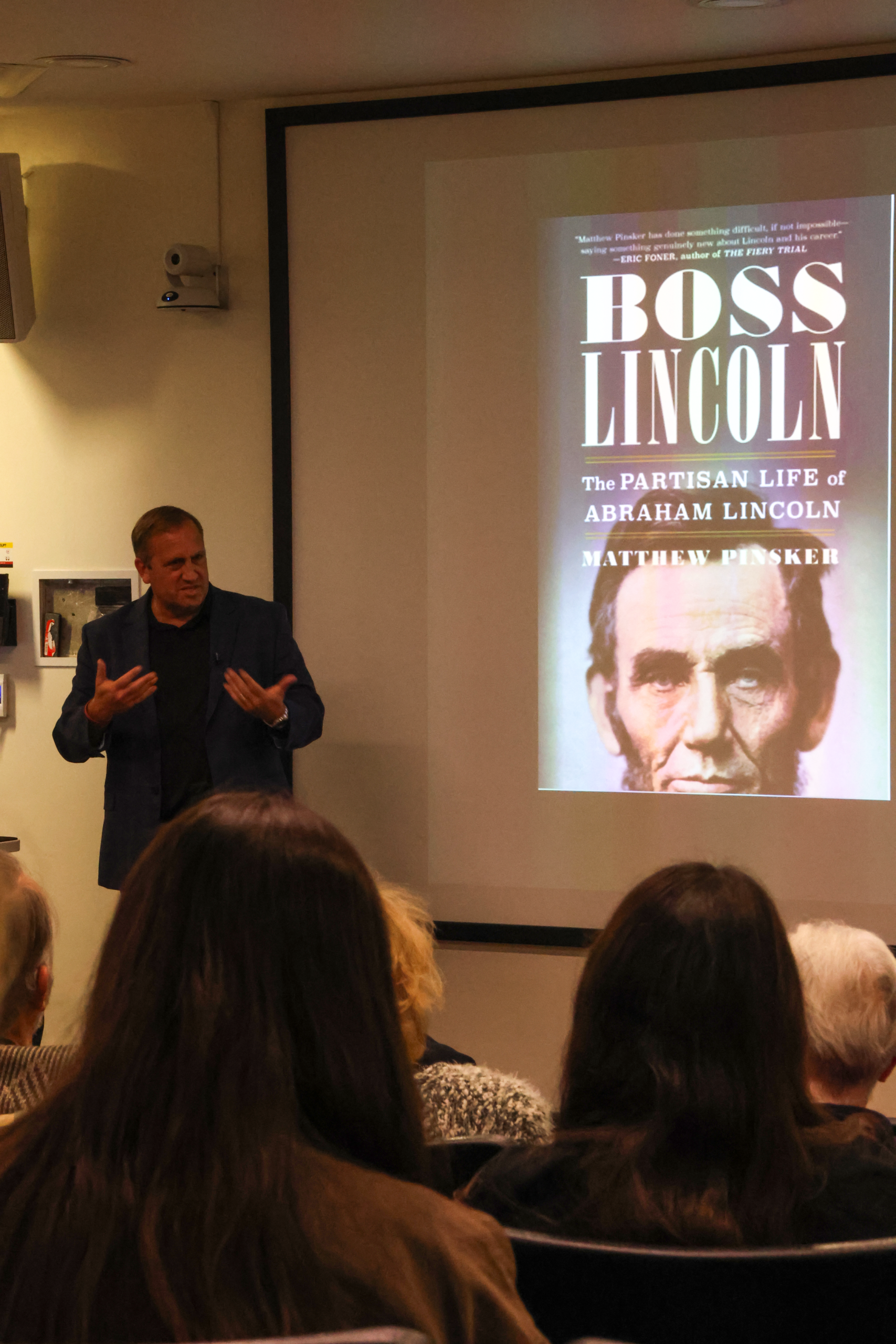
On Monday, Matthew Pinsker discussed his new book, “Boss Lincoln: The Partisan Life of Abraham Lincoln,” to an audience in the Beam Classroom in the Visual Arts Center kickstarted by an introduction from Professor of Government Andrew Rudalevige.
Pinsker holds a chair in Civil War history at Dickinson College, where Rudalevige taught before Bowdoin. The Government and Legal Studies and History departments sponsored the talk with support from the John C. Donovan Fund.
Pinsker opened by addressing the book’s title, which he said can lead readers to expect an exposé.
“When you title a book ‘Boss Lincoln,’ people get nervous,” Pinsker said. “[I titled it ‘Boss Lincoln’] because [Lincoln] was commanding, not corrupt.”
Rather than focusing on Lincoln as an orator or statesman, “Boss Lincoln” examines what Pinsker described as the most significant work of Lincoln’s political career, including building and leading three political parties: the Whig, Republican and National Union parties, the last under whose banner he won reelection in 1864.
“He had an ego. He was ambitious, but he was an organization man,” Pinsker said.
Pinsker said most historians dismiss the Union Party as a rebranding of the Republicans. In his book, however, he argues that Lincoln began building the party as a separate, broader coalition during the 1862 midterm cycle, bringing together Republicans, pro-war Democrats and conservatives from the border states.
To explain how Lincoln held this coalition together, Pinsker used two terms from 19th-century politics. “Fusion” meant reaching beyond the party for allies, while “ultra” meant holding the party to a principle. As a Whig, Lincoln was a fusionist. Yet in the late 1850s, he became an “ultra Republican,” refusing to welcome Democrat Stephen Douglas into the party unless Douglas took a moral stand against slavery. As president, Lincoln moved between the two strategies.
“He figures out how to breathe in and breathe out,” Pinsker said.
Much of Pinsker’s research draws on Lincoln’s personal correspondence, which Lincoln labeled “private,” “confidential” and, in about half a dozen surviving cases, “burn this.” Pinsker said those letters show Lincoln keeping his coalition focused, not hiding wrongdoing.
He specifically pointed to an 1862 letter in which Lincoln rebuffed Maryland Senator Reverdy Johnson, who had warned against emancipation. Days earlier, Lincoln had already read a draft of the Emancipation Proclamation to his cabinet.
“What Lincoln was doing was preparing the ground,” Pinsker said.
Pinsker also reframed the Gettysburg Address, delivered in November 1863 before governors, party leaders and reporters. He traced its closing phrase, “a new birth of freedom,” to New York Times correspondent Samuel Wilkeson, whose 19-year-old son Bayard was fatally wounded on the battle’s first day. In his dispatch, written from beside his son’s body, Wilkeson described the battle as “the second birth of freedom in America.” Wilkeson, once a critic of Lincoln, later helped organize his renomination.
“[That] doesn’t diminish [the] sacred quality of the Gettysburg ceremony or the address, but it humanizes it,” Pinsker said.
Pinsker also highlighted Anna Dickinson, who became the first woman to speak before an audience in the House of Representatives in January 1864. Dickinson was only 21, and with Lincoln in attendance, she criticized his slowness on emancipation before endorsing his reelection. Pinsker argued that Dickinson’s role has been forgotten, and that her story belongs in high school history classes.
During the question-and-answer session, audience members asked how Pinsker’s portrait fits with other accounts of Lincoln. He rejected the patronage deals depicted in Steven Spielberg’s 2012 film “Lincoln” as fiction and contrasted his book with Doris Kearns Goodwin’s “Team of Rivals,” which credits Lincoln with forging consensus within his cabinet.
“In my book, I show that they were never a team,” Pinsker said.
Asked about Lincoln’s use of executive power, Pinsker described “a chronology of powers, not just a separation of powers,” in which the president acts, Congress responds, the courts review and voters ultimately decide. Pinsker concluded by tying Lincoln’s partisanship to citizenship in the nation’s 250th year.
“Partisan is not an insult,” Pinster said. “You resolve disagreements with ballots, not bullets. You’re not worthy of winning an election unless you’re willing to lose.”
Attendee Sophie Donnelly ’29 said the talk showed her a new side to Lincoln.
“I thought that Professor Pinsker was very effective at giving a really unique perspective on Lincoln’s impact on party politics, and I feel like it introduced me to another side of Lincoln that I hadn’t really thought of before,” Donnelly said.
Comments
Before submitting a comment, please review our comment policy. Some key points from the policy: