
At the water’s edge
November 13, 2026
 Kiran Elfenbein
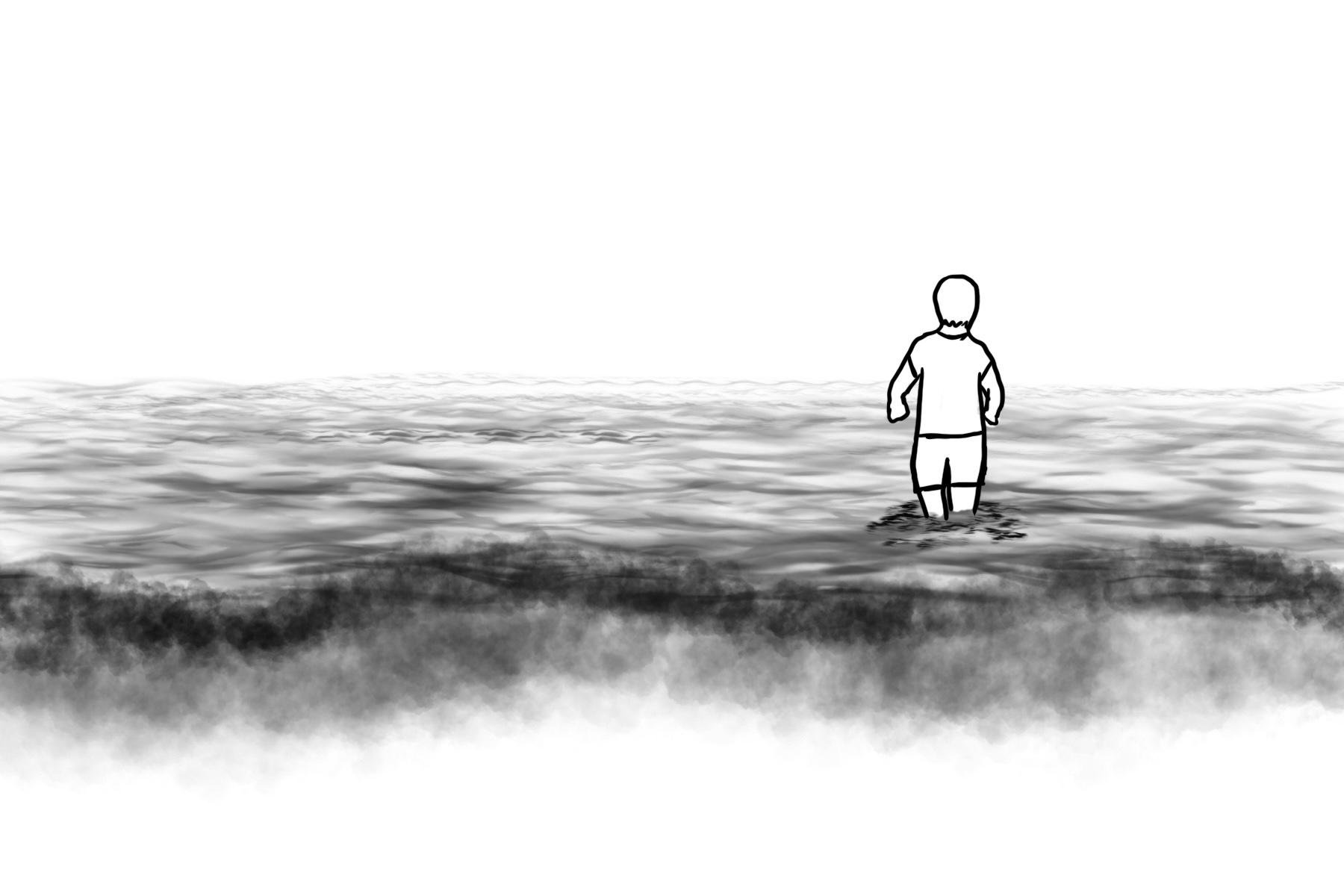
I remember being a little girl at the water’s edge. Sometimes, it was a deep blue hue, dotted with the sunlight’s reflection. Sometimes, it was churning into grey; at others, it was tinged with greens and overwhelmingly clear. It didn’t matter the color of the water, the ruckus of the wind or even the height of a wave as it rode into rock. Somehow, the ocean’s presence on the earth, knowing it was solidly there and I was able to see it through my own eyes, was always enough.
In both brightness and clouds, I would deeply inhale the crisp, cool atmosphere carrying the smell of salt. I felt the air enter through my nose and fill my lungs, until my whole upper body swelled. Just the ocean and me.
Ever since I was little, my mom told my brothers and me never to turn our backs on the ocean. It was an unpredictable force indifferent to us and where we stood. The healthy caution she instilled didn’t have the effect of scaring me, but rather, I learned to give the ocean my respect.
I imbued the environment of the beach with anthropomorphic meaning and watched the waves recede in defeat, as I went just close enough to wet my feet before sprinting to the line between soft and packed sand. It was a game, and the ocean was my playmate who was always ready to dance: sprinting toward, sprinting away, mimicking ebbs and flows of the tide, watching my ankles become enveloped and not a few seconds later, being returned to my sight.
I was little but never meek. My mind wandered frequently, and questions rolled over with the inevitability of the rising sun, revealing a shape for the amorphous, loud mass the ocean turns to in darkness. The questions were often unanswered, and as I pondered them, they could come to feel too vast to hold.
Some of the more formidable questions arose from my hyperfixation on the reality of death, which began before I can remember. We all worry about our mortality, but when I was younger, my worry seemed overwhelmingly there. I was too familiar with the conclusion that my parents will die, I will die, we will all die one day. I couldn’t imagine a life without living, and knowing for certain that its time would come tightened my throat. As my eyes glistened, I blinked fast and my breath came unevenly; I had many moments of miring myself in existential fear.
On weekends, when my family and I drove to the Monterey peninsula and visited my grandmother in Carmel, we always paid a visit to the ocean. With each trip I realized with increasing certainty that walking down to the beach meant walking to a place I could count on to free me from confinements made by my own mind. Staring out to the place where the ripples of the water met smooth sky in harmonious transition, I didn’t feel so alone in it all. Instead, I felt part of it—part of the wind around, the spraying sea stretching beyond and the sand beneath. I existed in expanding moments of humility where I could experience the paradox of being everything and nothing all at once. The ocean didn’t know if I was there or not. It didn’t have feelings about whether I came or left. But through the time standing in front of it with just my perception, I would always be part of the sea and the sea would always be part of me. With every passing year, the way I articulate my relationship with the water’s edge evolves, but the purpose that humility serves remains necessary and constant.
Sometimes I wonder what it will be like to be a “real” adult with a home of my own, kids I raise and hopefully a career I believe in. I see myself happy. I see myself in love. I still have the questions; I always will. It is working on discovering contentment in acknowledging what is unanswerable and finding liberation, rather than entrapment, in my membership in a world cycled by nature that carves out a home in the vastness, in the inevitable beginning and end that isn’t really a beginning or end at all.
A couple weeks ago, my mom sent me the poem “The Waking” by Theodore Roethe. This weekend, I finally read it. Roethke writes, “I wake to sleep, and take my waking slow.” The line reminded me not to forget the little girl and what she felt next to the water where she learned how to “wake slowly.”
Anya Houston is a member of the Class of 2030.
Comments
Before submitting a comment, please review our comment policy. Some key points from the policy: