
Lyle Goldstein discusses naval politics in book on China-Russia quasi-alliance
October 30, 2026
 HJ Yun
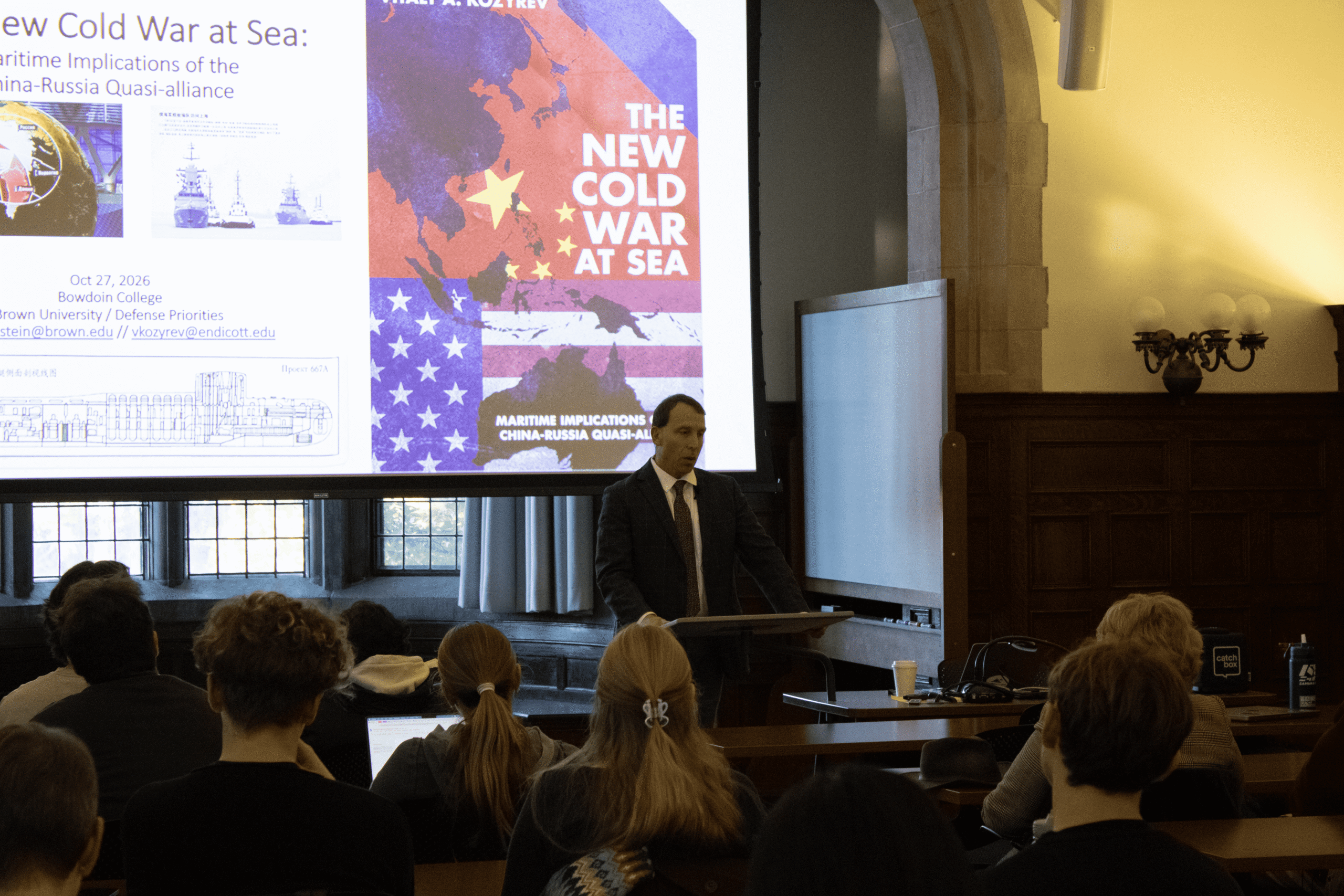
On Tuesday afternoon, students, faculty and community members convened in the Pickering Room of Hubbard Hall to hear Senior Fellow at Brown University’s Watson Institute for International and Public Affairs Lyle Goldstein lecture on his newly released book co-authored by Vitaly Kozyrev, ”The New Cold War at Sea: Maritime Implications of the China-Russia Quasi-Alliance.” He gave a far-reaching summary of the topics the book covers, discussing how the two nations support one another’s interests and the tensions that remain between them.
Goldstein was formerly a professor at the United States Naval War College, where he served as director of the China Maritime Studies Institute and earned the Superior Civilian Service Award.
The talk was organized by Professor of Government and Asian Studies Christopher Heurlin.
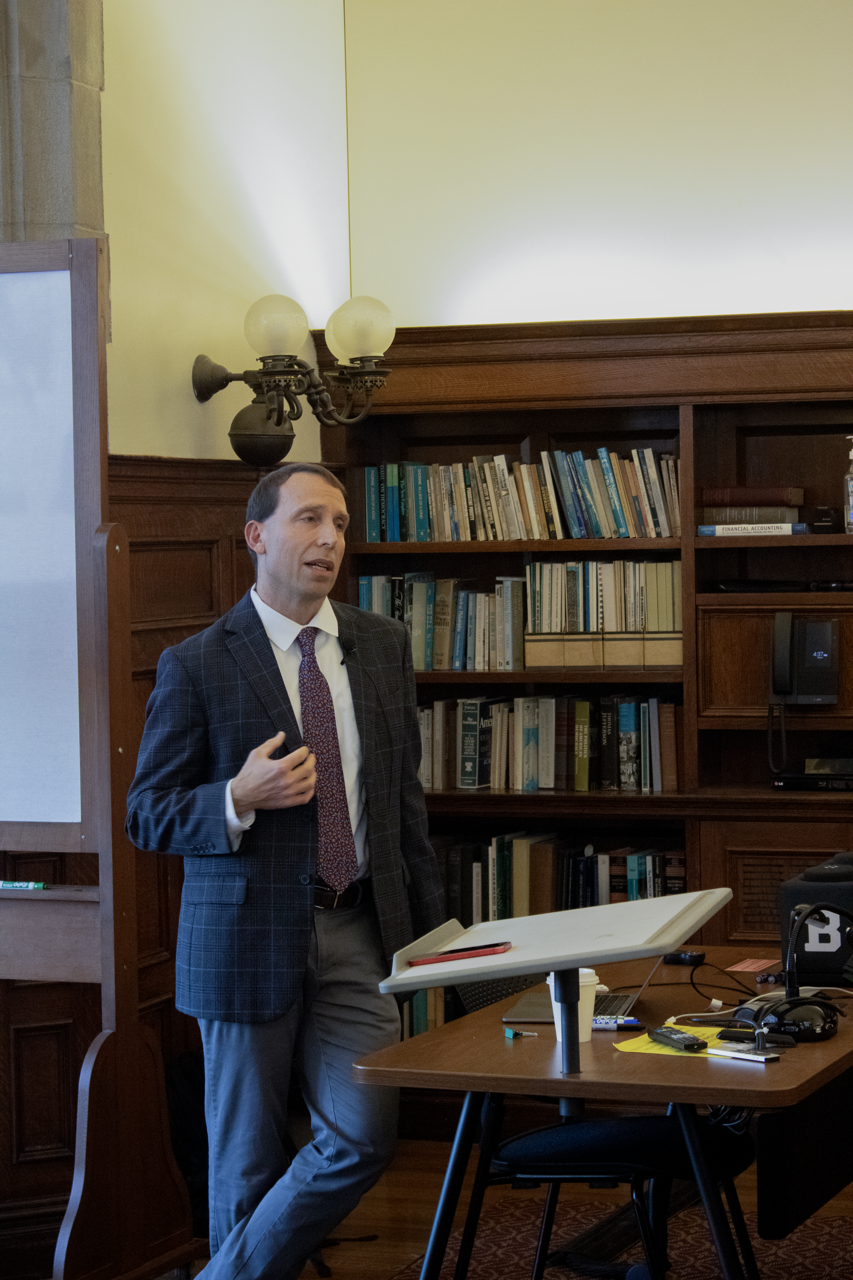
Goldstein began the lecture by explaining that China-Russia relations impact every part of the world. He expressed that he would be advocating for a “Goldilocks solution,” where the United States remains concerned about this partnership, while preventing that concern from getting out of hand.
He then discussed the historical relationship between China and Russia, and how their partnership dates back to the Soviet era.
“I call it the first wave of China-Russia cooperation…. China went from being basically zero as far as naval power to being something reasonably respectable with submarines, torpedoes and its first initial [ocean] victories in the mid ‘50s,” Goldstein said. “You could not overestimate the amount of Russian influence at this point.”
He then extrapolated that influence to the modern day, where China is developing a navy that is, in some ways, more advanced than American naval forces. He argued that one of their aircraft carriers, the Fujian, is superior to U.S. naval carriers. China relies on Russia for submarine and helicopter technology and is learning from its nuclear program.
“China could possibly want to follow the Soviet example and develop a nuclear first strike capability as a kind of coercive leverage,” Goldstein said.
He went on to explain that this is not a mainstream view, but a possibility of the consequences that the U.S. could confront if it does not deescalate and mitigate tensions between itself, China and Russia.
Goldstein expressed that the Russia-China partnership was not a full alliance, because both countries remain suspicious of each other. China has taken steps back in the previous decade from their prior policy of strengthening military support for Russia.
“Ten years ago there seemed to be more interest on the Chinese side in taking this [relationship] to a higher level, and they were kind of pushing the limits…. They started to do a joint exercise in the South China Sea and the Baltic,” Goldstein said.
Russia attempted to get China’s military support in the Russia-Ukraine War, but China was cautious about strengthening their alliance. Goldstein described China throughout the lecture as a nation that exercises restraint in matters of foreign policy, particularly compared to Russia.
“[In the Russia-Ukraine War, however,] Russia is in a desperate state. They’re asking all their neighbors for help…. China has said no, it’s not going…. Generally, the Russians have accepted the fact that China is going to maintain this veneer of neutrality and not send people,” Goldstein said.
 HJ Yun
He continued by explaining that China does not want to see Russia lose the war and is functionally keeping the Russian economy standing.
Goldstein discussed the two nations’ often competing relationships with other countries. For example, Vietnam has a strong relationship with Russia, dating back to the Cold War, and regularly purchases arms from them. Goldstein explained that this exchange elicits frustration from China, who was a major reason North Vietnam won the Vietnam war.
On the other hand, some geopolitical ties may be a positive influence on the Russia-China relationship. Goldstein is optimistic about India’s moderating role in diplomacy as a partner of both countries.
In the Arctic, he explained, Russia and China’s interests are largely financial. China has developed nuclear-powered icebreakers that allow them to extend shipping routes. However, relations could turn drastically if both nations agreed to have stronger military cooperation near Alaska.
“A Russian military analyst with knowledge of the Arctic [argued that Russia should] give them access for their submarines to operate out of Arctic ports.… That’s pretty disturbing. The good news here is that this is not in any way being enforced by the Chinese government… I think this is just a Russian strategist sort of thinking aloud,” Goldstein said.
Considering how the U.S. should reduce tensions and prevent these concerning outcomes, Goldstein argued that a cautious respect of other nations is important. He advocated for moderation and remaining aware of potential threats to the U.S. while avoiding overreacting to them, which could cause Russia and China to escalate in turn.
Goldstein concluded with a list of strategic recommendations for the United States. Notably, he recommended not underestimating the Russia-China quasi-alliance, returning to a system of nuclear arms control, retaining Japan as a strong ally in the Pacific and allowing India to remain neutral in their position between China and the United States. His final recommendation was a less aggressive approach to U.S. foreign policy.
“A functional world order where world powers respect each others’ vital interests…. This is why our world order is so dysfunctional, because we haven’t really realized the basic level of great power cooperation…. Seeing the world as it really is and not trying to fight it, but actually trying to work within it to create a more peaceful, stable world,” Goldstein said.
Olwyn Blackston ’30, an attendee, described her takeaways from the lecture.
“I’m interested in the Cold War dilemma, and the fact that this talk was called the ‘New Cold War’… was interesting because I wasn’t aware of the pervasiveness of this issue,” Blackston said, “I thought it [helped] me to expand my knowledge on current international relations.”
Comments
Before submitting a comment, please review our comment policy. Some key points from the policy: