
Dur e Aziz Amna reads excerpt of “A Splintering,” discusses unlikability in female protagonists
October 30, 2026
 Addison Moore
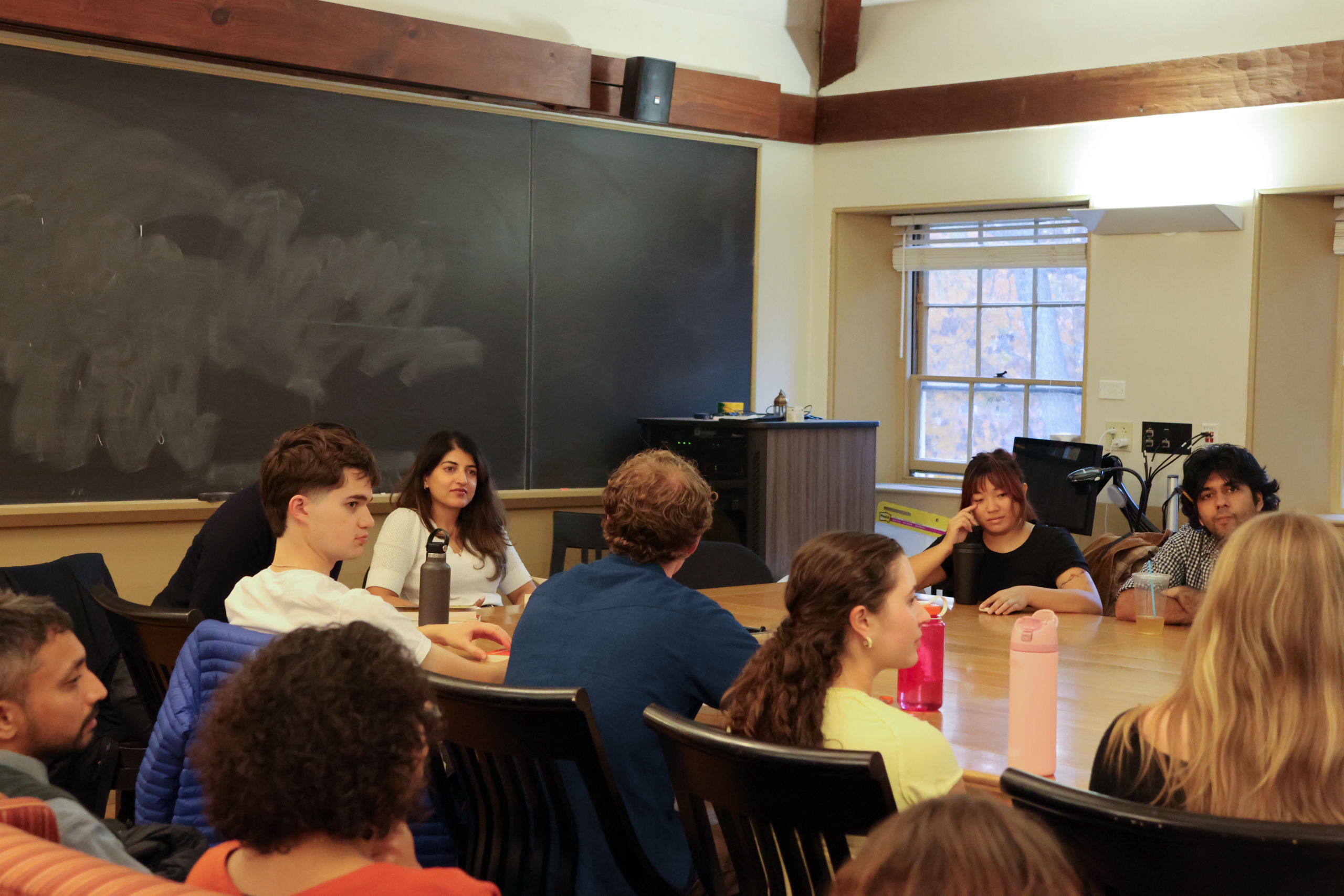
On Thursday afternoon, students, faculty and community members gathered in the Massachusetts Hall Faculty Room to hear author Dur e Aziz Amna read an excerpt from her newest novel, “A Splintering.” The novel follows Tara, a young woman living in Pakistan who escapes her small village to live in the big city and gain wealth.
Amna read from the first chapter, where the protagonist introduces herself. In the excerpt, Tara implores the reader to listen to her story, even though they may find her immoral or unlikable. Amna explained that, significantly, this was the last part of the book she had written. Initially, the beginning scene was one where Tara argued with her brother, but her agent was concerned the scene would prevent readers from sympathizing with her.
“Once I finished the book, my agent had feedback for me, which was that it might be hard for people to relate to that particular scene,” Amna said. “Her recommendation was to find a broader tent, to have an opening that more people could immediately access.… I was very angry at having to do this opening, and that anger kind of also shows through in what [Tara’s] saying: ‘Oh, I know I’m not relatable. I’m not likable, but can you just listen to me? Can you hear me out?’”
Amna also compared her experience writing “A Splintering” to her debut novel, “American Fever.” This book centered around a young woman during a year-long high school exchange program in the United States when she became sick and was forced to quarantine. She noted that “American Fever” was much more autobiographical than “A Splintering,” and because the protagonist mirrored Amna herself quite closely, she tended to include more literary and political references in her first novel.
“[Tara] herself is actually very apolitical, and she wants to be very ahistorical,” Amna said. “There is a point in the book where she says that history is something to be avoided. It’s like the viper in the dark field at night. You just have to step out of the way. But at the same time, there’s no question that all of these things are affecting her.”
 Addison Moore
Assistant Professor of English Zahir Janmohamed, who attended graduate school with Amna and is currently teaching “A Splintering” in his Introduction to Fiction class, invited her to campus and introduced her reading. Janmohamed shared that he particularly admired her willingness to write a protagonist that may not necessarily be likable to the reader.
“I really like how [Amna’s] novel isn’t written towards respectability,” Janmohamed said. “That is a very bold choice. Oftentimes, we’re conditioned for these novels, especially around sort of misunderstood places, to write toward respectability or likability. And yet, Tara is a very complex figure, and her family dynamics are complex as well.”
In an interview with the Orient, Amna spoke about her hope that readers will see Tara’s journey not as a representation of all the women in Pakistan, but rather as an exploration of what a woman gangster could look like.
“The only kind of reading that I would really caution against is thinking of it as only about Pakistan, which unfortunately happens with books from other parts of the world,” Amna said. “They’re read as anthropology and not as universal things that can happen everywhere.… I would hate for people to read the book and be like, ‘Oh, this is what happens to women in Pakistan.’”
Rather, Amna hopes that Tara can represent something of her own version of Tony Soprano. When she wrote “A Splintering,” Amna was inspired by the main character of “The Sopranos.” To Amna, Soprano’s moral contradictions and flaws that receive celebration from audiences are heavily influenced by his gender.
“So much of Tony’s charm as this gangster is predicated on him being a man.… I don’t think that that applies the same way to women,” Amna said. “I think the bar for being loved, if you’re a woman, even in fiction, is much higher,” Amna said. “I wanted to create a female gangster, but then it won’t be just a woman doing the things that a man does. A female gangster thereby inherently means a different kind of person than Don Soprano.”
Comments
Before submitting a comment, please review our comment policy. Some key points from the policy: