
UNESCO Chair Loes Damhof leads workshop on AI, futures literacy
October 2, 2026
 Sadie Smith
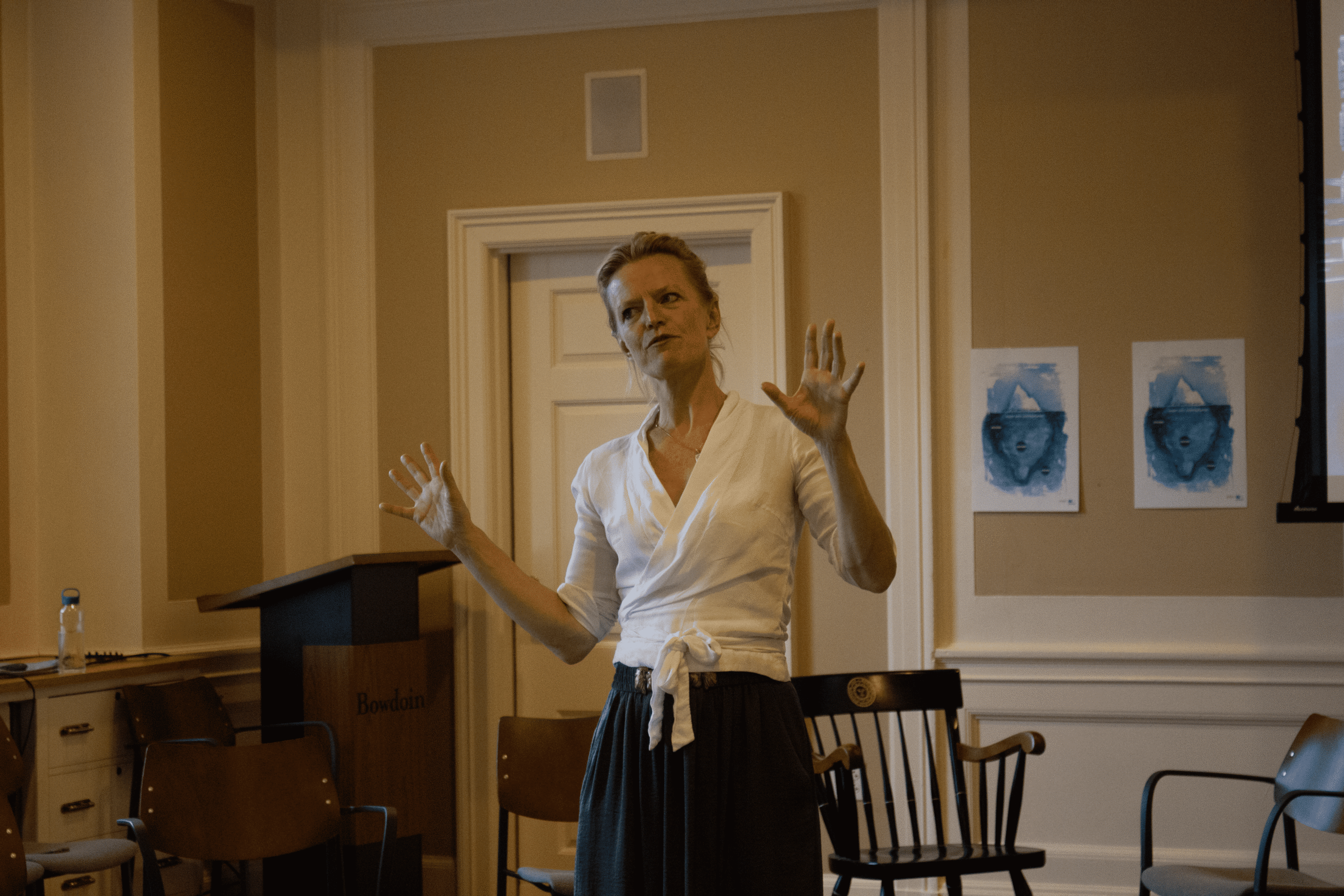
On Thursday afternoon, a dozen participants gathered in Lancaster Lounge for the workshop “How Futures Literate Are You? Rethinking the Present with Loes Damhof” led by UNESCO Chair on Futures Literacy in Higher Education Loes Damhof.
Post-baccalaureate Fellow in AI and Humanity Anya Workman explained that Damhof was invited through the Hasting Initiative in correspondence with their annual theme of AI and creativity.
Damhof received the prestigious Comenius Award and was elected Lecturer of the Year across all higher education in the Netherlands in 2016. She was appointed to her position at UNESCO in 2018, becoming the first to translate the organization’s futures literacy framework into hands-on training for students, policymakers and professionals. She travels worldwide to facilitate learning spaces for people to explore multiple possible futures in order to understand the present in new ways.
“I will introduce to you a new way, a different way to engage futures, and it’s called futures literacy for a reason. There are many … futures possible, and at the same time, the way we talk about it is like it’s a singular entity,” Damhof said. “My work is really about thinking about how we think about futures to get a better understanding of how it impacts our thinking in the present.”
Damhof began the workshop with the Polak Game, where participants place themselves on axes in the room to map how they feel about the future and their sense of agency. Prompting participants to explain their place on the map, Damhof then stressed that their beliefs are fluid.
“We often talk about a future that is somehow written in stone, and what I’m trying to do in this workshop is … make us aware that the only way the future takes place in the present is through anticipation, through imagination,” Damhof said.
Damhof then split the room into two groups and took participants to the year 2076, asking them to imagine the most probable future and post notes on iceberg charts. After the groups discussed their predictions, Damhof had everyone imagine their dream for humanity in 2076 and post them on adjacent iceberg charts.
Predictions included denser, more technology-driven urban living with potentially increasingly divided, isolated and unequal conditions, while dream scenarios centered on enhanced equality and human connection. Reflecting on the activity, Damhof highlighted how it can be much more difficult to imagine a dream future than to describe one’s predictions for the future.
“It’s more pleasant, but it also can mean it’s more difficult,” Damhof said. “You often see that if you think about a desirable future, you go to kind of broad concepts, like a very abstract amount of hope and love and connection, and it’s more difficult to be specific.”
In the next phase, Damhof urged participants to examine their assumptions about the future by writing down their initial response and subsequent reflection on a thought-provoking hypothetical reality.
“In 2076, humanity has lost all of its physical form,” Damhof said.
Participants were initially met with shock and resistance to the idea. When asked about their underlying assumptions, many found they believed physical form to be an innate feature of humanity, as well as how humans relate to one another and their surroundings .
Others challenged their assumptions, wondering whether a lack of physical form could enhance human connection through reduced friction and focus on solely internal expression. Still, others believed that friction and differences defined human relationships.
For the final phase, Damhof brought the room back to the present day. She asked participants to consider the three futures they imagined in previous phases and devise a new question about the future of humanity that should not be forgotten as consequential decisions are made. Participants’s queries ranged from how to preserve individualism and individual connections, to how to ensure AI is used for the improvement of human health and community.
To conclude the workshop, Damhof explained that she had just taken everyone through the learning curve of a futures literacy laboratory: beginning with revealing existing assumptions, then reframing with an alternative scenario and finally discovering what understanding is reached about the present.
“So now you’ve explored these different futures, ‘What do I wonder now?’ ‘How can I go back to the present with a little bit of a new frame in mind?’” Damhof said. “That’s what future literacy is about. It’s this capability to imagine and engage with multiple futures. Expand your imagination, so your frame of what is possible or desirable is expanding.”
Calvin Cecil ’28, who worked for the Hastings Initiative last summer and continues now as a student ambassador, said the workshop expanded his understanding of the present.
“We spend so much time thinking about the past in history classes,” Cecil said. “And while there’s a lot more information [and] we know what happened in the past, thinking about the future is also hugely important to how we perceive the present and how we make decisions, which isn’t a muscle that is trained as much.”
Comments
Before submitting a comment, please review our comment policy. Some key points from the policy: