
Nascimento launches new book on digital ethics
September 25, 2026
 Ana Beatriz Lopes
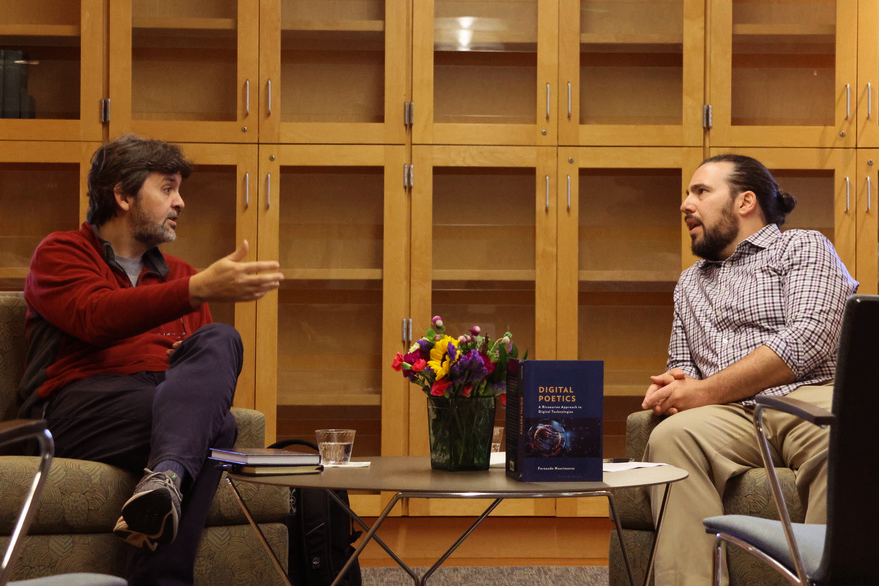
Thursday evening marked the first faculty book launch of the year, with faculty, community members and students celebrating the release of Assistant Professor of Digital and Computational Studies Fernando Nascimento’s book “Digital Poetics: A Ricoeurian Approach to Digital Technologies” in Hawthorne-Longfellow Library’s Nixon Lounge. Associate Professor of Anthropology Willi Lempart joined Nascimento, known by students as Nasci, in discussion.
The title hook, “Digital Poetics,” references the Greek root of the word “poetic,” where both creative design and use are inextricably linked. Later, it was Aristotle who made the distinction between what we do and what we create.
“Over time, in two millennia, this process of differentiation between technical matters and ethical matters just grew far apart to the point that after industrialization, it wouldn’t make sense for an engineer to think about ethics,” Nasci said.
The disconnect between creation and intention is a key focus of Nasci’s book, specifically in the consequences that arise when digital developers do not consider the ethical implications of their designs.
“What I am proposing is that that’s one of the reasons why digital technologies sometimes are very problematic, because, the developers, they see themselves as creating things in the world without any ethical repercussions,” Nasci said in an interview with the Orient.
Developers are one of three groups Nasci addresses in his book as contributing to the ethical use of new technology. Along with the developers, the users and the regulators, institutions and governments also play an active role in the ethical daily use of technology.
“Every way, every form that we decide to give to an app, for instance, the buttons, the order of the algorithm, the notifications you receive when you are following someone on TikTok, those are both poetical, they do things, but they are also ethical,” Nasci said.
Drawing from the ideas of French philosopher Paul Ricoeur, Nasci emphasized the need for developers, users and regulators to use practical wisdom when making decisions. His book offers a framework for digital developers to create, for consumers to use and for regulators to govern, all with the end goal of the common good.
“And when these spheres start working together toward the common good, then I feel like it’s possible to see change,” Nasci said. “In that sense, I’m hopeful.”
Practical wisdom is linked closely with deliberation, another concept Nasci proposed as fundamental to the ethical use of technology. Deliberation asks people to consider their end goals before making a decision, focusing on how their actions in the moment will get them closer to their final goal.
“It seems to me that it’s obvious that technology itself is neither neutral nor deterministic, but what makes the difference? Deliberation,” Nasci said.
Nasci argued that educational institutions, as regulators, should encourage students to cultivate both practical wisdom and deliberation.
“We have removed the idea of wisdom, perhaps too much, out of our classrooms and our joint environments. In a certain way, it has been banished from our intellectual life because it’s not measurable, and it’s hard to publish papers [about],” Nasic said. “A very valid educational goal is to make our students wiser.”
To Nasci, wisdom allows for better deliberation, and grows not only from individual experience but collaboration. He illustrated the benefits of collaboration with the idea of a thread count, as sheets with a higher thread count are more expensive.
“I apply the idea of narrative to deliberation, and I suggest that as a type of fabric with multiple threads,” Nasci said. “Those threads in a narrative deliberation are the different voices that you are able to put together to come up with the deliberation, and that official institutions would benefit to think about this deliberative process.”
Attendee and Instructor in Anthropology Weeyang Gelles-Soh appreciated the book launch’s discussion of wisdom and ethical action in the age of AI.
“My takeaway … is trying to understand what human wisdom is in the context of AI … to try to define that within this space,” Gelles-Soh said.
Ultimately, Nasci sees technology as incapable of practical wisdom and deliberation, concepts he views as uniquely human experiences.
“We have to take back our responsibility and find ways to make it meaningful, because the technology will never be meaningful itself,” Nasci said. “The task of having a meaningful life has to be ours.”
Comments
Before submitting a comment, please review our comment policy. Some key points from the policy: