
Professors Rael and Chakkalakal discuss interpretations of American citizenship
October 30, 2026
 Sirui Wang
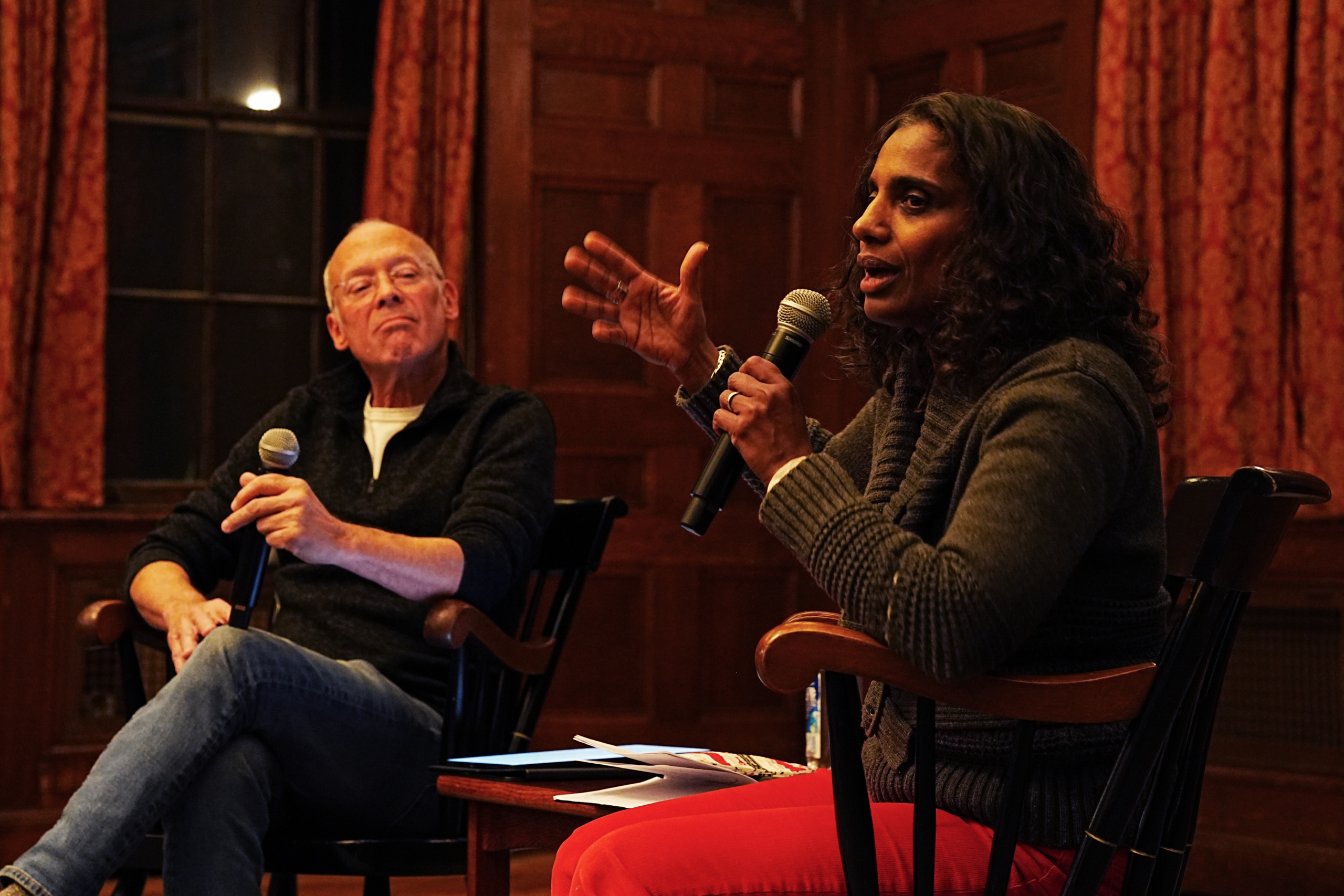
On Wednesday evening, Professor of History Patrick Rael and Professor of Africana Studies and English Tess Chakkalakal discussed their interpretations of American citizenship in the latest edition of the What Matters conversation series hosted by the McKeen Center for the Common Good. Associate Director of the McKeen Center for the Common Good Tom Ancona helped put together the event, titled “Constituting American Citizenship.” Students were provided with dinner and invited to participate in the discussion in the latter half of the event.
“The goal of this [series] is to show how our faculty can have constructive conversations and can disagree with one another and be able to have a good conversation about that,” Ancona said. “The whole point of this was to model good and knowledgeable discussion in ways that maybe students don’t necessarily see on a daily basis.”
Ancona approached Chakkalakal about participating in the series over the summer. Ancona also thought Rael would be a good partner for a topic related to American history in light of the country’s 250th anniversary.
“[Rael’s] a historian and I’m a literary historian,” Chakkalakal said. “We work on the same period, but we come at it from different angles, not so much ideologically, but actually in terms of disciplines, and so we like to exchange notes. We talk about ‘Uncle Tom’s Cabin’ together, for instance.”
Rael opened the conversation on Wednesday by describing his background in game studies and the view of the Constitution as a rulebook. He also noted that politics is more than a game because the stakes are tangible.
“It’s a rulebook that we keep changing, and it’s a rulebook that we fight over all the time. It’s a rulebook that defines who’s in and who’s out,” Rael said.
He went on to discuss the country’s founders, specifically citing “Federalist No. 47” of The Federalist Papers, and how they feared both concentrated power and popular democracy, as well as political parties in general. Rael said the modern political landscape looks very different, raising questions about who the rules apply to and, therefore, what rights noncitizens have.
Chakkalakal opened with a recent case, Trump v. Barbara (2026), that revived the debate over how birthright citizenship is interpreted.
“When I think about the Constitution, I think about it as a rulebook, but I mostly think about it to be interpreted,” Chakkalakal said.
Her reading of the 14th Amendment, which established birthright citizenship, holds that citizenship should depend on one’s allegiance to a country rather than the simple fact of being born there. To illustrate her point, Chakkalakal said she renounced her Canadian citizenship.
The conversation grew heated at times as the two discussed how assimilation, foreign involvement and illegal immigration affect domestic issues.
Rael argued that civic virtue has declined in part because civic education has declined. He described growing up during the Cold War, when civic rhetoric increased because the era gave Americans a common enemy and a goal of teaching the subject in school.
Ultimately, they agreed that civic education needs more support and funding to improve allegiance.
Nick Romano ’30, who is in Rael’s first-year writing seminar, “Serious Games: Critical Play for History,” shared his perspective on the Trump v. Barbara (2026) discussion.
“The Supreme Court case they brought up, that’s something recent and super powerful, and I think that showed the power of the Constitution still holds today,” Romano said. “[I am interested in] the idea about the interpretation of the Constitution and how it represents the values of the time.”
As the event closed, the professors went around the room and spoke with students who had lingering questions.
“I hope [students] become more curious and understand what the conditions are of [United States] citizenship and what it means to be a U.S. citizen or not. I hope that’ll encourage them to go read Supreme Court justice cases, which are actually fascinating documents, so I’d like them to become curious about it and start reading some of the text referenced [over] the course of our conversation,” Chakkalakal said.
Comments
Before submitting a comment, please review our comment policy. Some key points from the policy: