
Professor Vladimir Douhovnikoff talks future of the Brunswick Dam
November 6, 2026
 Addison Moore
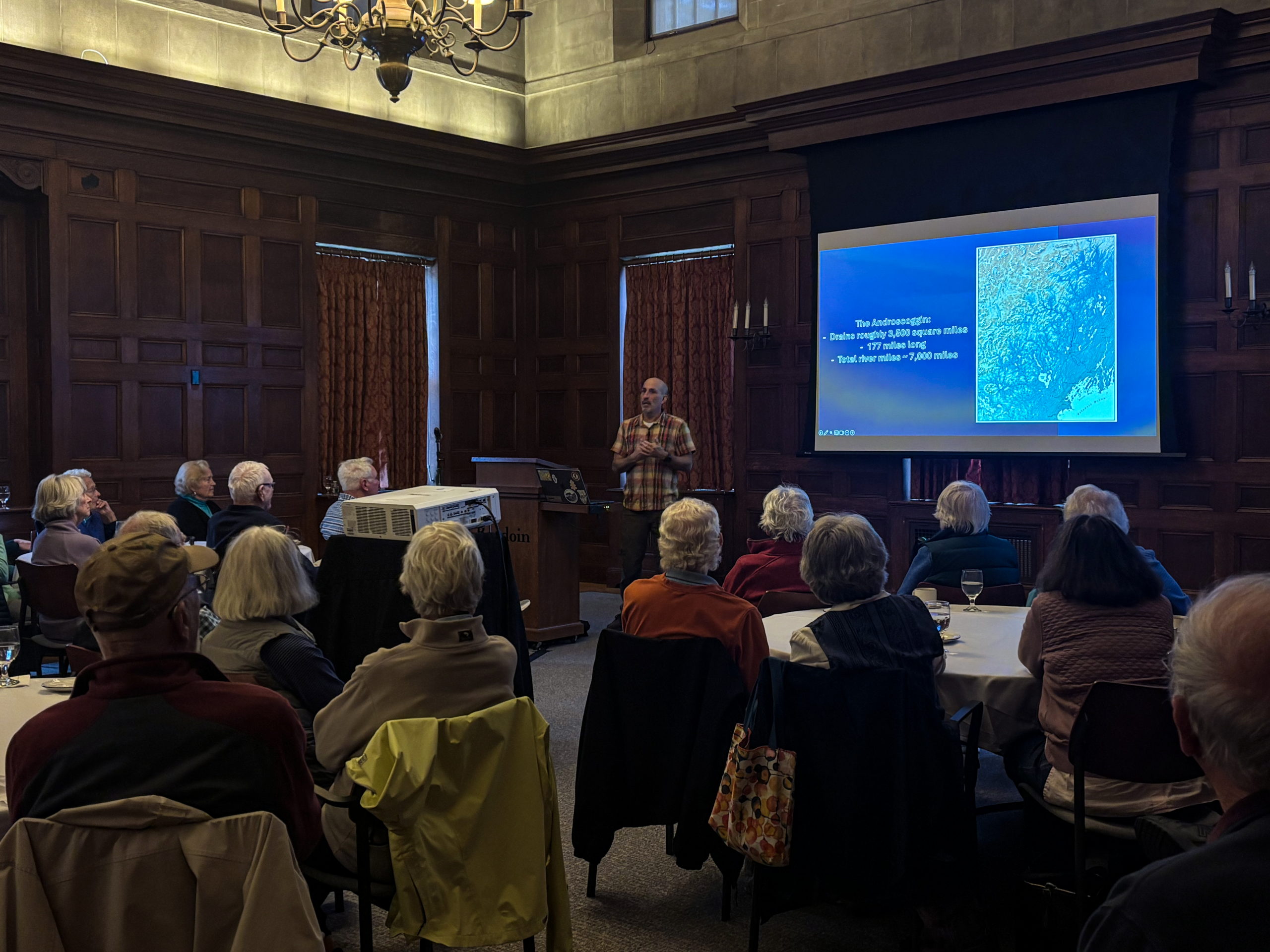
On Thursday, Associate Professor of Biology Vladimir Douhovnikoff and science chair of FreeTheAndro gave a talk in the Main Lounge of Moulton Union entitled “Androscoggin For All: Managing the Brunswick Dam to Better Serve the Common Good.” The talk was sponsored by the Association of Bowdoin Friends and occurred as the Brunswick Dam’s fifty year operating license is up for renewal.
Douhovnikoff remarked that back in 1979, when construction on the Brunswick Dam just started, the Androscoggin River’s poor water quality limited its use in other facets, so it made sense to harness the river’s energy. However, despite today’s healthier river having more to offer, it remains limited by the Brunswick Dam.
“We’re right at the very end [of the river system], just as it hits Marymeading Bay and joins up with the Kennebec River. This is what’s called the head of tide. This is the lowest point on the river that is basically still river. Below us, it’s tidal. You’re basically transitioning to the sea,” Douhovnikoff said. “This dam is the entryway to this entire landscape, and it’s closed.”
At the time, the federal government required the dam’s owners to build a fish ladder. Fish have to either find a 16-inch pipe which shoots them out underneath the dam, wait for high flows to wash them over the top for a 40 foot drop or get grinded through active turbines. The latter case resulted in the death of thousands of fish two weeks ago.
“So basically, we’ve got a huge Bass-O-Matic here where we’re grinding fish up, and unfortunately, this happened about two weeks ago here in Brunswick, and we lost thousands of fish, maybe tens of thousands, ” Douhovnikoff said. “The turbines are going whenever they’re going. They are killing fish.… These extreme events are when we really take notice.”
Furthermore, Douhovnikoff presented data proving the ladder wasn’t even close to achieving the government’s goal of one million fish crossings, let alone the river’s much higher potential of over nine million.
Douhovnikoff urged the audience to be inspired by the upcoming opportunity to improve the river rather than discouraged.
“This is a really unusual moment because the license is expiring … in 2029, and so we have the opportunity now to participate and comment and give feedback and engage with the relicensing process,” Douhovnikoff said.
The key to this process will be pushing the Federal Energy Resources Commission (FERC) to set binding fish passage targets for dam owners, which will require public engagement. Douhovnikoff pointed out that the focus of the Androscoggin in Brunswick until now has primarily been hydropower, which leaves out numerous other benefits, including recreation, commercial fisheries and local economic and cultural opportunities.
Douhovnikoff looked to the Benton Falls Dam located on the much smaller Sebasticook River as a good example of what is possible with improved dam management. Last year, roughly 10 million fish were passed over the dam with the help of its fish elevator.
“Thanks to careful management and community engagement, the recovery of the fish run has been so successful that Maine lobstermen are allowed share of the bounty,” Douhovnikoff said. “The Maine Department of Marine Fisheries and the Town of Benton issue permits for harvesting hundreds of thousands of dollars worth of fish, and the town of Benton receives one-third of the value in fees. So recovery is possible even while generating power.”
While the Benton Falls Dam is better for fish, it has its own drawbacks such as requiring an engineer to run it at all times and possible malfunctions that leave fish in the lurch. As such, Douhovnikoff is advocating a “river-runner dam,” which is a half dam involving a barrier wall that connects the middle of the dam to the Brunswick swinging bridge. This would effectively restore half the river.
“You still get the same amount of head pushing the turbines, but now you’re sharing with fish passage,” Douhovnikoff. “And what we like about this option is that it’s volitional; that the fish can use it as they want, when they want, and there’s no calendar or no schedule. The other advantage to it is both upstream and downstream passage.”
While the option would be the most expensive, Douhovnikoff notes that its feasibility, which has been confirmed by both the National Oceanic and Atmospheric Administration (NOAA) and the Main Department of Marine Resources (MDMR), is all that matters at this stage. Douhovnikoff encouraged Brunswick residents to stay engaged in the process and push community leaders to act.
Lindell Smiley ’29 attended the talk due to his interest in the field, which stemmed from his summer internship with MDMR at the Milford Dam. The talk gave him hope for the future of the Androscoggin.
“It was very inspiring. I feel a lot of hope for this because, like [Douhovnikoff] says, this is an unusual opportunity,” Smiley said. “In these 50 year cycles of relicensing, we actually have a chance to make a change here.”
Comments
Before submitting a comment, please review our comment policy. Some key points from the policy: