
Lopez performs exhibit-inspired program at the BCMA
October 16, 2026
 Addison Moore
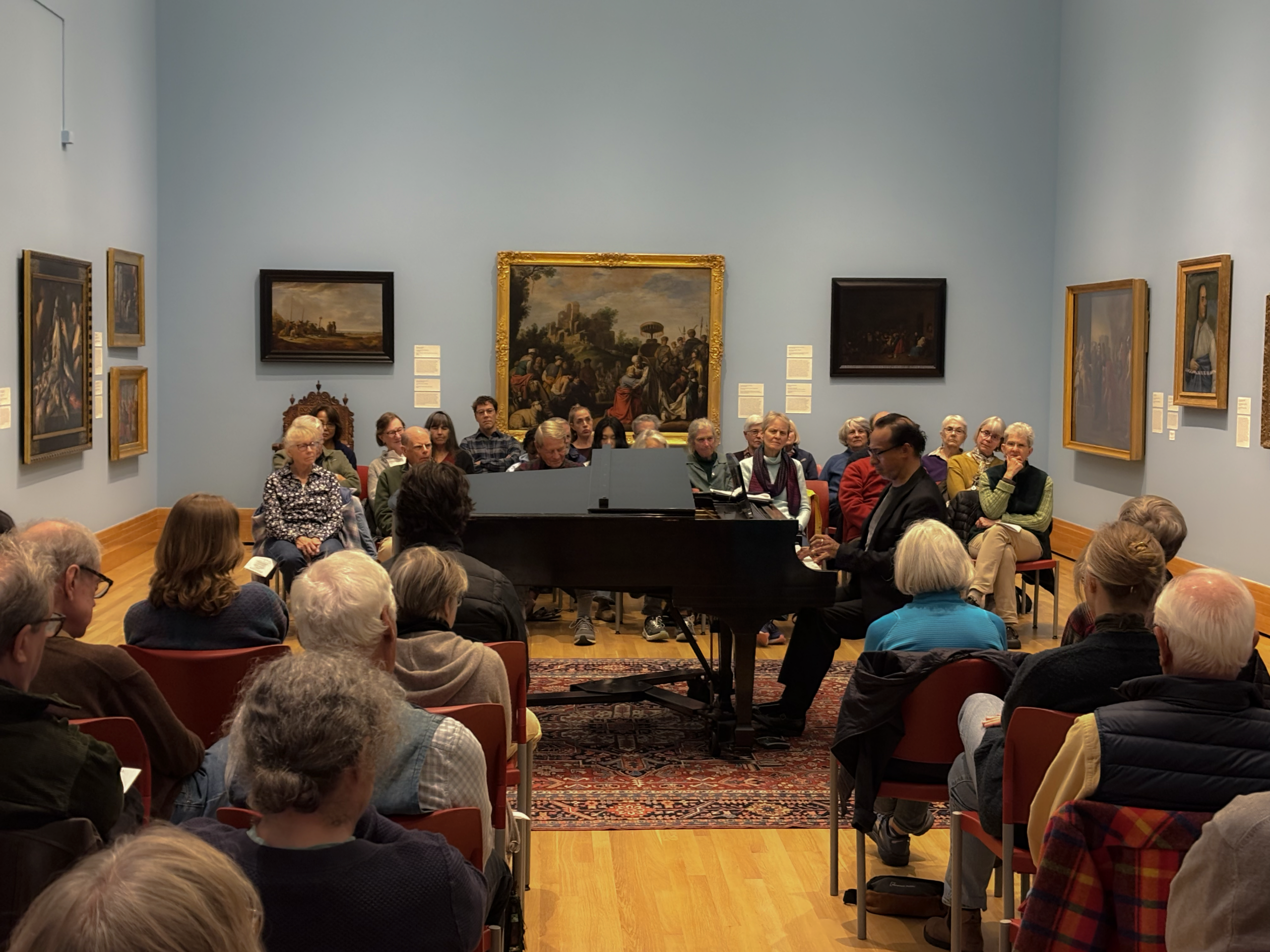
On Thursday, Beckwith Artist in Residence George Lopez performed 13 songs that make up “Journey to the East and Back Again: Oases of Resistance Around the Globe” at the Bowdoin College Museum of Art (BCMA). The program accompanied “Healing in Apartheid South Africa: Michael Goldblatt’s Photographs of the Alex Clinic,” an exhibit about a health clinic in Johannesburg’s Alexandra township. Lopez divided the performance into four sections, each exploring an aspect of resistance.
He opened by describing the two threads that the exhibit brings together: the history of power and control, tied to imperialism and conflict, and the history of care and consolation, tied to health and healing. His first section, “Epidemic: Ancient Causes,” covered the ancient theories of the four humors.
“I thought a good place to start would be to give that very unsettling feeling about these ancient thoughts about illness before we make our way to the actuality of healing,” Lopez said.
In the next section, “Early Missions to South Africa,” Lopez turned to disease during colonization, focusing on smallpox and connecting it to his own family history.
“Smallpox is the greatest killer of its time, having decimated the region where my family comes from in Belize,” Lopez said.
Lopez added that the Khoikhoi people of South Africa lost roughly 90 percent of their population within a year of an outbreak. Smallpox also shaped the music of the period, which Lopez explored in “Birth, Death and Consolation.” Johannes Sebastian Bach lost half of his children to smallpox, diphtheria and cholera. Lopez played Bach’s “Courante,” part of a set of dances written to celebrate the birth of his employer’s son.
“He writes this beautiful, beautiful set of dances, and he’s so proud of it,” Lopez said.
Lopez followed the thread from Maine to South Africa in the program’s most direct link to Bowdoin. Rufus Anderson, who graduated from Bowdoin in 1818, became foreign secretary of the American Board of Commissioners for Foreign Missions and sent its first missionaries to South Africa in 1835. In 1925, Ruth Cowles, the daughter of two of those missionaries, arrived in Johannesburg as a nurse. Finding that patients were walking eight to ten miles for care, she moved the clinic to Alexandra, where help was most needed. That clinic became the Alex Clinic, the subject of the photo exhibition.
The Alex Clinic revolutionized community-oriented primary care, a concept students working there eventually brought to the United States. The idea spread around the East Coast, and Columbia University professors and social epidemiologists soon adopted it. Around the 1960s, one of those Columbia students, Matilda Riley, became the first professor at Bowdoin to start the sociology department.
“That’s the meaning of our journey to the East and Africa. We go there and come back renewed as a result of this incredible history and interaction with South Africa. As an example of an oasis of resistance: ‘Can you imagine having to leave your life to Earth, be displaced to a place you’re not familiar with and somehow maintain enough joy to be created? And to write a symphony that then becomes celebrated so much so that the Chicago Symphony wants to play [it]?’” Lopez said.
In “Voice of the People,” Lopez’s partner Dr. Gulimina Mahamuti, applied music instructor for classical piano, performed Beethoven’s “Piano Concerto No. 4, Op. 58.” Lopez introduced the section with a story about Harold Rubens, a pianist who hosted secret African National Congress meetings at his home shortly before Nelson Mandela’s arrest in the early 1960s. Under fear of surveillance, Rubens played loudly to cover the conversations.
He also presented a work by Florence Price, who left Little Rock, Ark., during the Great Migration and kept composing in Chicago. Her manuscripts were rediscovered in a box in 2008. Lopez highlighted how the piece represented a safe haven within the resistance movement.
Mandela had a link to the clinic’s neighborhood as well. After leaving home in 1941 to escape an arranged marriage, he found his first place of his own only blocks from Alexandra. As president, he returned to help the clinic. Lopez noted that Alexandra remains poor, even though it sits beside one of the wealthiest areas in the world. The exhibit’s photographs were taken in part to raise money for vaccines, clean water and clean milk.
Cassandra “Casey” Mesick Braun, a BCMA curator, helped Lopez with the art and historical context of the works on view.
“As he said in his closing remarks today, one of the great things about having programs like this on a college campus is that [Lopez] freely avails himself of the expertise of various faculty members who might have some sort of content area expertise on these topics as well,” Braun said.
The audience included other BCMA curators, Bowdoin faculty, students and local community members. Lopez closed with three South African pieces, ending with Abdullah Ibrahim’s “Mannenberg.” Written in 1974, the tune became an unofficial anthem of the anti-apartheid movement, a perfect conclusion to his historical tour using music as resistance during times of turmoil.
Comments
Before submitting a comment, please review our comment policy. Some key points from the policy: