
Sean Latif Heiser balances the abstract and personal in “Stationary Shift” exhibition
October 2, 2026
 Ana Beatriz Lopes
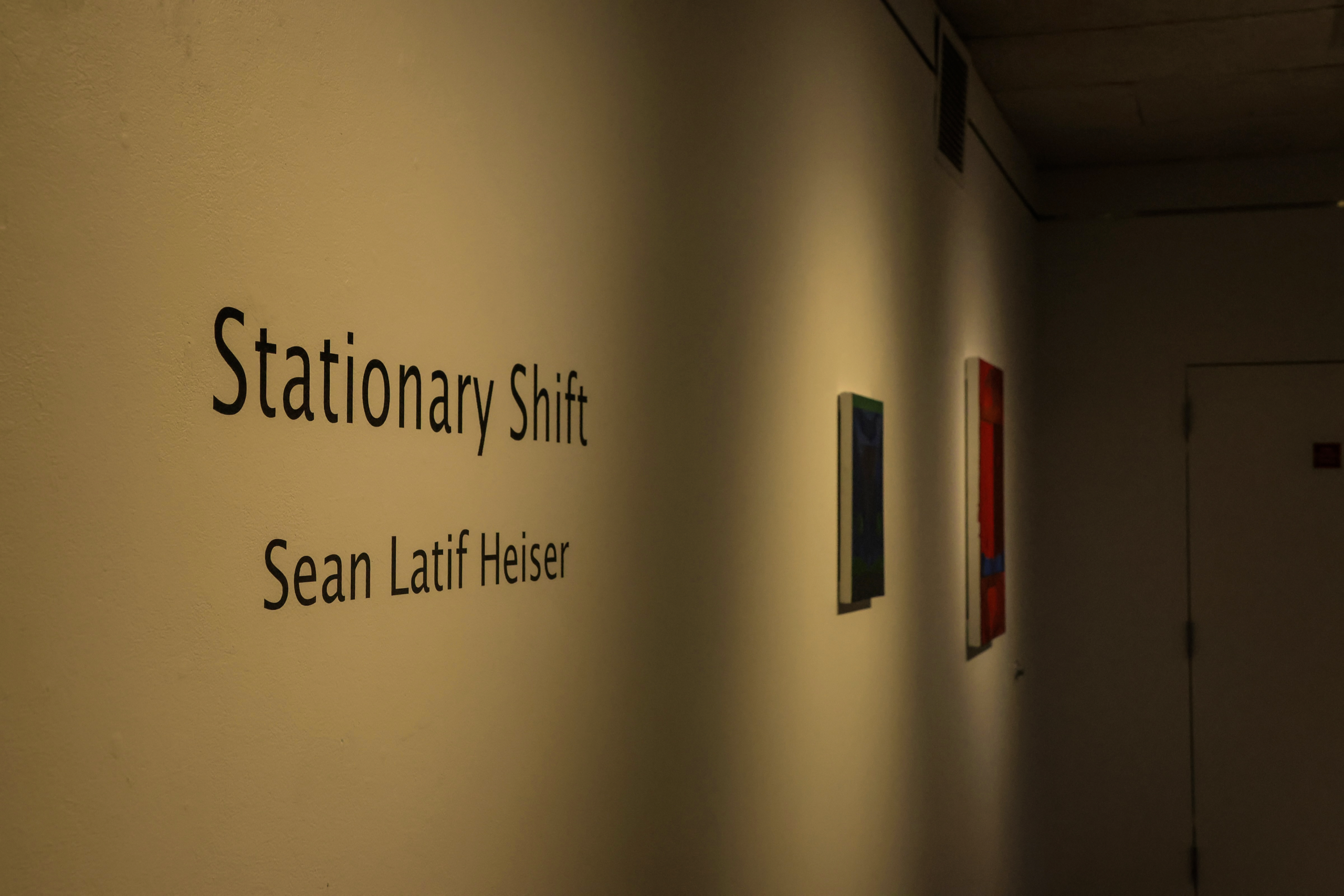
On Thursday evening, Bowdoin welcomed New York-based, Malaysian-born artist Sean Latif Heiser for the opening of his exhibition in Edwards Front Gallery, titled “Stationary Shift.” Walking into the gallery, viewers observed six small paintings, all full of geometric shapes, clean lines and colors with depth and fluidity.
Assistant Professor of Visual Arts and painter Eleanor Conover, the organizer of the exhibition, explained that she invited Heiser to Bowdoin after their paths crossed at the University of Tennessee, Knoxville, where she taught at the School of Art while Heiser worked as a graduate teaching assistant. Their overlapping interest in abstraction and representation as well as his ability in teaching led her to extend the invitation.
Like the title of the exhibition, Heiser’s work balanced two seemingly diverging themes: the formal abstract and the personal expressive. His passion for formal abstraction while combining and juxtaposing ideas came from his background in philosophy, in which he pursued a graduate degree before he pivoted to art. However, Heiser also worked to ground his work in the personal.
“Being abstract is important to me. [But] I try to also ground that in things from day to day life. Like I mentioned, architectures that I see, things that interest me in the street, things that I’m thinking about and then sort of seek to build a composition, which I then try to articulate in a way that is both doing justice to the picture plane, but also to maybe a more personal connection to the abstracted forms,” Heiser said.
Relating to this first-person viewpoint, perspective was also an important part of Heiser’s work.
“I’m always interested in active looking. I think that’s really central to my work,” Heiser said. “I feel like whether or not I have my own opinions or judgments on how things are going, I’m always constantly aware that I’m watching myself and watching things around me. I think that that is a starting point for what I have to offer visually.”
Among Heiser’s more recent thematic adoptions was the symmetry of his paintings. This inspiration came to him during the Covid-19 pandemic, while taking walks through a cemetery near his house to get fresh air.
“I was really interested in trying to learn [about] the symmetrical forms of the tombs and the monuments. And I also began thinking of [how] there’s a certain mindfulness in that symmetry that I could maybe carry forward into the work and use that as a way to communicate a certain sort of intentionality and perspective,” Heiser said.
The intentionality of this symmetry contributed to his vision of paintings as standalone objects.
“I’m really interested in paintings as objects, more so than paintings. Meaning an object can have its own history that’s unrelated to you, and I think a lot of paintings are maybe more so just like, ‘Oh these are like paintings made by X artist,’” Heiser said. “I was like, ‘How can we sort of build paintings that can be different things at one time, and also in doing so have their own sort of history or worth as just a thing?’ I think symmetry is like an access point that communicates that intention.”
Prompted by art students during the Q&A session, Heiser discussed the more technical aspects of his painting practice, including his use of Photoshop to collage different ideas in an efficient manner, his method of creating sharp lines and his choice to shift to smaller canvases in recent years with his move to New York.
“I would say the collaging doesn’t always occur, but it occurs in the midpoint or later as a way to shake up the composition. I feel like one of my worst traits as a painter is [being slow at creating]. So using a digital tool is a faster way to take risks and then evaluate the risks … I think about it as a tool, like a brush or a knife or something that I use at certain points to try to alter the image in a way that I maybe previously didn’t consider was strictly entertaining,” Heiser said.
Conover hoped that these exhibitions would provide students an opportunity to interact closely with the artists and learn from them.
“I do think that it is such a wonderful experience [for students] to be able to ask questions in a non-high-stakes environment, and also to be able to talk to an artist in a more intimate setting than in a museum or in a really large audience,” Conover said. “I also think that these are good opportunities for the arts community here to get together in a less [formal] way and to be able to interact with artists … and to give students the opportunity to see what other kinds of making exist out there in the world in terms of contemporary art practices.”
“Stationary Shift” will remain open until October 30.
Comments
Before submitting a comment, please review our comment policy. Some key points from the policy: