
Professor Pamela Fletcher discusses “Fungi and Flesh”: The implications of color, technique and artistic style
October 2, 2026
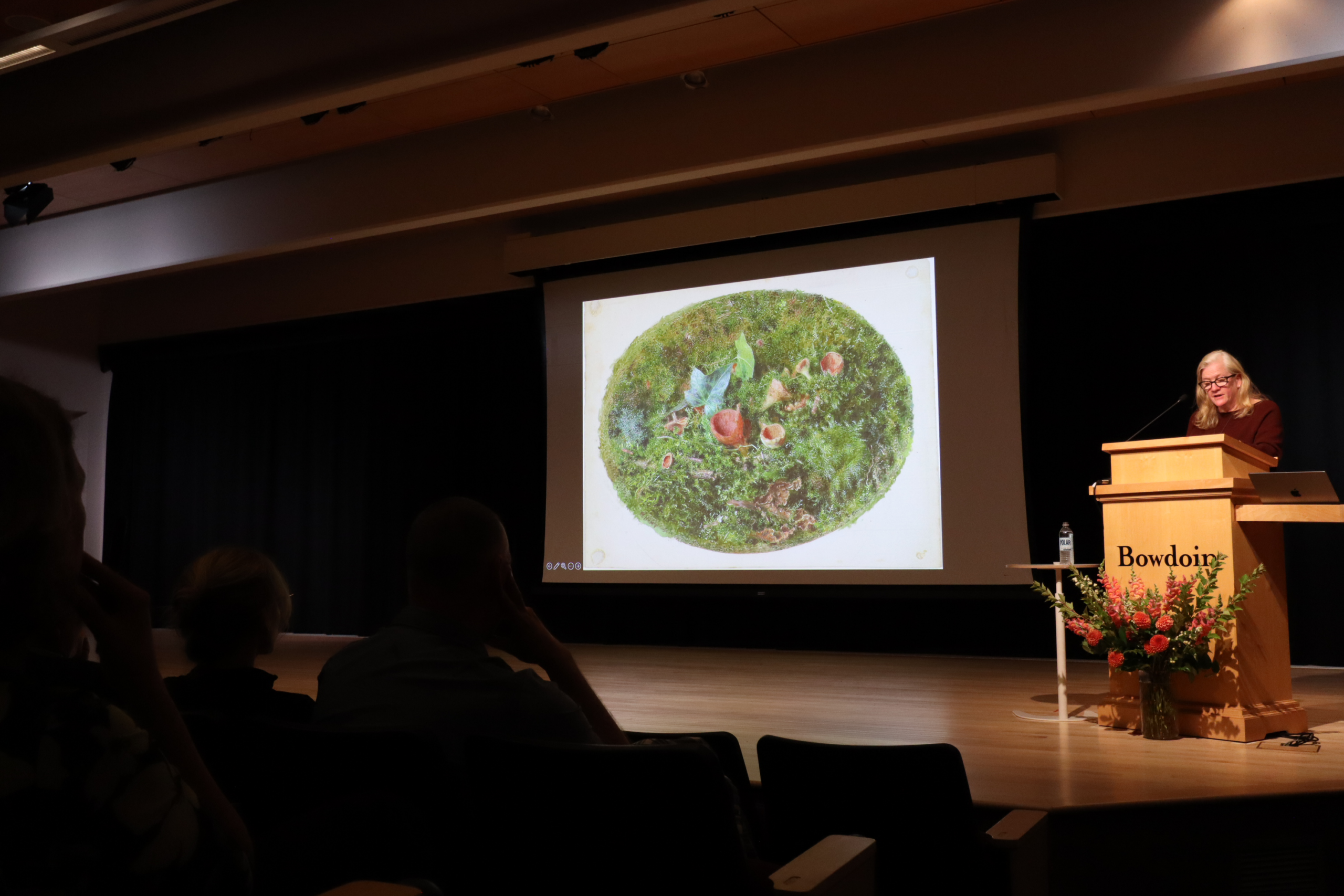 Addison Moore
On Wednesday evening, students, faculty and community members gathered in Kresge Auditorium to celebrate the inauguration of Professor of Art History Pamela Fletcher as the third Edith Cleaves Barry Professor of the History and Criticism of Art. This recognition was established in 1979 and has since propelled innovation and scholarly work within the art history department.
The evening began with a warm introduction from President Safa Zaki, where she introduced Fletcher and her contributions to the Bowdoin community. Fletcher specializes in 19th-century British art and engages with how art portrays culture and historical context.
The inaugural event was centered around a lecture Fletcher facilitated about the British watercolorist William Henry Hunt and his acclaimed painting “Fungi” (1858).
The watercolor was gifted to the Bowdoin College Museum of Art (BCMA) by donor Susan Dwight Bliss alongside a large collection of other drawings and paintings.
“It came with the wrong artist name attributed to it, but the Museum, because it’s a teaching museum and because they aspire to have stuff from all periods of time, preserved it and kept it,” Fletcher said.
Fletcher mentioned how the watercolor piece was one of the first artworks she encountered from the BCMA collection when she joined the College community as a professor.
“We don’t have a lot of 19th-century British art in the collection, so when the curators were pulling stuff out, that was one of the things they showed me,” Fletcher said. “I would return to it over the years with teaching, but I really didn’t work on still life or watercolor, so I wasn’t interested in it as a research subject. But I always pointed students to it.”
In the lecture, she focused on the motif of color consistent across a multitude of Hunt’s pieces and how in-depth analysis allows us to better understand politics, history, culture and social hierarchy. Over time, Hunt became associated with pointillism, a technique where he layered multiple small dots of pigment to create textural diversity and unique visual appeal.
The subjects of Hunt’s artworks were largely influenced by his upbringing. Hunt grew up working-class, without a formal education and with disabilities that limited his physical mobility. His social marginalization informed the approach he took in his artwork: portraying other working-class individuals, lower-status communities and nature.
Considering Hunt’s use of color, structure and subject matter, Fletcher left audience members to consider how Hunt’s depictions of nature in “Fungi” leave no indications of social hierarchy, challenging viewers to consider a fictional world where humans aren’t dominant.
Compared to his contemporaries, Hunt was more concerned with depicting the still life “quietly,” creating extravagant worlds where social context is lacking and the subject of the piece takes complete authority. Fletcher relates this idea to how “Fungi” is meant to be viewed strictly for depicting the beauty of natural life.
Similarly, Fletcher argued that Hunt paints the bright red cups in the center of “Fungi” in the same way he paints human skin to draw parallels between humans and nature. Coming full circle, Fletcher emphasized the central idea of Hunt’s art—that there is no distinguished hierarchy between human and nature, and that we all possess the same innate qualities.
Fletcher concluded her lecture by discussing the continued importance of studying the liberal arts and humanities. This was a major takeaway for Finn Taylor ’30, a student in Fletcher’s course, “The Art of Urban Life in Europe.” He shared how the lecture reinforced the value of close observation, especially considering the intricate details and subtle color variations in Hunt’s work.
“I think the importance of … stopping, slowing down and appreciating the natural beauty that is all around us … in order to appreciate its intricacies and its inner workings in a way that William has done, clearly, is [something] to emphasize,” Taylor said.
Taylor also highlighted how Hunt’s artistic techniques point to sociopolitical structures.
“I really enjoyed the portraits and his use of complementary colors as a way to show that skin tone is easily portrayable [with] many different colors. His ability to use the pointillism style was very evocative and spoke to the fact that race is something we create,” Taylor said.
Fletcher is continuing to explore Hunt’s work and his relationship to these themes in a new project.
“Nobody is really working on him right now; watercolor is not very fashionable,” Fletcher said. “His subjects don’t seem super political or interesting in any way. I got interested in thinking about connections between the fact that he is praised for using color on these ordinary, boring subjects. What if we start to think about color more as connected to questions about the relationships between human and nature and pollution—the ways in which we can or can’t understand [differences] between people in terms of what their external appearance and skin color is like?”
Comments
Before submitting a comment, please review our comment policy. Some key points from the policy: