
Jennifer Berkshire and Jack Schneider discuss education policy in Brodie Lecture
October 2, 2026
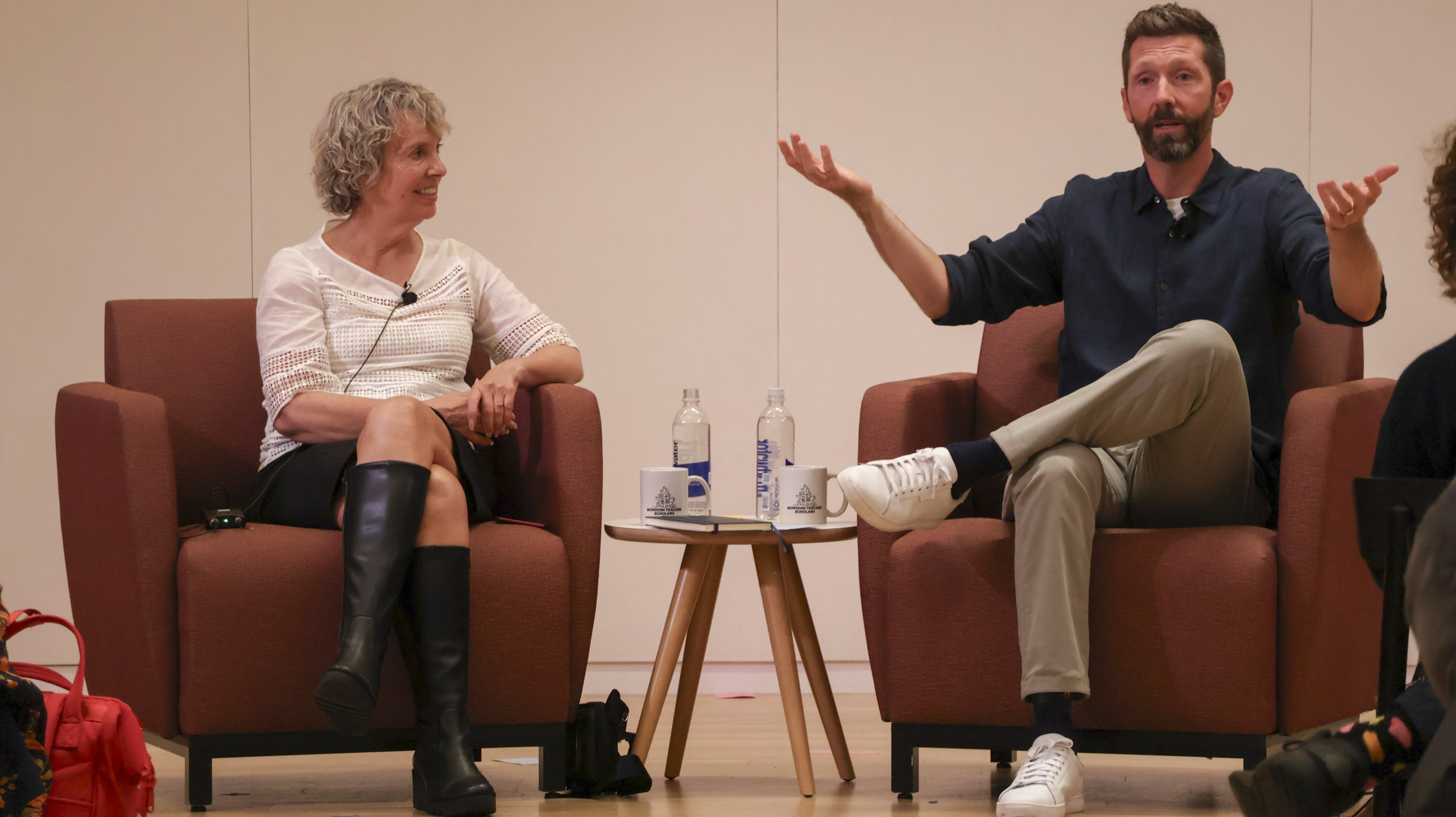 Abigail Hebert
On Thursday evening, Jennifer Berkshire and Jack Schneider spoke on their research and teaching on the intersection of policy and public school in the annual Brodie Family Lecture. Both writers and professors, the two host the “Have You Heard” podcast, which is quite popular in the education sphere, and have coauthored a pair of books together.
Berkshire is a journalist whose work has been published on platforms such as the Nation, the Baffler and The New York Times. She is a professor at both the Boston College Prison Education Program and the Education Studies program at Yale University. Schneider is a historian and policy analyst who studies how politics and culture shape attitudes toward schools. An author of six books, he leads the Center for Education Policy at the University of Massachusetts Amherst where he is the Dwight W. Allen Distinguished Professor in Education Policy and Leadership.
The Brodie Family Lecture series was established in 1997 by Theodore H. Brodie ’52 to bring a speaker in the field of education to campus each year. Associate Professor of Education Alison Riley Miller expressed thanks to the Brodie family and to Berkshire and Schneider for their time on campus.
“Berkshire—a journalist—and Schneider—a historian—bring both clarity and context to some of the toughest and most politicized issues related to public education in the United States,” Miller wrote in an email to the Orient.
On the topic of alternatives to the normal public and private school systems, Schneider shared both concern and hope. He expressed skepticism for Alpha School, an online, artificial intelligence-powered curriculum.
“It’s kind of the worst of both worlds, where we embrace the potentialism, rapids and the idea of education as truly useful for getting ahead. They crush academics in two hours a day,” Schneider said. “The sales pitch is you’re going to have this wonderful time. But, of course, you’re alone [and] you’re doing this online.”
One audience question brought up the recent Nikole-Hannah Jones piece in the New York Times Magazine, whose article on segregation in New York City public schools touches on many of the points Berkshire and Schneider brought up during the talk.
“Tonight, we started out talking about the purpose of public education, and not even mother and daughter agree on what it is. And then you think about … how high the stakes are in New York City, [where] you have unbelievably concentrated inequality and segregation,” Berkshire said. “On top of that, you have this incredibly competitive system where kids have to start thinking about what selective high school they’re gonna apply to when they approach seventh grade.”
Berkshire continued, giving a shoutout to New York City mayor Zohran Mamdani ’14.
“I’m also thinking about, as excited as I am about the fact that Bowdoin graduate [Mamdani] is talking about how we can remedy inequality of the level of the economy, I can’t help but notice that he doesn’t seem to have much to say at all about education,” Berkshire said.
In addition to their evening talk, Berkshire and Schneider spent time with the “Curriculum Development” (EDUC 3302) class, chatting with students about their latest book and the podcast. Miller noted how influential their work has been in the education department and curriculums.
“Berkshire and Schneider’s work is being highlighted in some form across all education courses this fall. Students taking Power and Dilemmas in U.S. Education (EDUC 1101) are reading their book, ‘The Education Wars: A Citizen’s Guide and Defense Manual,’” Miller wrote. “In other classes, we are using relevant episodes from their education-centered podcast.”
Maggie Zeiger ’28, a student taking “Education and Law” (EDUC 2250/GOV 2024) this semester, was drawn to the duo’s point on the stresses of education.
“I liked the idea … of education being a pressure cooker and … put[ting] the joy back into education, but we have to focus on creating a school system [that’s] not only focused on outcomes, and it’s more about the process,” Zeiger said.
When asked about what Bowdoin students can do to stop running on the “hamster wheel of education,” Berkshire had words of empowerment and encouragement for the audience.
“My advice would be to do anything you can to resist that kind of pressure,” Berkshire said. “Look into your heart, because it’s the fact that we’re all marching along in the direction that we don’t necessarily want to go in that makes it so hard to stop.”
Comments
Before submitting a comment, please review our comment policy. Some key points from the policy: