
David Simon and Franklin Leonard discuss nuanced writing amid political tensions
October 2, 2026
 Andrew Shi
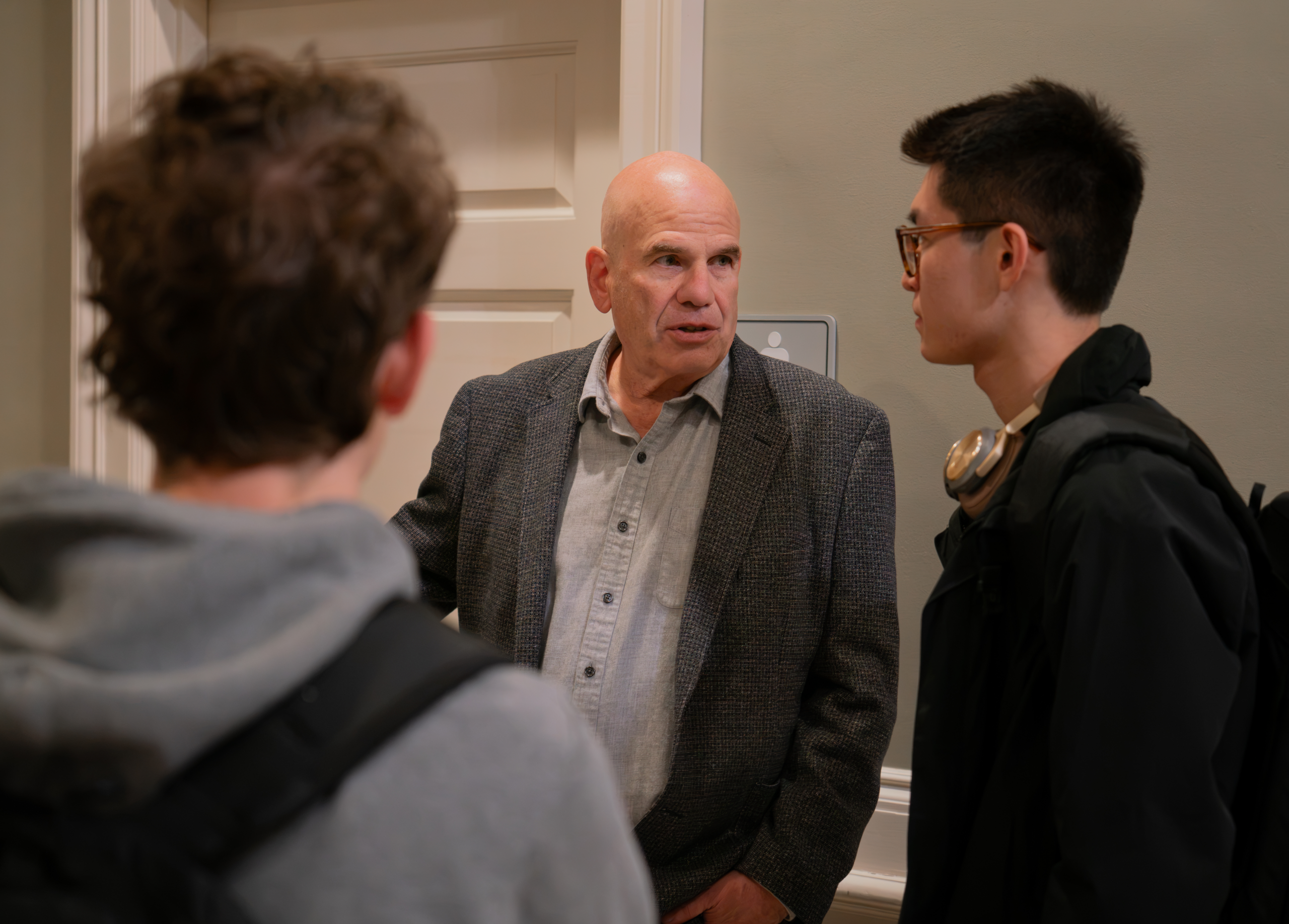
On Monday evening, students, faculty and community members convened in Pickard Theater for this semester’s Kenneth V. Santagata Lecture, a conversation between journalist, author and television producer David Simon and film producer Franklin Leonard, Bowdoin’s inaugural Herman S. Dreer Leadership Fellow. Hosted in conjunction with the Viewpoint Exchange Series, the conversation explored the intricacies of honest storytelling and writing in what Simon called “the middle ground.”
Leonard introduced Simon as one of the most compelling ethical voices in screenwriting and journalism, citing the critically acclaimed television series “The Wire” and Simon’s two works of narrative nonfiction. He contrasted Simon’s reputation for moral clarity with the controversial notion of writing in a “middle ground,” which he said is often misconstrued as centrism.
Simon explained that he developed his approach while reporting for The Baltimore Sun’s City Desk. Ideological purity, Simon argued, would have prevented him from contending with the nuances of crime and homicide through his reporting.
“As I reported on actual problems, there was nothing to which you could apply … a pure ideology,” Simon said. “You’re obligated to give room to the counterargument where the counterargument is credible.”
Following 12 years at the City Desk, Simon spent a year embedded in the Baltimore Police Department’s homicide unit, research that culminated in the nonfiction book “Homicide: A Year on the Killing Streets.” He said prolonged immersion allowed him to move beyond the more performative impressions people provide when they know they are being observed.
Simon applied a similar approach while researching “The Corner: A Year in the Life of an Inner-City Neighborhood,” which he co-wrote with former detective and teacher Ed Burns. Both books, he said, depended on consistency, humility and cultivating trust.
Simon described effective journalism as a willingness to ask simple questions and “be an idiot” rather than an attempt to demonstrate expertise. He argued that deferring to experts, even if they are not conventional authors or scriptwriters, is often integral to telling stories authentically. For this reason, a potential season of “The Wire” discussing immigration was not produced during his tenure because the writers’ room lacked fluency in Spanish.
Simon’s journalistic nuance later influenced his television work, particularly “The Wire,” which examines institutions including law enforcement, mass incarceration, public education and the drug trade. “The Wire,” renowned as one of the defining television dramas of the 21st century, has more recently been interpreted as a prescient depiction of America’s social and political decline.
Despite his stated conviction that policing should prioritize violent crime rather than drug enforcement, Simon said his work has still been criticized by those who share many of his political beliefs. He recalled disapproval from advocates of defunding the police or abolishing prisons, positions he said can become ideological absolutes that fail to account for institutional complexities.
“They would look at me like, ‘You betrayed us,’” Simon said. “I came to realize that people are … committed to their ideology, how they perceive themselves and their own purity, but they aren’t actually solving the problem.”
Simon said his willingness to reconsider his views has become central to thoughtfully considering institutions.
“As I get into the new exploration of every institution, if there was an ideal that I thought could prevail … so be it, and if I had my mind changed somewhere, that happened,” Simon said. “I came to respect the middle.”
However, Simon acknowledged that he does not consistently write “in the middle.” He named his conviction in the preservation and funding of public education, his opposition to school vouchers and his reluctance to accept artificial intelligence as a replacement for human screenwriting as examples. Still, he remains interested in engaging with persuasive counterarguments.
“The moment you start reading the other side’s best arguments is the moment you start growing up,” Simon said.
Simon also recognized that nuanced storytelling can be less immediately engaging than narratives with clear moral divisions.
“You can’t tell me writing a simple story where somebody’s right and the rest of the world’s wrong, and they go to war and they either win or they die on the mountaintop, isn’t a more powerful narrative,” Simon said. “It is.”
Nevertheless, Simon argued that writing about competing forces produces more honest drama, revealing the intricacies of moral tensions that television dramas often overlook. Returning to “the middle” in his series was a creative risk in an industry that rewards familiar, formulaic stories, and he often fought to retain artistic integrity in later seasons of “The Wire.”
The conversation also touched on Simon’s current writing, including work inspired by Larissa MacFarquhar’s reporting on foster care and child protective services.
For attendee Atticus Orbach ’27, the event provided insight into the political dimensions of Simon’s work.
“I think ‘The Wire’ is a very political show that deals with a lot of the issues that were contemporary at the time,” Orbach said. “It’s not surprising that he wanted to talk about contemporary issues, and I thought he had pretty good takes on them.”
Editor’s Note, Friday, October 2, at 7:45 p.m.: In a previous version of this article, the Santagata Lecture was referred to as an annual lecture. This lecture actually occurs every semester. The article has been updated to reflect this.
Editor’s Note, Monday, October 5, at 6:45 p.m.: In a previous version of this article, Larissa MacFarquhar’s name was misspelled. The article has been updated with the correct spelling.
Comments
Before submitting a comment, please review our comment policy. Some key points from the policy: