
Weekly Stillpoint retreat provides space for student meditation and reflection
February 6, 2026
 Andrew Shi
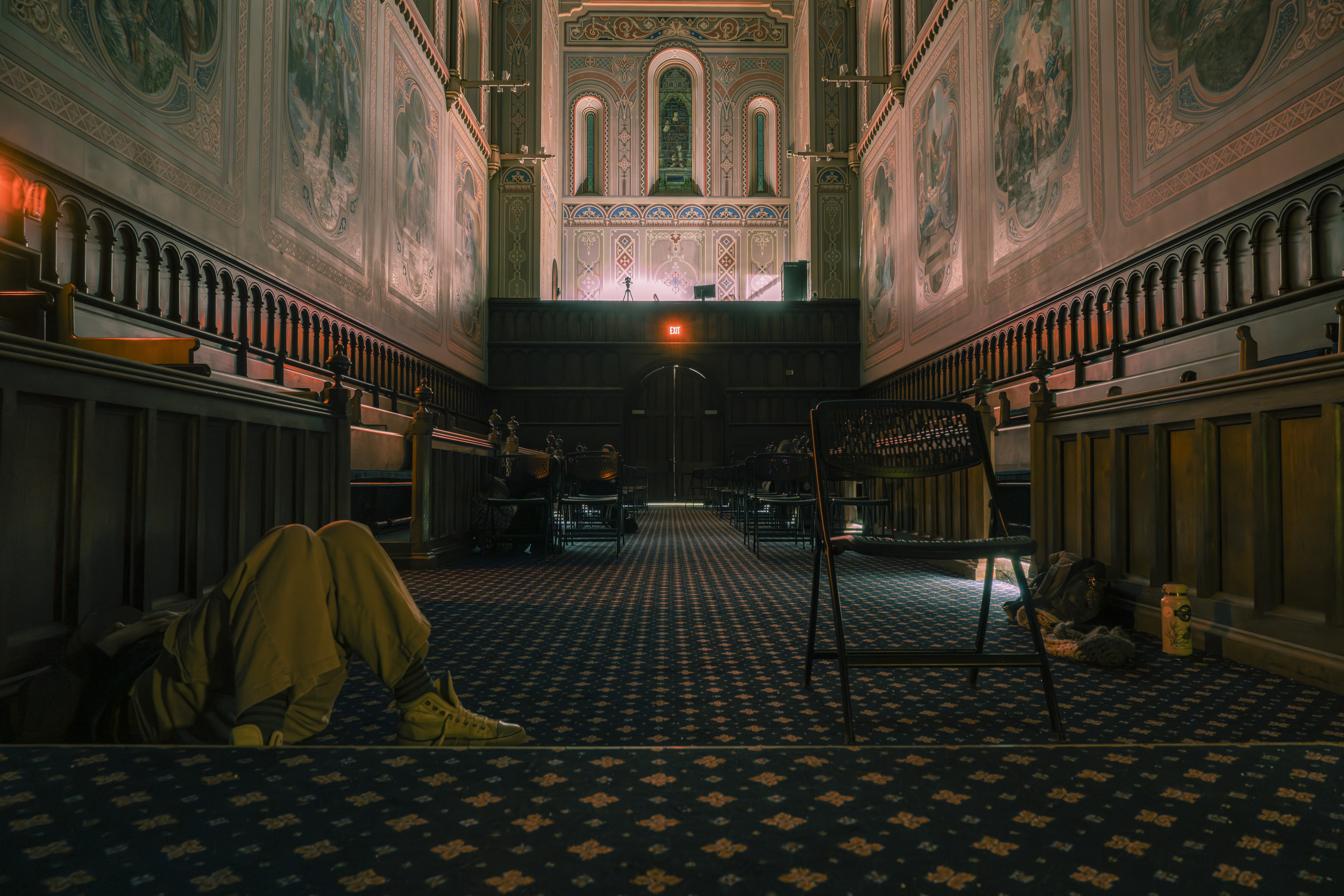
Stillpoint, held in the Chapel every Tuesday at 9:00 p.m., offers students, faculty, staff and community members 30 minutes to pause. Though the retreat appears on Bowdoin’s events calendar and has roots in the Rachel Lord Center for Spiritual and Religious Life, for students that attend, it exists more as a personal practice than as a college-offered program.
All that is needed to participate in the retreat is to enter through the doors. Stillpoint is not a religious event, nor should it be considered distinctly meditative. After listening to a poem or other literary work, attendees may use the time as they wish, accompanied only by instrumental music. As phones are turned off and put away, some close their eyes; others fix their gaze on the vaulted ceiling above.
For Cameron McDonald ’29 and Matthew O’Meara ’29, those thirty minutes have become one of the most essential parts of their week—a rare, invaluable opportunity to retreat from the day’s demands and look inward.
“It’s become something that’s so vital to how I function,” O’Meara said. “And [it’s] became something that I think I was missing in my life.”
“This is not a religious space; this is just a place for stillness and for quietness and for community.… A space for deep listening and deep being,” McDonald said. “I would say it’s spiritual in the sense that it tries to dig deeply into the moments that we share together.”
Though O’Meara noted that meditation had been part of his experience at his Jesuit Catholic high school, he emphasized that the event’s nonspecific nature, from religion to purpose, is precisely what he finds so important.
“I want to make sure it’s a welcome and open space for people to come in and be able to have that sort of silence and have that break from the craziness of the day to day,” O’Meara said.
McDonald’s experience with Stillpoint has rested heavily on the opportunity for reflection, both internally and externally.
“I think that when you’re looking for inner peace or looking deep into yourself, you’re also needing to look deep into the world,” McDonald said. “I think that the most important thing that you can do with your time is to teach yourself how to look at the world and how to move through the world.”
As the lights dim, participants find themselves in what O’Meara and McDonald named as one of the most difficult parts of the practice, and one they suspect students may be particularly challenged with: stillness.
“It’s not easy to sit there and do nothing. Like, I get it, because I’m with them,” O’Meara said. “It’s not easy for me either, but it’s something that I think is necessary, and it’s something that I’ve noticed has made a really, really big difference in my well being.”
Both O’Meara and McDonald advocated that Stillpoint, or at least the habitual silence it offers, should be something Bowdoin students integrate into their weeks.
“Even if you are skeptical that you’re going to get something personal out of it, even if you’re skeptical about grounding yourself or just taking time out of your day for this, I think it also has a practical application,” O’Meara said. “You get to learn to be more comfortable with silence, and that’s not something that a lot of people are comfortable with. And once you get comfortable with that, I’ve found that that’s helped me have better conversations.”
In a campus culture defined by movement, whether one is moving to class, practice, study spots or meals, Stillpoint offers a space void of expectation. At Stillpoint, Bowdoin students have an opportunity for 30 uninterrupted minutes of presence, without agenda or distraction. The event will be held weekly until the end of the semester whether participants choose to adopt it as a ritual or simply as an occasional retreat from a long winter and a longer task list.
“It’s so vital that we understand that that self-reflection time and that quiet time, it’s something that we need,” O’Meara said. “And it’s something that we don’t realize we need.”
Comments
Before submitting a comment, please review our comment policy. Some key points from the policy: