
Mills, Platner speak before senate primary
April 17, 2026
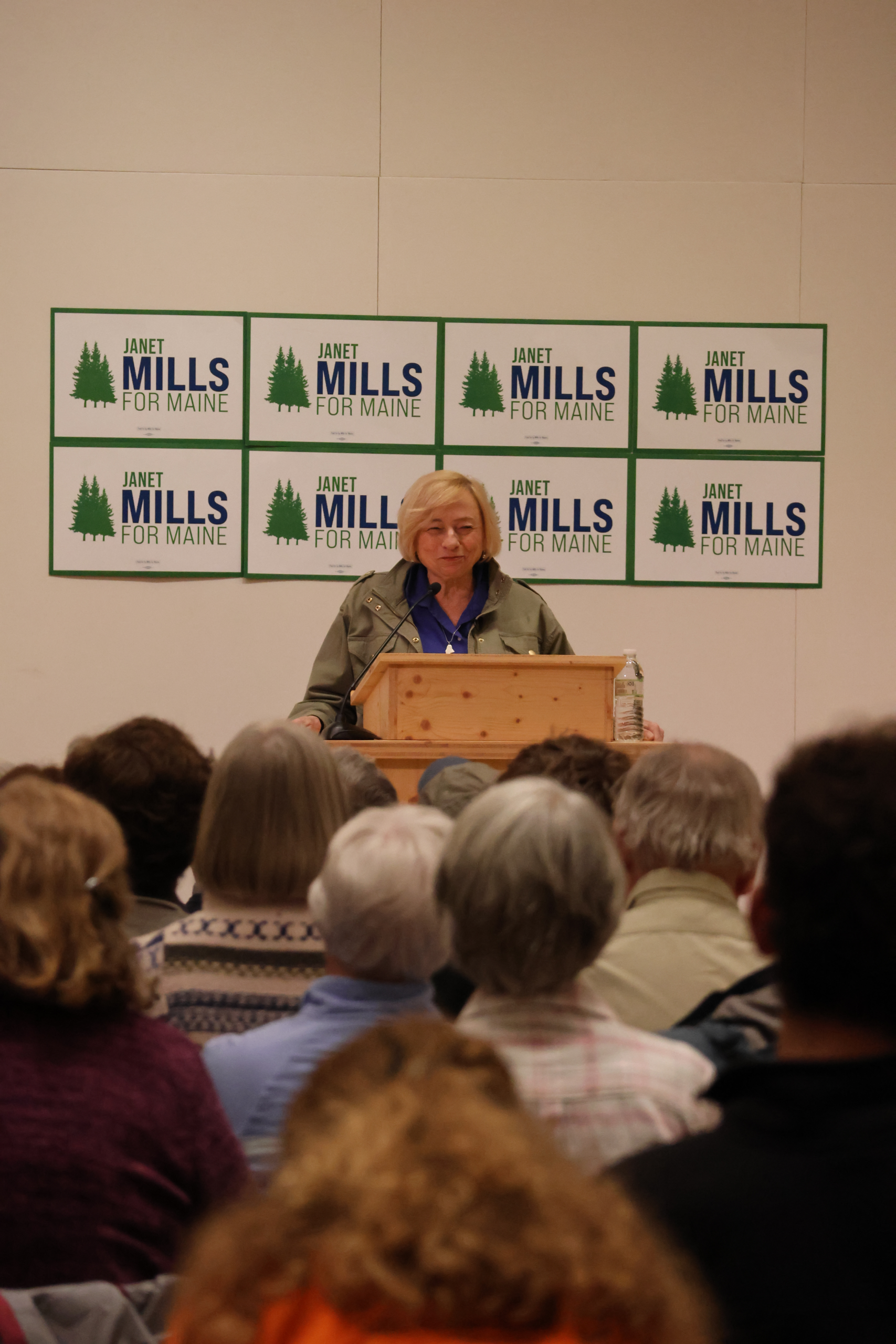 Addison Moore
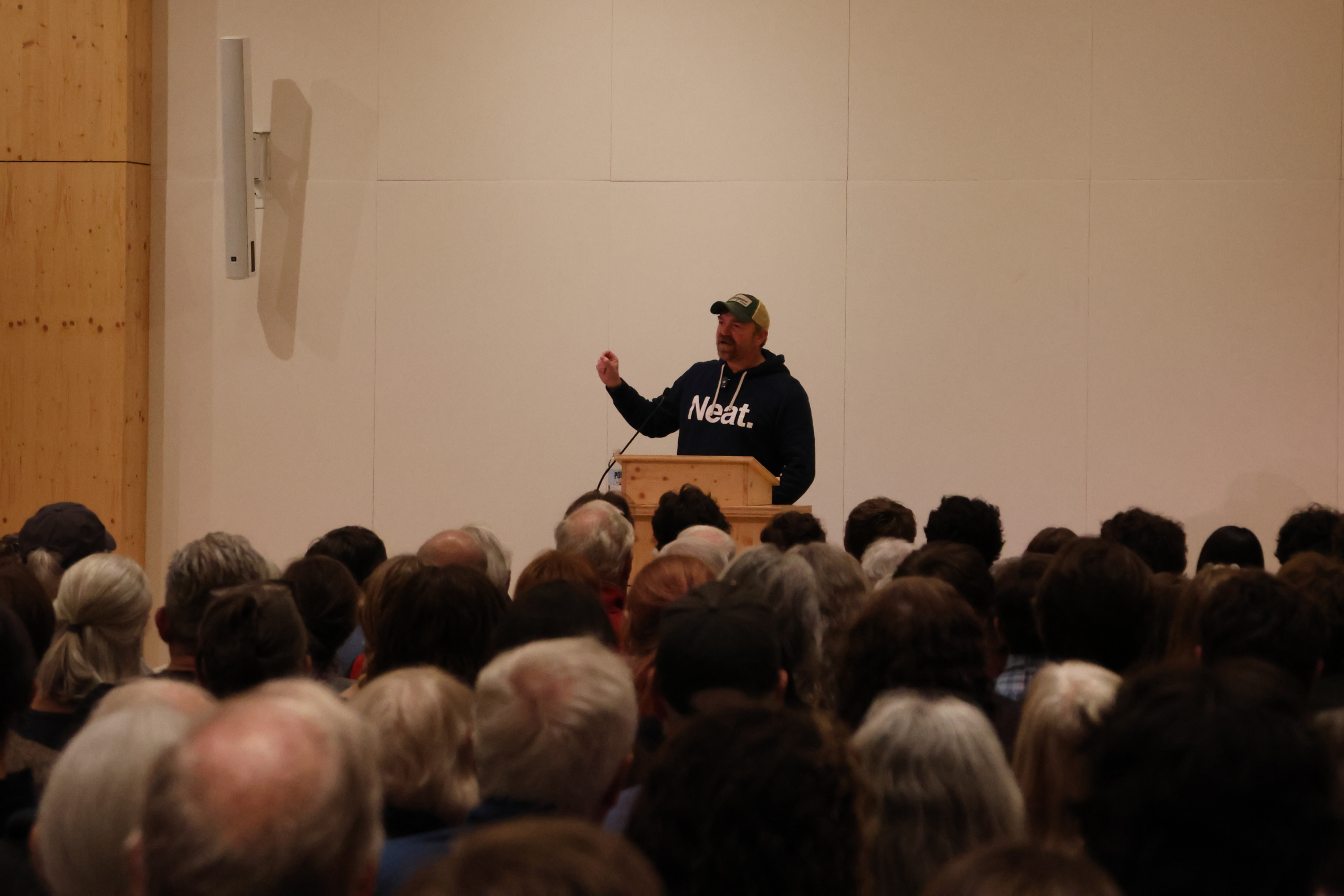 Addison Moore
On Tuesday and Wednesday, Democratic primary candidates for the U.S. Senate in Maine Janet Mills and Graham Platner respectively spoke at town halls organized by the Bowdoin Democrats. To audiences of students, faculty, staff and community members, Mills, the current Democratic governor of Maine, and Platner, a veteran and oyster farmer, discussed their platforms and visions of politics.
“We knew we wanted to do these types of town halls, because in the midst of such a competitive (and meaningful) Democratic primary, we hoped to be part of helping Bowdoin students become educated on their primary votes,” Maggie Zeiger ’28, co-president of the Bowdoin Democrats, wrote in an email to the Orient.
Zeiger said this event was a first for the club and that the planning process took some time, particularly in securing a venue large enough to accommodate attendees.
“To my knowledge, this is the first time something of this scale has been held by [the] Bowdoin Democrats, at least during my two years at Bowdoin,” she wrote.
Zeiger said she and another of the club’s co-presidents, Brittany Yue ’27, hoped the events would encourage students to participate in the Maine primaries—elections that usually have lower turnout than the general election.
“We hope students will be encouraged to cast their votes in the Maine primary and make an informed choice at the ballot box. At the end of the day, that was our primary incentive for having these town halls,” Zeiger wrote.
During her town hall, Mills argued that her policy accomplishments as governor would make her a compelling candidate, highlighting Maine’s progress in renewable energy and the establishment of free community college under her administration. She stressed how this would make her competitive in a race against Susan Collins, Maine’s current Republican U.S. Senator, whom the Democratic nominee would challenge in the general election this fall.
“I’ve worked toward fulfilling housing, childcare, tax reform,” Mills said. “I can say to [Collins], in any debate, in any public forum, I did this. I can go toe-to-toe with having delivered progress for Maine people.”
Mills also highlighted the campaigning experience she would bring to the general election.
“I’m the only person in this primary who’s actually run statewide for office,” she said. “I’ve done it. I know how to do it. I know how to get through it. They throw everything but the kitchen sink at me. That’s happened to me. I don’t care. I’m too old to care, frankly.”
Mills spoke about her experience with national politics as governor, highlighting a confrontation with the Trump administration last spring during which the U.S. Department of Agriculture froze federal funding for Maine school nutrition programs until a lawsuit brought by the state led a judge to order the funds unfrozen.
“I’m the only one in this campaign, in this primary and in this state who’s actually stood up to Donald Trump,” Mills said. “This was at a time when he was intimidating Columbia University. He was intimidating [Paul, Weiss, Rifkind, Wharton & Garrison LLP] and many other law firms to get them to do his bidding, and they were backing down.… We took him to court, and we won.”
Mills’ 25-minute speech was followed by a 20-minute Q&A session. Many students asked her questions about foreign policy issues, including several related to U.S. military support for Israel. In her answers, Mills indicated her support for a two-state solution to the conflict. When prompted by a student question, she stopped short of saying that Israel is committing a genocide.
“I recognize that October 7 was a horrific event, and that the things that have happened in Gaza are also horrific and unnecessary and cruel,” Mills said. “I believe the Israeli state has a right to exist, and the Palestinian people have a right to exist as well.”
An audience member recorded Mills’ answer about genocide in a video, which was initially shared by the journalist Ryan Grim on X and received more than 677,000 views at the time of publication. It was later reposted on Platner’s Instagram.
Mills closed the event with a broad appeal to voters.
“I can win this race, and I need to win this race. I’m not in it for personal gain whatsoever. I just want to save our country,” she said. “If we don’t save our country, we’re gonna lose it.”
The next day, Platner spoke for 45 minutes, followed by a Q&A session. He opened by speaking about the inaccessibility of politics.
“I think we need to fundamentally change how we do politics in this country. We have a political system that is entirely inaccessible to the average American,” he said. “It really isn’t a representative system. It’s a performance. It’s a theater that is conducted by elites.”
He spoke about his belief that political power is derived from two sources: organized money and organized people.
“The money is organized,” Platner said. “It always has been, and it always will be, until we take the lessons of our past and realize that it’s only through organizing people that we’re going to be able to build a future for working America.”
The example he cited for this was the current war in Iran, which he called “magnificently stupid.”
“I talk to Republicans and Democrats and independents. I talk to people that say they don’t care about politics. Everybody thinks that this is stupid and a waste of our time and our resources and our morality,” Platner said.
Platner also emphasized the importance of Medicare for All, a key tenet of his platform.
“We need Medicare for All, and it’s not just because it’s a moral thing to do. It’s not just because health care is a human right. It’s not just because we can afford to,” he said. “It’s because it makes our society better.”
In his Q&A session, Platner was also asked about his recognition of genocide in Gaza and what he would do to fight for the people of Palestine.
“We’re going to be remembered for a very long time as a nation that not only didn’t stand up against the genocide of the Palestinian people in Gaza but enabled it and funded it and ran political cover for it,” he said. “The only solution is one in which every single person in the region gets the exact same democratic rights and guarantees of security as everybody else…. I do think we as the United States need to use every single lever of power we have to bring about that outcome.”
Platner ended his time with a broader call for student involvement.
“If you don’t want to join our campaign, that’s okay,” he said. “Join Maine People’s Alliance. Join a food bank. Join a wood bank. It doesn’t matter what you do, but you have to do something.”
The Democratic primary will take place on June 9 to determine which candidate will run as the party’s nominee against Collins in the November general election.
Comments
Before submitting a comment, please review our comment policy. Some key points from the policy: