
Woody Holton discusses hidden history of American Revolution
November 6, 2026
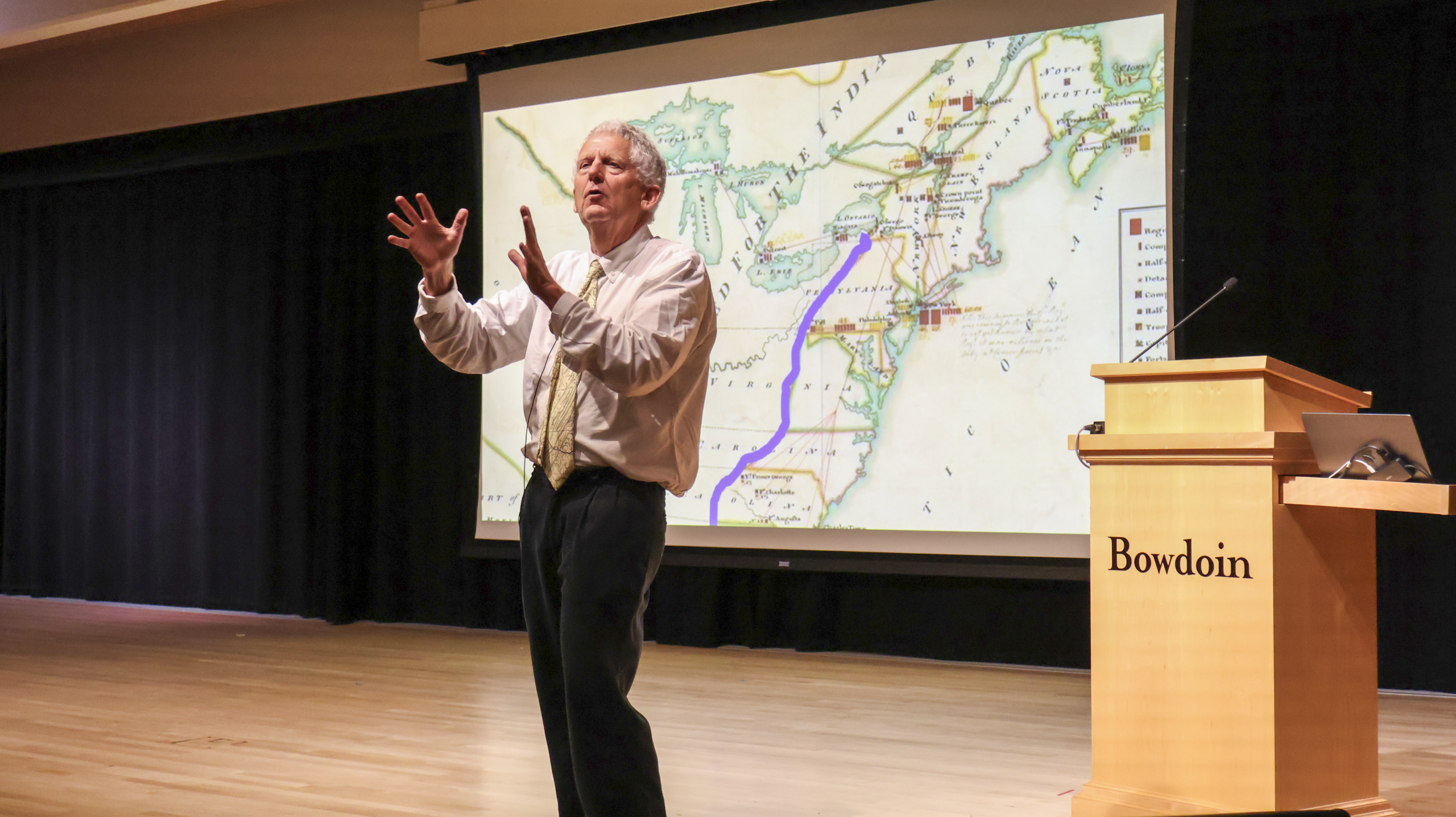 Abigail Hebert
On Wednesday evening, students, faculty and community members gathered in Kresge Auditorium to attend this year’s Alfred E. Golz Lecture, delivered by Woody Holton on his newest book, titled “Liberty is Sweet: An Integrated History of the American Revolution.”
Holton is a historian at the University of South Carolina and won the Bancroft Prize for his book, “Abigail Adams.” He has also written the books “Unruly Americans and the Origins of the Constitution” and “Forced Founders: Indians, Debtors, Slaves, and the Making of the American Revolution in Virginia.”
His book and his lecture centered on what he calls the “hidden history” of the American Revolution, particularly the influence of underrepresented groups on a large-scale movement.
“We don’t always talk about how the people we used to ignore, the 99 percent who were female or Indigenous or African American and so forth, how they affected the big decisions,” Holton said.
Holton’s work primarily focuses on the contributions of Native Americans, women and African Americans during the American Revolution. Rather than simply summarizing the oppression these groups have faced, he looks at the effect historically marginalized peoples had on early American history.
One of his examples concerned how Native Americans influenced the creation of the Proclamation Line of 1763.
“It was Native Americans who gave the British government an incentive to draw that big blue line, a proclamation line and therefore infuriate the colonists,” Holton said.
Holton explained how the line, which was used to separate Indigenous lands from white settlers, required funding from American colonists. In order to raise money, the British government passed the Stamp Act, which became a major catalyst of the Revolution.
“When you’re thinking about the Stamp Act, the last thing you’re thinking about is Indigenous people, and I’m saying to you, cut that out because there is absolutely a connection,” Holton said.
Holton went on to discuss the role African Americans played in the Revolutionary War. He described how the British policy offering freedom to enslaved people who joined the British Army pushed many Southerners to side with the Patriots.
“White folks in the South were furious at this British-Black alliance,” Holton said.
He went on to assert that the Battles of Lexington and Concord “provided the emotional push over the edge to get people to be ready for independence in the North.” However, he claimed that in the South, “it was that alliance between the British and the slaves.”
Holton also focused on women’s significant participation during the Revolutionary War. He asserted that women contributed heavily to the success of product boycotts. Though protest was considered “men’s work,” he explained how women in the Revolution were vital to the boycott of tea and cloth.
“They did, in fact, shame the men into doing the boycott,” Holton said.
Holton’s scholarship represents a portrait of women, African Americans and Native Americans that is often ignored in traditional accounts of the Revolution. However, this single-minded view of history appears to be changing.
Holton displayed a painting set during the American Revolution.
“If I was back in college in the 1970s, and you’d showed me this picture, and said, ‘What do these people all have in common?’ I would have said, ‘I’m not sure. Let’s see. They all seem to have those long white socks.’ And somebody now would probably say, ‘They’re all white men,” Holton said.
Holton’s work reflects an increasing awareness in the field of how certain groups have been overlooked in the field of history. When asked about the evolution of historical scholarship in regards to marginalized groups, Holton credited the importance of innovations.
“The most interesting books are the ones that are doing new things,” Holton said.
For Holton, shifting standards in historical analysis have also found roots in societal change.
“It’s related to what’s happening in society, too,” Holton said.
Absorbing new and inclusive historical ideas inspired Holton to focus on his current research, inspired by previous historians who influenced him.
“They were exploring a new frontier, the people doing Black history and women’s history, and later for me, Native American history,” Holton said. “They were just doing the more interesting work.”
Holton has brought a respect for scholarly innovation to his latest work. His goal when writing “Liberty is Sweet” was for “the book to look like every other book about the Revolutionary War that focuses on the war itself, but to not be that.”
“My theme is the impact of ordinary people on the elites,” Holton said.
Sam Robbins ’30, an attendee, spoke highly of Holton’s ideas.
“I really thought it was great to dive back into something that gets so skimmed over in history class in high school … just to dive deeper into topics that are taught with such conviction,” Robbins said. “This gives it so much more depth.”
Comments
Before submitting a comment, please review our comment policy. Some key points from the policy: