
“Tea with Harriet”: A Celebration of Harriet Beecher Stowe’s literary circle
October 16, 2026
 Ana Beatriz Lopes
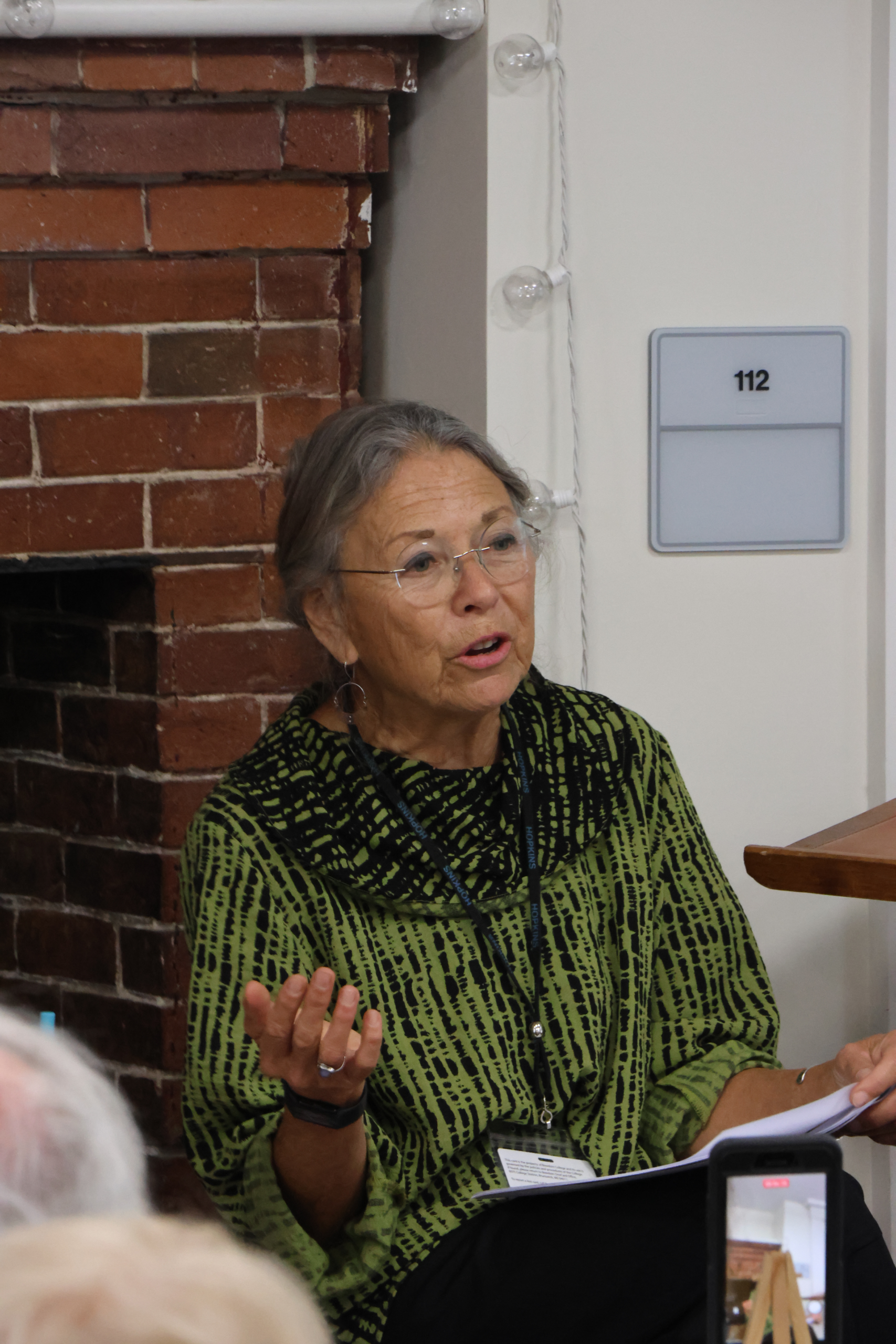
On Tuesday, students and community members gathered at the Harriet Beecher Stowe House to attend “Tea With Harriet,” led by docent Cathi Belcher. Complete with tea and home-baked goods, this monthly talk presents the audience with a slice of the fascinating life of Harriet Beecher Stowe, who wrote the sensational novel “Uncle Tom’s Cabin” in her Federal Street home.
This month’s talk, “Harriet and her High Fallutin’ Friends,” focused on Stowe’s extensive connections to other 19th-century literary giants, and how their correspondence influenced their respective writing processes. The inspiration for Belcher’s talk this month came from a request from a community member, who brought the novel “A Summer of Hummingbirds” to Belcher’s attention. In the book, Christopher Benfey explores the summer of 1882 and the intertwined lives of Stowe and other political and literary thinkers decades after the Civil War. Amazed by Stowe’s connections to notable figures such as Mark Twain and Emily Dickinson, Belcher went on a deep dive into Beecher’s social circles to find out more.
“There were so many people that [Stowe] came in contact with or knew or corresponded with.… But after I gave that talk…, I thought, ‘I wonder … who’s not listed in this book, that [Stowe] had contact with’ … and I found a lot more people,” Belcher said.
To open the talk, Belcher introduced writer Celia Thaxter, whose father, Thomas Laighton, opened the Appledore Hotel on the Isles of Shoals, a small cluster of islands just off the coast of Maine and New Hampshire. Thaxter shared Stowe’s passions for painting and gardening and later transformed the resort into an artistic hub which Stowe frequented.
“[Thaxter] had this literary and artistic salon where the who’s who of New England would come and stay and have discussions,” Belcher said.
Stowe hosted a writing salon of her own while writing “Uncle Tom’s Cabin,” drawing on the Bowdoin community around her as she wrote it first in installments for The National Era newspaper in Washington, D.C.
“On … Saturday night, [Stowe would hold a salon with her children, Bowdoin students, Bowdoin professors [and] some neighbors. They’d all congregate, she’d read the latest chapter and they would discuss it.… So, it was like a writing circle, and presumably based on the feedback she got, she might make minor edits and then send it off,” Belcher said.
Not everyone Stowe hosted in her home was a writer or scholar. In an interview with the Orient, Belcher explained how Stowe looked beyond her own position as a white Northerner to learn about slavery firsthand, visiting slave states, speaking to Underground Railroad conductors and sheltering people who escaped slavery in her Brunswick home.
“While she was at the Stowe House … she put up a fugitive slave overnight whose name was John Andrew Jackson,” Belcher said. “The night that he was there she spent a lot of time talking with him and trying to get some knowledge of what his experiences were.”
Stowe’s interactions with literary peers like American teacher and author Lucy Larcom demonstrated how dialogue often crossed social lines.
“They came from very different backgrounds. [Stowe came from] a very prominent theological family and [Larcom] wrote from poverty … in a mill town. But they shared social causes and literary circles,” Belcher said.
However, not all writers in Stowe’s circle were supportive. Jealousy and unequal commercial success colored Nathaniel Hawthorne’s opinion of Stowe and women writers in general.
“Hawthorne was kind of two-faced,” Belcher said. “He would praise women in public but he didn’t think much of women writers.… He says [in correspondence with his publisher, William D. Ticknor, in 1855], ‘America is now wholly given over to a damned mob of scribbling women. I should have no chance of success when the public is occupied with their trash.’”
Professor of Africana Studies and English Tess Chakkalakal noted that Stowe declined to help two formerly enslaved abolitionists, Sojourner Truth and Harriet Jacobs, publish their work.
“It did creep in there, that kind of class, racial … distinction,” Chakkalakal said. “But I think of her class, she was probably more welcoming, open and democratic than a lot of her peers.”
Tuesday’s talk highlighted both the cultural conflicts and collaboration in Stowe’s literary circle. As attendee Will Davis ’29 noted, the talk transformed the Stowe House from a historical exhibit to a space for critical inquiry of the complexities of Stowe’s life.
“I think what actually stood out to me most was how the people who attended interacted with it. I was pretty impressed with some of the questions that they had. I thought they were thinking pretty critically,” Davis said. “It’s easy to look at Stowe as this figure to put on a pedestal and to idolize, but she also was not perfect and had her flaws both from a class and race perspective.”
Comments
Before submitting a comment, please review our comment policy. Some key points from the policy: