
Daniel Blinderman speaks on legacies and lessons from authoritarianism in the South
October 16, 2026
 Ana Beatriz Lopes
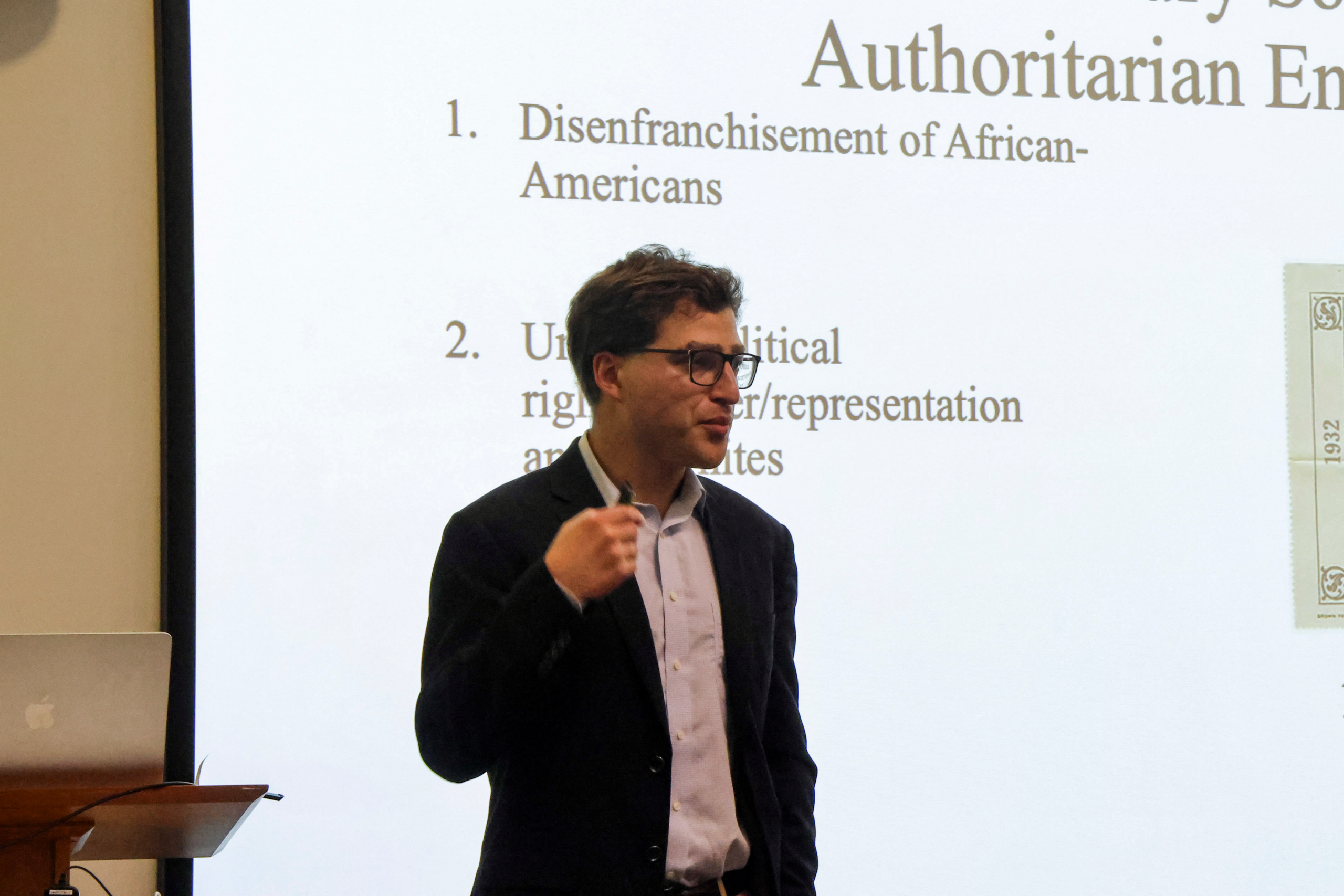
On October 5, University of Virginia Postdoctoral Fellow Daniel Blinderman gave a talk in the Visual Arts Center’s Beam Classroom titled “American Authoritarianism: Lessons and Legacies from the Origins of Jim Crow.” During this lecture, Blinderman compared the current state of American politics to the post-Reconstruction South while discussing the electoral mechanisms that different states in the post-Reconstruction South used to resist authoritarianism.
Associate Professor of Government Jeffrey Selinger, who brought Blinderman to the College, noted Blinderman’s use of strategies that are typically seen in the comparative politics field within the study of American political development.
“[Blinderman] shows a path forward on how to talk about questions of democratization and de-democratization in the United States … bringing theories that were developed by comparatives to the [study of the] United States and doing so very successfully,” Selinger said.
Blinderman began the lecture by comparing the January 6 insurrection to the 1874 Battle of Liberty Place in New Orleans.
“We actually do have experience with insurrections in [regime] changes,” Blinderman said. “They [typically] happen on the state, not at the national level. I’m hoping that by looking at the state level, we can discern some lessons about what authoritarianism looks like in the United States, how it develops … and just better understand our time.”
Blinderman argued that the South in the 20th century represented an undemocratic and authoritarian enclave, shown through the disenfranchisement of Black people, the inequality of power and representation between former slaveholders and poor white people, the concentration of political power in one party and governmental regulations on private space and associations. Though most of the states in the South ended up in such similar positions directly after Reconstruction, Blinderman found that, by contrasting Louisiana and South Carolina, institutional mobilization and change among poor white farmers charted electoral resistance to authoritarianism in the future.
“The puzzle of the authoritarian South’s founding [and] development is that these states and these enclaves, these regimes, are pretty similar, right? They have similar legacies of slavery, similar political economies, reliance on agriculture … and they’re governed by similar types of elites,” Blinderman said.
Blinderman found that electoral resistance to the authoritarian South existed in four steps: agrarian mobilization, elite coercion, institutional settlements and an eventual policy legacy.
Louisiana and South Carolina, importantly, had different developments of agrarian mobilization against the encroachment of industry. Whereas South Carolina had a largely pluralized agrarian mobilization still dominated by white supremacists, the agrarian networks in Louisiana broke from the sugar planters and other plantation owners of the Democratic party and ended up with a more biracial and unified people’s party. Blinderman visualized this difference through electoral maps that demonstrated that more people in Louisiana participated in elections where this agrarian third party was available, even though it ultimately lost.
“This area up here is what’s called the Louisiana upcountry, [with] a lot of majority white parishes, areas that were not particularly invested in the slave economy,” Blinderman said. “They are pulled away from the Democratic party by biracial lines. But South Carolina, that area of the state stays Democratic.”
Following this agrarian mobilization, the government and local elites attempted to bring these parishes back into the Democratic fold through taxation. Essentially, Blinderman found that land valuations for areas voting for Republican candidates significantly increased compared to areas voting for Democratic candidates. However, he argued that despite this retaliation by the elite and the eventual defeat of these agrarian institutions, they were able to secure meaningful policy gains.
“These agrarian mobilizations did not prevent authoritarian rule, not by a long shot.… Specifically, African Americans did lose all their political rights,” Blinderman said. “But there are these concessions they secured in the defeat that I do think are analytically meaningful.”
In Louisiana, these concessions included a better balance of power in apportioning, where legislative seats rich landowners held reduced over time, while in South Carolina, malapportionment largely increased over the same time period.
Louisiana also saw the rise of an expanded local government, a strong railroad commission and governor Huey Long, who spearheaded a funding redistribution between rich and poor white schools. Though Long later faced potential impeachment, the populist support he had from both state and independent institutions kept the impeachment from being successful. In comparison, similar left-leaning figures in South Carolina did not have the institutional backing to change school funding.
Blinderman concluded that resistance to authoritarianism must be collective, cut across class and racial lines and, critically, include institutional backing. He also emphasized the need to preserve the independence of the current Democratic party, as well as the necessity of bringing in sympathetic elites to support it. In an interview with the Orient, Blinderman further explained what a cross-cutting issue in modern politics could look like.
“Tariff policy is a thing that is causing people who maybe want to vote one way, to vote another way, right?” Blinderman said. “Part of the lesson is that trying to find cross-cutting political issues that can appeal to a broad range of people’s economic interests can be useful in terms of building a coalition that can at least try to resist authoritarianism.”
Comments
Before submitting a comment, please review our comment policy. Some key points from the policy: