
Annette Gordon-Reed discusses historical and future applications of the Declaration of Independence
October 16, 2026
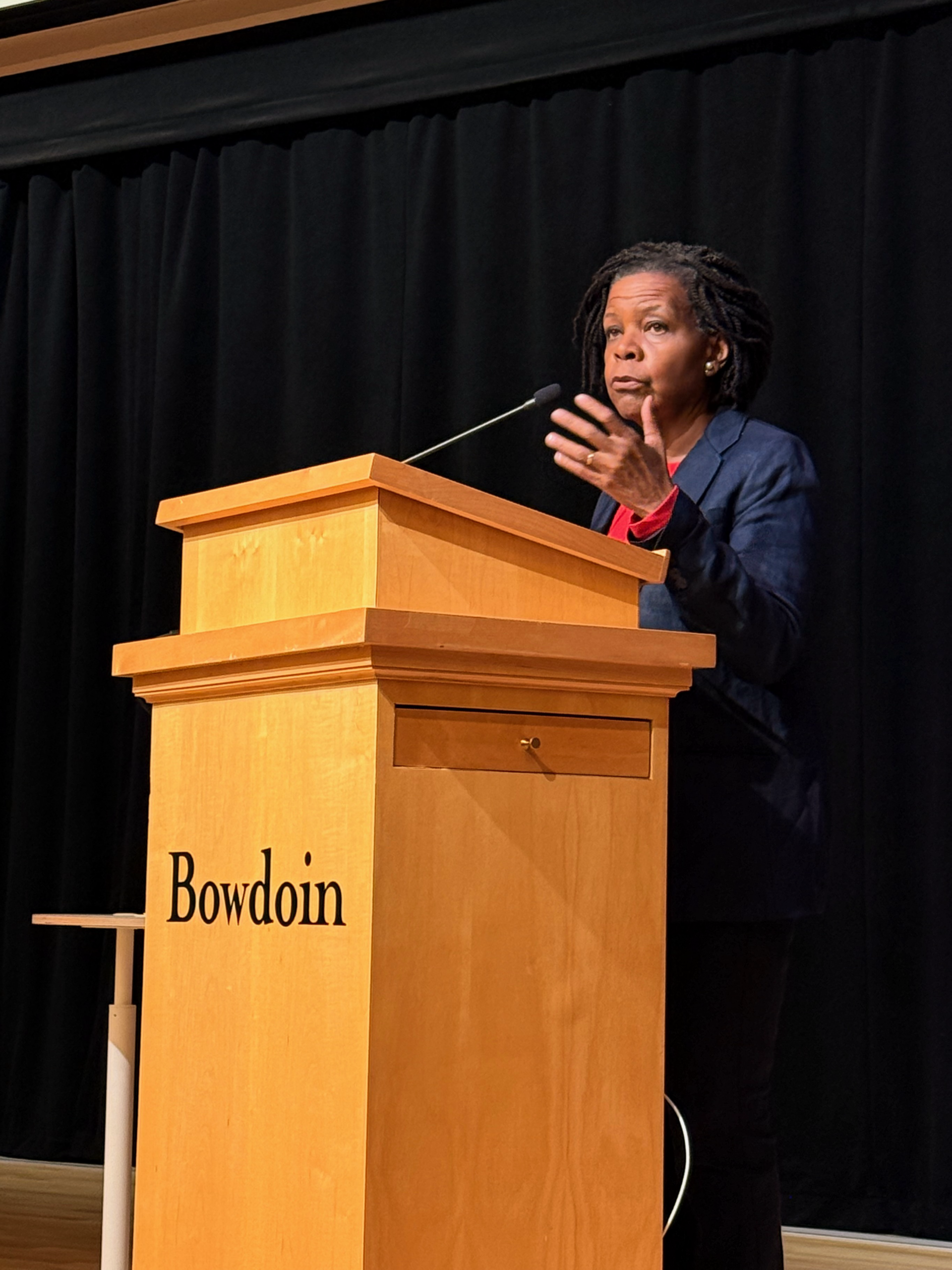 Sadie Smith
On the afternoon of Thursday, October 8, students, faculty and community members gathered in Kresge Auditorium for the third Viewpoint Exchange talk of the semester. Hosted by the Office of Inclusion and Diversity, the talk welcomed guest speaker Annette Gordon-Reed, historian and professor of history at Harvard University. Gordon-Reed is noted for her scholarship on Thomas Jefferson, with her 2008 book “The Hemingses of Monticello: An American Family,” winning the National Book Award and making her the first African-American winner of the Pulitzer Prize for History.
Isabel Marangoni ’29 welcomed Gordon-Reed to the stage by sharing a quote from The New York Times, which labeled Gordon-Reed as “one of the most important American historians of all time.”
To begin, Gordon-Reed shared her perspective on what the Declaration of Independence represents for the United States and how it continues to shape the ways in which our society acts today.
“The Declaration speaks truths that we can learn from, and because the nation was founded with this document, it’s an integral part of who we are, and we should take it seriously,” Gordon-Reed said.
Gordon-Reed began by explaining how the notion of equality, stated in the Declaration of Independence, is the basis for transforming American society. She provided several examples of this theory throughout U.S. history.
Abraham Lincoln specifically referred to the Declaration during the Gettysburg Address, stating that the United States is “dedicated to the proposition that all men are created equal.”
“By the time we get to Lincoln, [the Declaration is] useful to him because he has to put the country back together again, and he has the perfect document for saying the things that need to be said about what had to be done,” Gordon-Reed said.
Gordon-Reed further explained how Supreme Court Justice Thurgood Marshall’s efforts to dismantle the Jim Crow laws during the 1950s referenced the Declaration.
“[Marshall] used this notion of equality before the law to strike down, to destroy the system of Jim Crow and of segregation,” Gordon-Reed said.
Along with using the values in the Declaration to transform society, Americans have also used the promises of the document to advocate for their individual freedoms.
“Marginalized people can use the Declaration [and] what it stands for to advocate for their rights,” Gordon-Reed said.
Gordon-Reed referenced the Seneca Falls Declaration, in which suffragists took the language of the Declaration of Independence, changed it to include women and used that revised version to argue for women’s equality.
Gordon-Reed then shared her perspective of what equality means in the Declaration.
“Human beings are equal, not in the sense that everybody is equally talented, everybody can sing, you know, everybody can dance.… [Rather,] it’s the idea that you’re equal in your worth as a human being,” Gordon-Reed said. “This is the promise that the women at Seneca Falls were given, and why they took up the Declaration as a statement about America’s purpose and what it means to be an American.”
While the Declaration continues to function as the “American creed,” as Gordon-Reed calls it, it also acts as the basis for the American identity.
“Many Americans were descended from people who came at the end of the 19th century and the beginning of the 20th century, and the Declaration, as well as the Constitution, were explicitly used to teach them about what it meant to be American,” Gordon-Reed said.
However, not everyone accepts this idea of what it means to be American.
“There are other people who say no, that’s not who we are. [That] is a fanciful notion. It’s about blood. It’s about religion. It’s about community,”
Comments
Before submitting a comment, please review our comment policy. Some key points from the policy: