
Preserving Bowdoin’s Polar Past with Genny LeMoine
November 6, 2026
 Sadie Smith
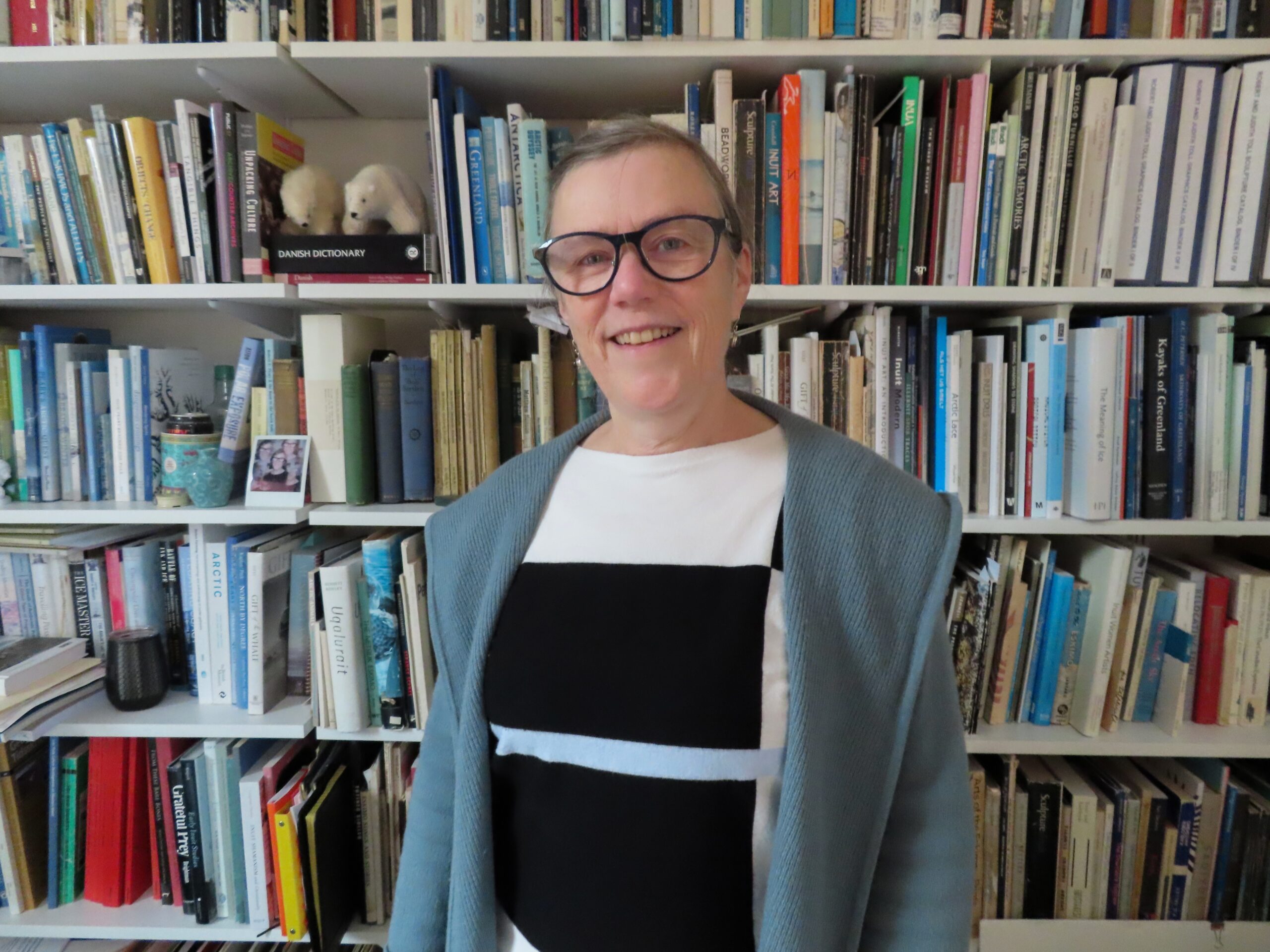
With the Arctic Studies Center’s dedication in 1967 and establishment in 1985, the Peary-MacMillan Arctic Museum is one of the only museums in the country entirely dedicated to Arctic studies. For many years, Genny LeMoine has been the lead curator and registrar, managing its thousands of artifacts and choosing what to showcase in the exhibit spaces.
LeMoine is originally from Canada, and earned a graduate degree from the University of Calgary where she specialized in Arctic archaeology. She was a visiting professor at the College for a couple of years until the former Arctic Museum curator left for another job, when LeMoine applied for the role.
“I transitioned from thinking I was going to be a teaching faculty to being the curator here,” LeMoine said. “But it’s been a great position for me. I’ve been able to continue to do my archaeological research, but also to expand into all other kinds of areas of Arctic research based on our collections.”
As both a curator and registrar of the Museum’s collections and exhibits, LeMoine juggles many hats in her day-to-day work.
“It’s highly variable, which is one of the things that makes it easy to keep doing a job like this … that you do the same things multiple times, but it’s always a little bit different,” LeMoine said. “There’s also managing the collection … The registrar is a person who’s responsible for the care of the collections, [so] that means managing a big database, cataloging things, getting them out onto the web, all those kinds of things.”
LeMoine noted that, given the museum is one of only a handful of Arctic museums in the country, many people reach out to donate artwork or artifacts.
“This photographic archive, [which] will be the subject of our next exhibit that opens in early February, are [from] two photographers who’ve been working and doing photography in the Arctic since 1971, and they wanted to sell their complete archive,” LeMoine said. “It took many years of working with the development office to find enough money to purchase [the archive], but we had a very generous donor [who] gave the core gift [so] that we could purchase it. That’s the first time we’ve had that kind of an acquisition, but it’s very exciting and the exhibit’s gonna be amazing.”
When researching, curating and displaying art and artifacts of an Indigenous and threatened area, ethical questions arise. LeMoine assures that in every exhibit, the manner in which her team receives and purchases Inuit artifacts is in the most respectful and responsible way.
“We try to use direct quotes so people know that they’re hearing from local people. We try to work as much as we can with people in the community, but there [are] various challenges,” LeMoine said. “We are doing a screening with an Inuit, luckily, we convinced [the director] to cross the border from Canada. So we try as much as we can, but it’s very expensive to bring people from the North.”
This screening will be of the film “Nirilaurta: Let Us Eat,” accompanied by a discussion with the writer and director, Malaya Qaunirq Chapman from Iqaluit, Canada, on November 10 at 7 p.m. in Kresge Auditorium.
The museum is only in its third year in the John and Lile Gibbons Center, so LeMoine has many long-term goals and projects for her team, as well as plans for how to use the space moving forward. One of her main ideas is to better include Inuit and other Indigenous artists, curators and collaborators in the museum’s exhibits and research.
“We would very much like to have more direct indigenous collaboration on the exhibits, and that’s something we’ve been actively trying to raise funding for, because you need money to pay co-curators,” LeMoine said. “That’s something that we’ve been working on for many years. We’re getting closer to being able to do that. It would be ideal if we had a regular fellowship or something like that for indigenous curators to work on exhibits with us.”
The Arctic Museum’s two current exhibits are “Tip of the Iceberg: A Selection of Recent Acquisitions” and “Mamaqtuq! It is Delicious!: Traditional Foods of the North”, the latter of which will close in mid-December.
“I think everybody should come and look at the exhibits,” LeMoine said. “There’s lots of great stuff up there.”
Comments
Before submitting a comment, please review our comment policy. Some key points from the policy: