
Adebunmi Gbadebo explores legacies of slavery and historical repair in artist talk “Buried Beneath the Clay”
October 16, 2026
 Sirui Wang
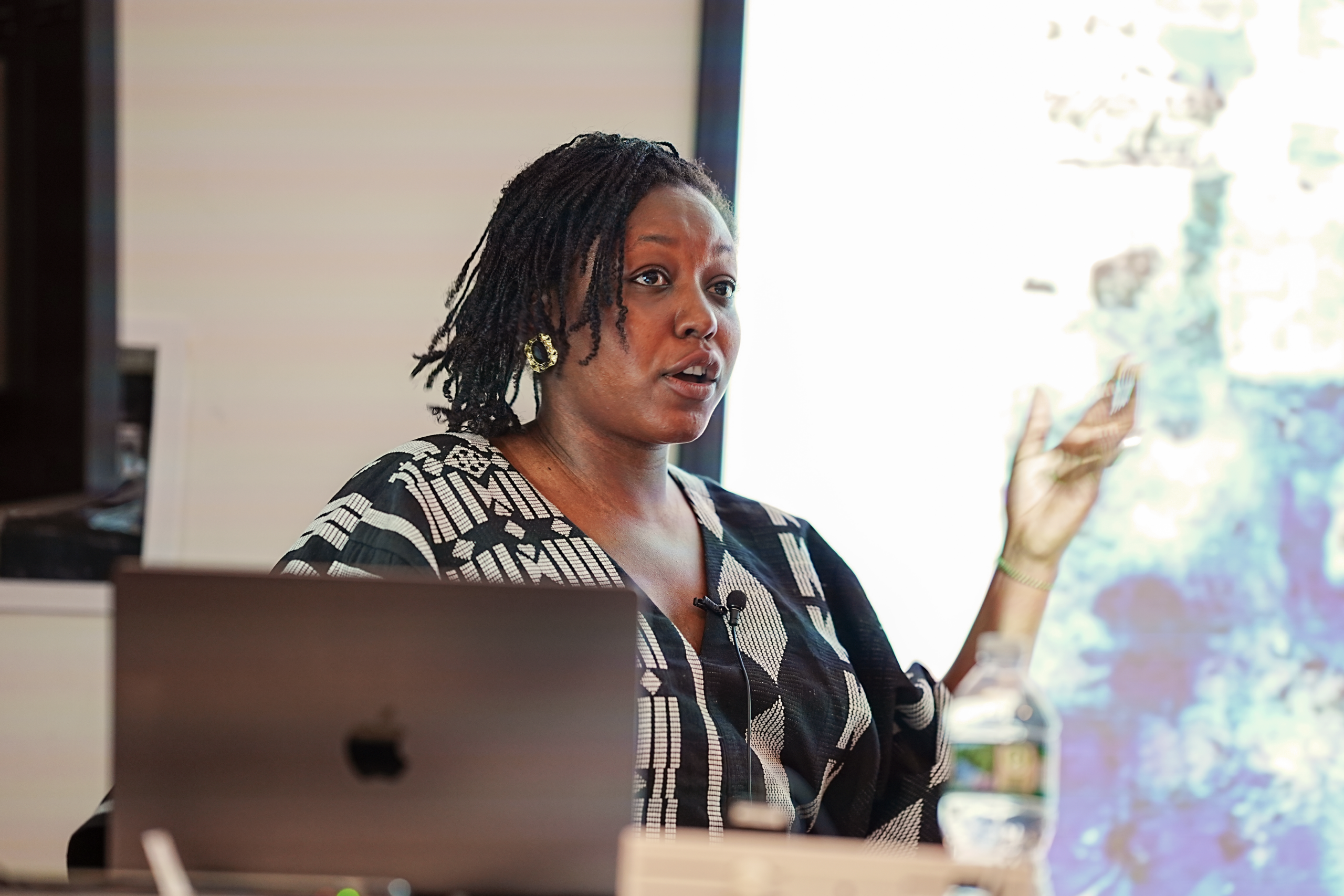
Last Wednesday, the Bowdoin College Museum of Art (BCMA) brought Philadelphia-based artist Adebunmi Gbadebo to campus to speak on her artistic practice and inspirations. The talk spotlighted her ceramic vessel “Ellis Sanders” (2025), a recent addition to the BCMA collection. The piece is on display for a limited time in the Boyd Gallery and will be featured in the upcoming exhibition “Making and Mending: Grief and Repair in the Atlantic World” curated by Andrew W. Mellon Postdoctoral Curatorial Fellow Anne Cross.
Using the iron-rich soil of the True Blue Plantation in South Carolina, where Gbadebo’s maternal ancestors were enslaved, Gbadebo created “Ellis Sanders” using traditional Nigerian and Cameroonian coiling techniques before studding the vessel with grains of California Gold rice. The piece was part of a series of vessels titled after the artist’s ancestors from her 2025 solo show “Watch Out for the Ghosts.”
Cross opened the talk by introducing Gbadebo’s recent work and past exhibitions, highlighting the artist’s personal connection to Maine—both as her mother’s birthplace and as the site of her current artist residency at the Indigo Arts Alliance in Portland.
Gbadebo began by reflecting on her arts education at a predominantly white institution, noting how the Eurocentric model of art history she was taught erased non-white histories. She pinpointed her use of materials rooted in her culture and personal history as a turning point in her artistic journey, beginning with Black hair and broadening to include plantation crops like indigo, cotton, rice and coffee.
“There comes a point, especially as a Black student, where you realize … that the history of art is really this history of white supremacy,” Gbadebo said. “And because that history was constructed mostly through the material paint, I even felt a disconnect to this material. So I went on this search: What material did I feel was connected to me as a person, as a Black woman, as an artist?”
Gbadebo also began to interrogate her relationship to America by investigating her family lineage on the True Blue Plantation. The artist highlighted how the preservation of history by the enslaver erased her ancestors’ humanity, both in historical records and on the plantation site itself.
“I remember thinking, there was this preservation of the enslaver, right? They still own the land; they’re still profiting from the land. Their names were the roads that I was driving on to get to these spaces, but where was the presence of my ancestors?” Gbadebo said.
Although the plantation held no trace of the enslaved people who created its wealth, her ancestors’ legacy was preserved through their burial grounds in the nearby forest. In contrast to the fields razed by plantation owners, Gbadebo noted that enslaved people would use the woodlands to engage in worship and spiritual practices, house maroon communities and bury their loved ones.
“I remember thinking that although there [are] still these erasures or absences … this history is all in this earth,” Gbadebo said. “My little ancestors, their bodies, their flesh, are all in this red clay.… That in fact, this earth, this physical soil is a repository of memory.”
Since her initial visit, Gbadebo has visited the burial grounds twice a year to dig up hundreds of pounds of soil for her ceramic vessels. She underscored the importance of digging in an ecologically and spiritually conscious manner, noting that she consulted anthropologists and archaeologists on how to avoid disrupting graves and ecosystems.
Gbadebo concluded the talk by emphasizing that the histories her artworks confront have persisting legacies, with Black workers continuing to dominate plantation labor today. Highlighting the importance of being witness to painful histories, Gbadebo raised the issue of the recent rise of data centers on former plantations.
“I’ve been doing a lot of research about the implications when descendants or Black people are removed or pushed off of these plantations and ancestral lands,” Gbadebo said. “I don’t think it’s a coincidence that the birthplace of slavery here in this country is now the birthplace of data centers.”
Beyond reclaiming the land through her artistic process and material, Gbadebo also plans to purchase two acres of True Blue Plantation to create her own artist residency, extending the work of Indigo Arts Alliance and similar institutions that provide space for Black and brown artists to create in community.
Gbadebo’s consideration of repair, not only in her ceramics and papermaking practice but also through her community work, informed Cross as she thought about the “Making and Mending” exhibition.
“Gbadebo’s work was kind of an entry point to thinking about the past and histories of enslavement, but then making something new out of it,” Cross said. “The fact that she’s literally taking the clay and then producing this work that is really putting her ancestors back in space … helped me articulate a lot of the ideas I was interested in about historical repair.”
Reflecting on the artist talk, Cross highlighted how the deep archival research involved in Gbadebo’s practice could inspire students across a variety of disciplines.
“I would invite everyone to consider how Gbadebo’s work might relate, especially to Bowdoin’s legacies of enslavement and abolition and a new model of care and approach to history that could be expanded to other areas,” Cross said.
Gbadebo’s talk was recorded and will be accessible to the public online.
Comments
Before submitting a comment, please review our comment policy. Some key points from the policy: