
NPR’s Peter Sagal speaks on finding humor in the news in Viewpoint Exchange finale
April 23, 2026
 Abigail Hebert
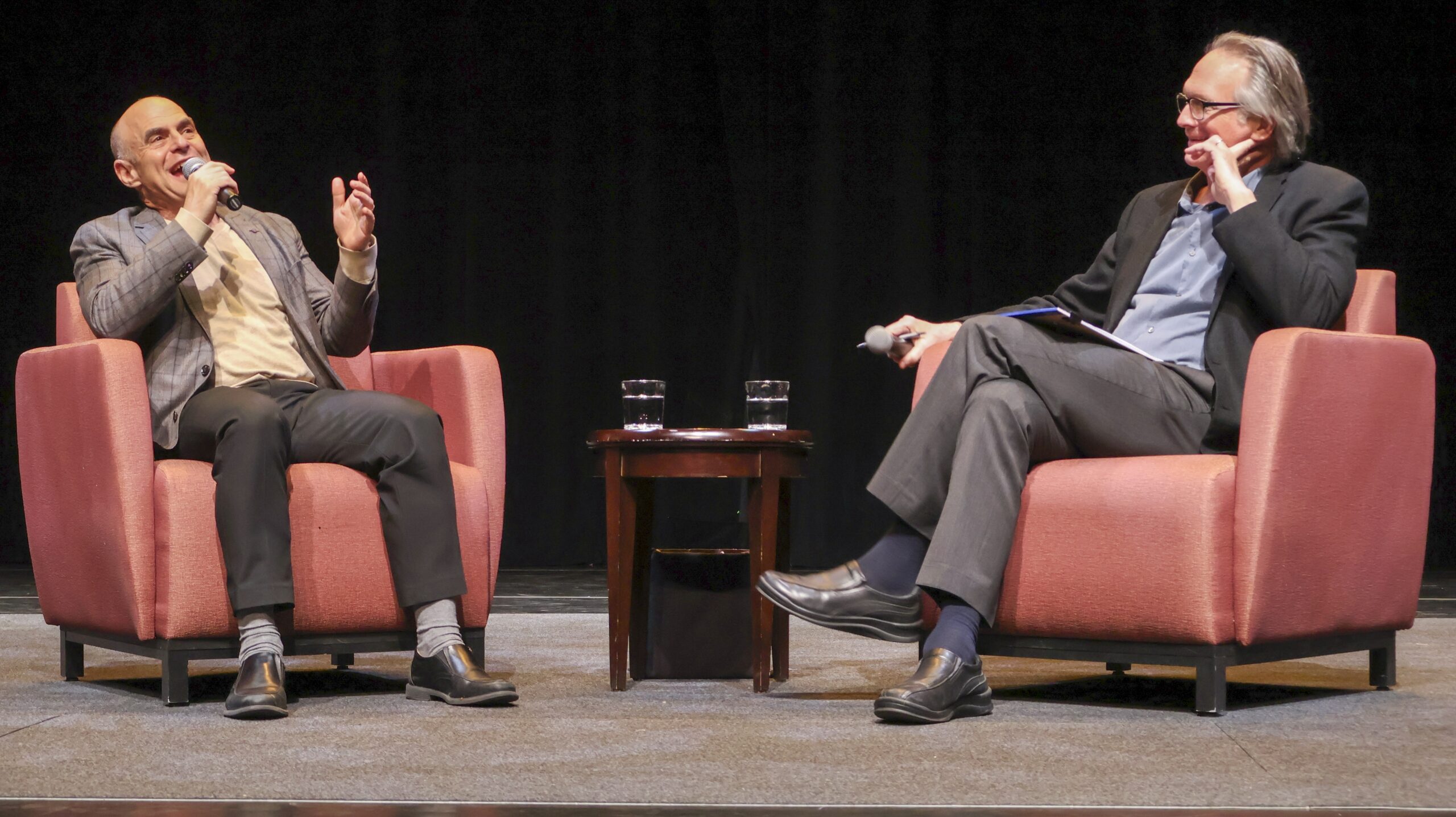
Laughter filled Pickard Theater on Tuesday night as Peter Sagal, creator and host of NPR’s “Wait Wait… Don’t Tell Me!” spoke on political satire, news media and the U.S. Constitution for the final lecture in the Viewpoint Exchange speaker series for this academic year. Sagal was interviewed by Associate Dean of Curriculum and Professor of History Dallas Denery.
Denery began by admitting that he’d never interviewed anyone before, prompting advice from Sagal.
“I’m glad they started you off with somebody insignificant,” Sagal said. “Here’s the thing you may not know, since it’s your first time. It’s important that I spend about two minutes just talking about nonsense and bullsh*t that nobody needs to know about, remember, because they’re all staring at me, going, ‘Holy sh*t. That’s what he looks like.’”
Sagal explained how the goal of “Wait Wait… Don’t Tell Me!” has evolved since the program’s inception and how he has come to see the show’s role in listeners’ lives.
“It’s a privilege and a pleasure to give people a break from all that. Back in the day, in the ‘before times’ when political division seemed bad, we liked to think of ourselves on our show as a place where everybody could enjoy [the news],” Sagal said.
However, he noted that this all changed after 9/11. Finding humor in current events, he said, hasn’t been as easy since. He even worried that the show would have to end.
“It was clear to us in our little office at Navy Pier in Chicago that the news would never be funny again because the news had just leapt out of the sky and killed 3,000 people. How are you going to make fun of the news?” Sagal said.
Sagal recounted some of the many guests he’s had on the show—including former Secretary of the Treasury Janet Yellen and Gene Simmons—and said that its format allowed for conversations with guests who wouldn’t agree to interviews from more traditional news outlets.
“People come on the show because they enjoy being silly. And there are a lot of people who don’t get to be silly professionally and would like to be for a moment,” Sagal said.
While “Wait Wait… Don’t Tell Me!” is based in Chicago, it is recorded live at venues across the country. As a result, Sagal has engaged with a wide range of audiences, though he noted these are fairly self-selecting audiences, leaning politically liberal. He stressed that there’s a charm to performing in a more conservative area of the country.
“Especially if you live in a place like Oklahoma City or Des Moines…, when we show up, it’s like a visit from the home planet, in a weird way, because the general cultural tenor of their place does not often provide them with us. They’re extremely grateful to see us,” Sagal said. “It’s even better sometimes to go there than to go to someplace like Portland, [Ore.]”
Despite this sense of community, he also recognized the dangers of today’s media landscape, comparing it to when everyone received the same information from the three major news networks of the 20th century.
While Sagal sees some benefits in having access to a diversity of media channels and viewpoints, he expressed concerns about their ability to further disseminate misinformation.
“There [are] no gatekeepers. Lots of people have access, and they can present themselves. I mean, the flip side of that, too, is a lot of nonsense can get said, and in fact, a lot of, to use the philosophical, technical term, bullsh*t gets spoken, and worse, simply lies,” Sagal said. “So a lot of these people are accepting the craziest stories.”
Sagal also discussed his documentary work on the U.S. Constitution and its value to unity in the country today, when so many people sort themselves into partisan media streams.
“The idea of constitutional governance … is the idea of narrative, the idea of an encompassing story that we can all agree on, which is very, very, very important,” Sagal said.
Sagal finished his talk by elaborating on some running advice he gave in his book “The Incomplete Book of Running.” A runner of 16 marathons, Sagal told readers to never wear headphones while running.
“We spend our days as if we were desperate to keep any thought of our own from emerging from our heads,” Sagal said. “We’re constantly inputting other people’s thoughts. You’ve got to stop for a minute, for 20 minutes, for half an hour, and just let whatever’s been piling up inside there like a clogged toilet come out. You have to see what you’re thinking. You have to let air in your ears and clean sh*t out, because otherwise you’ll forget who you are, and otherwise you will never put together two ideas at the same time.”
Comments
Before submitting a comment, please review our comment policy. Some key points from the policy: