
Afghanistan teach-in grounds global conflict in personal experience
April 17, 2026
 Abigail Hebert
On Tuesday afternoon, students and community members gathered in Ladd House for a teach-in organized by Amnesty Bowdoin, focused on the history of Afghanistan and current geopolitical dynamics in the region. The panel was led by Associate Professor of Government Barbara Elias and Visiting Assistant Professor of Government Muhammad Omar Afzaal, alongside students Ayezah Dar ’26 and Sharifa Hunarwar ’28.
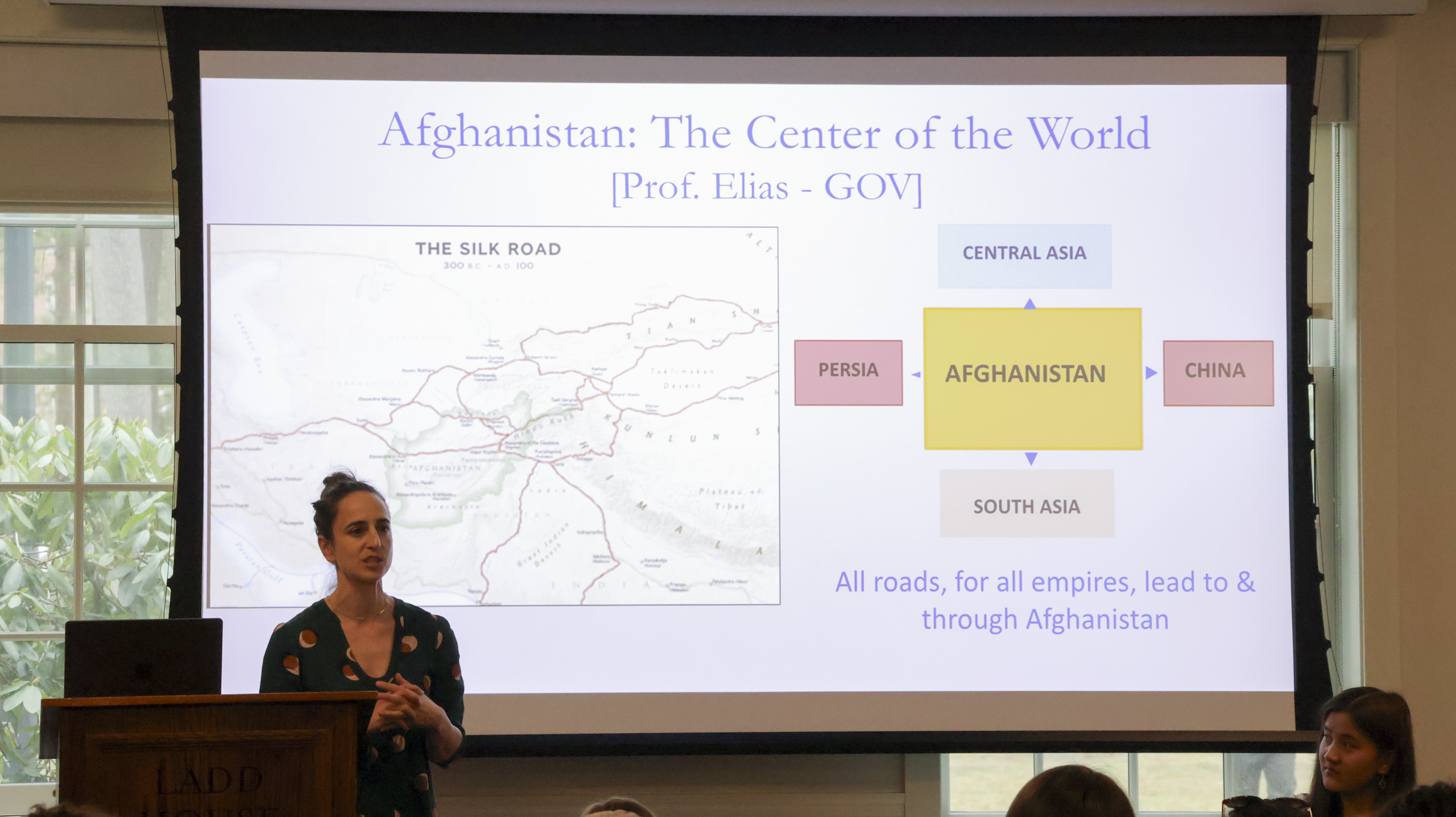
Before any discussion of war or the Taliban, Elias opened by arguing that Afghanistan must be understood in its cultural and historical context. As a civilization at the crossroads of Persian, Central Asian, South Asian and Chinese empires, it has been a hub of global trade long before any modern conflict defined its reputation in the western hemisphere.
Elias began studying Afghanistan as a college student in the aftermath of the 9/11 attacks. Even then, she noted that she foresaw the failure of American intervention.
“The fundamental lack of curiosity about Afghanistan in terms of culture, people, language and history was going to cause massive strategic mistakes in the war,” Elias said.
Afzaal, who grew up in Karachi, Pakistan and whose family has roots in Quetta—near the Afghan border—spoke about one of the region’s most consequential relationships: Pakistan and Afghanistan. The two countries have been locked in border and proxy conflicts since Pakistan’s founding in 1947, with consequences for civilians.
“The border is the key to the survival of the Afghan economy because it provides, whatever the regime is, whether it’s Taliban or not, access to the seaport of Karachi,” Afzaal said.
For decades, Pakistan covertly backed the Taliban as a way to maintain influence over its neighbor. The Taliban, a Pashtun Islamist movement that first controlled Afghanistan from 1996 to 2001 before being ousted by the U.S. invasion, retook the country in August 2021 following the American withdrawal. Afzaal explained that a fundamental misunderstanding of the Taliban’s structure defined America’s approach from the start and was a key reason for the mishandling of the conflict.
“[The Taliban] is typically considered what political science calls a polycentric organization, meaning there’s lots of different hubs of influence within the Taliban,” Afzaal said. “That was one thing that the U.S. found very hard to understand as it attempted to combat the Taliban, because … [the Taliban is] a plural word. It’s not a single thing. It’s kind of a grouping of different organizations under one kind of organization.”
Dar grew up between two worlds. Her maternal grandmother is Pashtun and her aunt is a second-generation Afghan refugee from Peshawar, Pakistan. Her research examines how Afghan women navigate life and the fight for girls’ education under a government that she said is far more fragile than it appears.
“The Taliban, in many ways, is weak. It’s [an] extremist group that has recently moved to being a formal government,” Dar said. “They do not have public support, so they need to find ways to solidify themselves and legitimize themselves simultaneously.”
Hunarwar grew up in the Hazara-majority province of Daikundi, in central Afghanistan, and moved to the capital city of Kabul in 2021 to prepare for university entrance exams with no plans to leave the country. The Taliban’s return in August of that year took her by surprise.
“We didn’t really know. We were not expecting the Taliban to come back. We thought that era was over. We were studying, hoping to go to schools in Afghanistan, improve our lives there and hopefully make Afghanistan better,” Hunarwar said.
She explained it was not the first time Afghanistan’s future was decided without Afghans.
“People didn’t really have a representation or a voice in all the changes that would happen in Afghanistan. Whether it was [the] U.S. [deciding] to come take over the country, or the Taliban who took over through force without any democratic process.… People have always been left out of this decision but always [have been] impacted the most,” Hunarwar said.
Taliban control is not uniform across the country. In the Pashtun-dominated southern and eastern regions, restrictions—especially for women—are near total. In central Afghanistan, where Hazara and other ethnic minorities live, the Taliban’s presence is slightly reduced and the laws are less strictly enforced. But for girls in the country, one of the most significant losses has been access to schooling, according to Hunarwar.
“Whatever the international community decides to do with the Taliban regime, people just want [girls’ schools] to reopen as soon as possible,” Hunarwar said.
Janie Lytle ’27, who is currently a student in Afzaal’s “Domestic Politics of International Relations” course, said that she left the teach-in with a better understanding of how the Taliban actually operates on the ground, especially as explained through personal perspectives.
“I really liked that it was [Dar and Hunarwar] who were giving their own stories.… I really didn’t know the breakdown of how policy would affect different regions in Afghanistan,” Lytle said. “I was very much not aware of how the Taliban has different efficacy in its spread throughout Afghanistan.”
Comments
Before submitting a comment, please review our comment policy. Some key points from the policy: