
“The Sacred Multiplied”: Lecture by Dr. Areford studies 15th-century printmaking as a tangible method of artistic communication
November 6, 2026
 Abigail Hebert
On Wednesday evening, students, faculty and community members gathered in the Visual Arts Center (VAC) to hear a lecture from Dr. David Areford, an acclaimed art historian and professor at the University of Massachusetts Boston specializing in early European printmaking.
The lecture was co-hosted by the Bowdoin College Museum of Art (BCMA) and the Hastings Initiative for AI and Humanity, the first in a series of three talks on creativity and technology sponsored by the Hastings Initiative. Professor of Art History Stephen Perkinson began by introducing Areford and his work. He explained how the initiative’s goals aligned with the talk, which revisited early art and its connection to technological change while reimagining the perceived limits of creativity.
Areford’s lecture primarily focused on 15th-century printmaking and the implications the medium had on the reproduction of knowledge and communication of art to society.
He began by showing the audience a print of a woman in prayer, noting the direction of her gaze, the surrounding landscape and the serene, quiet essence of her pose. Zooming into the print, Areford pointed out a small, plastered image of Saint Elizabeth of Hungary on the room’s wall.
This small detail led him to the central questions of his lecture: What impact do references to relics or ancient figures have in printmaking? How does it influence society? How can subjective meaning be found within contextualized meaning?
In another example, Areford discussed various depictions of the spear attributed to Christ’s crucifixion in prints and woodcuts. He presented one piece which outlined the large gold, plastered spear in the center of the print, surrounded by other various relics and inscriptions associated with the Holy Roman Empire. However, in a different print, in which the central focus was a physical depiction of Christ’s body, the spear simply became another object in the print, black and white, off to the side and smaller in scale.
Lora Morodai ’30 mentioned how this specific distinction in the lecture allowed her to consider the implications of color and size in print making.
“One thing I learned from the lecture was about … the knife that pierced Christ’s side,” Morodai said. “I thought it was really interesting how posters had different depictions of it and its size.… I also learned about how they have a gold cap on the knife to mark how deep the knife went into Christ’s side.”
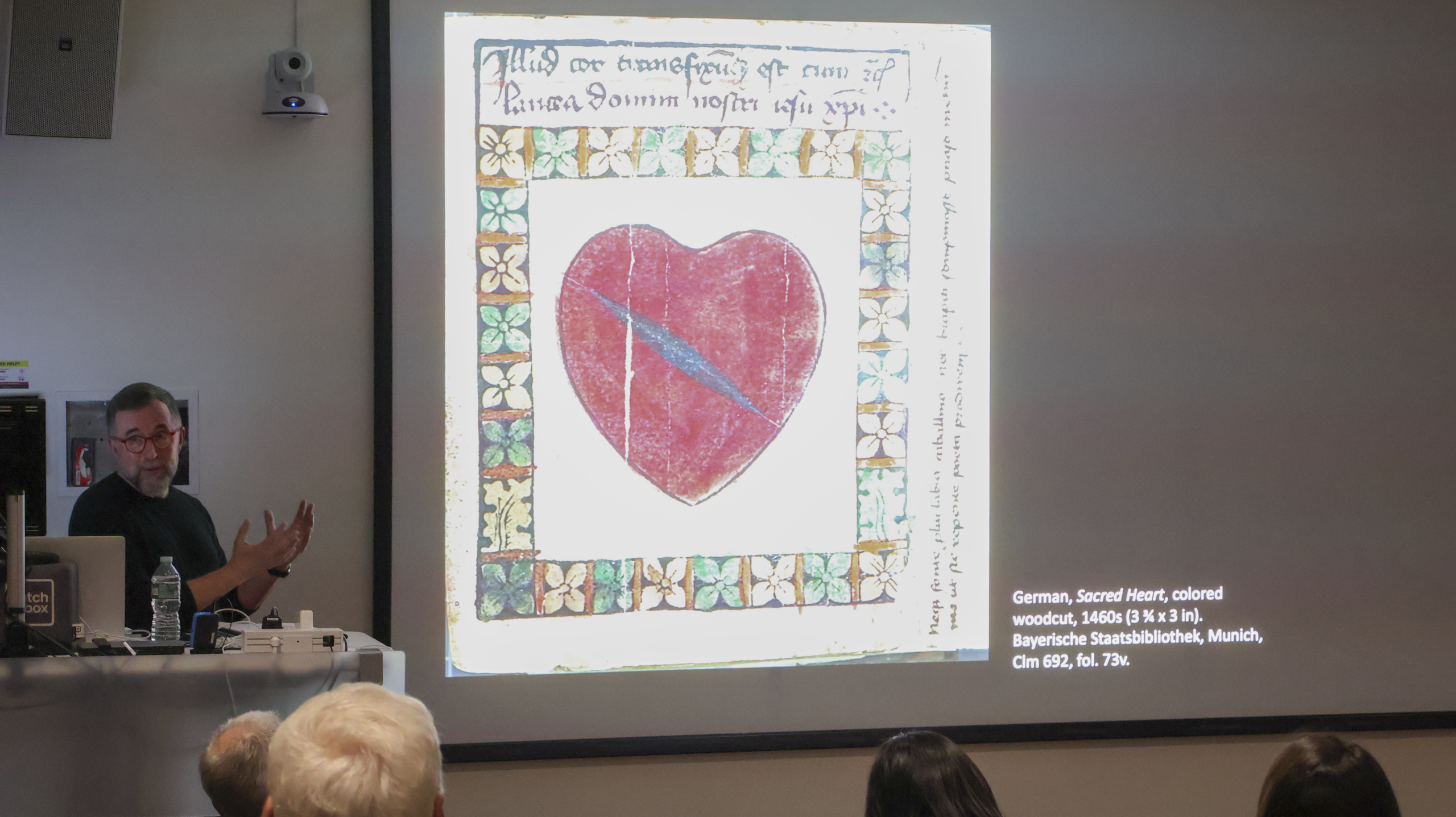
Another religious theme Areford challenged audience members to consider was depictions of the sacred heart. One print depicted a red heart with a slash through it in the center, surrounded by a border of flowers. However, once flipped around, the heart became adjacent to a splash of blood due to the red ink bleeding through the paper.
The contrast of the heart and blood in this print raised the importance of intentionality and most importantly, the idea of reproduction in printmaking. It was unclear whether the deep, red ink of the heart had any direct, causal relationship to the blood that could be found on the back.
The inverse technique illustrated in this print conveyed how meaning and intended effect are often subjective to the viewer and cannot be answered by historical contexts. Thus, the reproduction of these prints allowed for members of society to reconstruct their notions of history and form personal takeaways.
Areford wrapped up the lecture by discussing a major roadblock in his work studying this technique: the fact that woodcuts and prints aren’t intended for longevity. In comparison to framed art, often left untouched by time, Areford explained that prints were meant to be used and altered, not preserved over time.
Professor Perkinson similarly discussed how the style of 15th-century printmaking allowed for the reproduction of culture and artistic knowledge in a tangible way.
“Indeed, while we today might look at a print as if it is a finished artwork as soon as the artist pulls it from the press, in the 15th century the completion of these images was an ongoing process, in which the owners of the prints altered them over time, making them respond to their own personal needs,” Perkinson said.
Toward the end, a community member questioned the idea of artificial intelligence in relation to the artwork, given that the lecture was sponsored by the AI Initiative. Areford concluded that he remains largely skeptical of people’s usage of AI platforms, and that when analyzing such a complex technique, full agency, curiosity and a grounding in the original sources remain important.
Comments
Before submitting a comment, please review our comment policy. Some key points from the policy: