
Brunswick Dam mass fish kill renews longstanding concerns over the Androscoggin River’s future
October 23, 2026
 Addison Moore
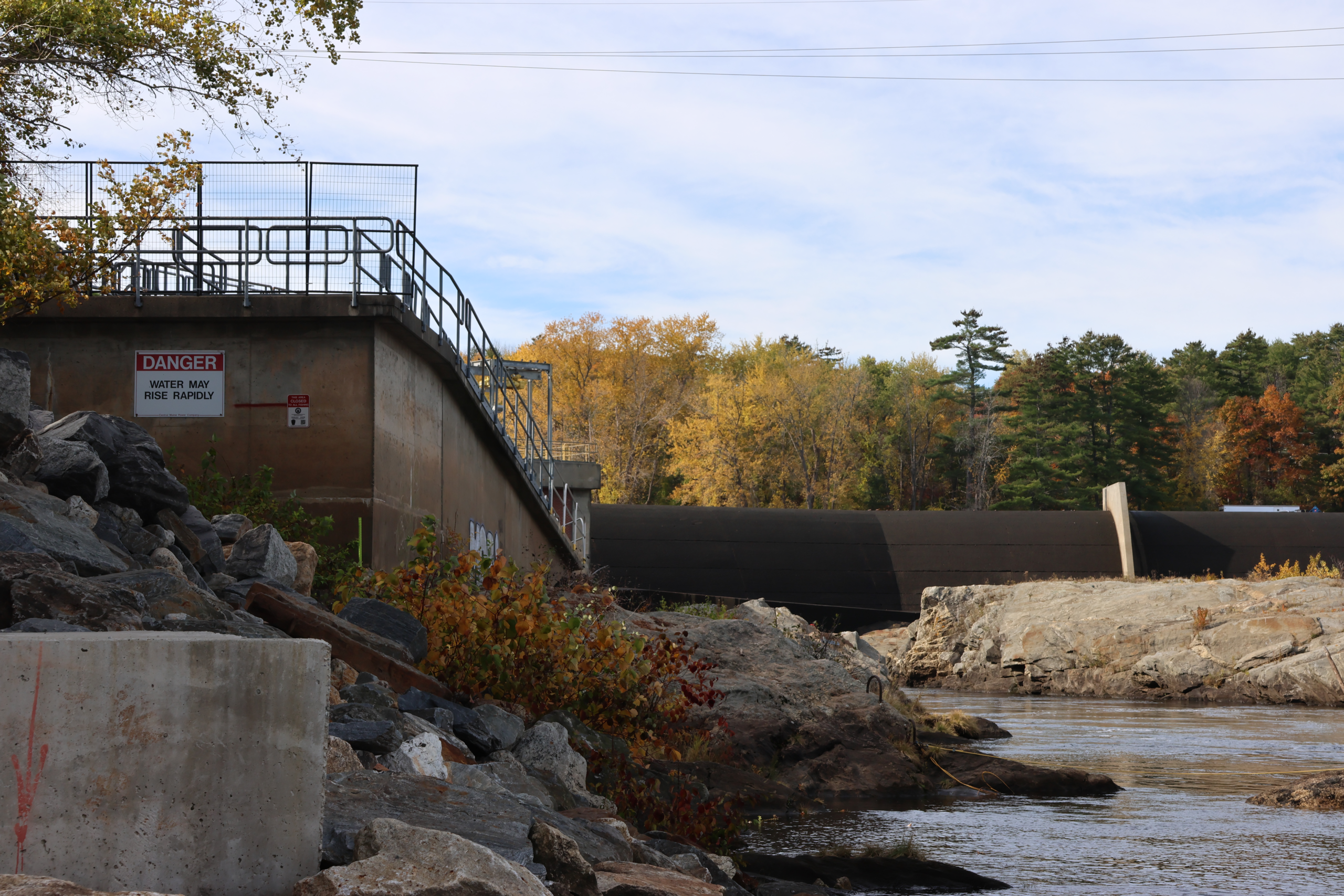
Along the banks of the Androscoggin River, thousands of dead alewives marked the aftermath of another deadly migration through the Brunswick Dam. Nearly a decade after a similar incident in 2016 exposed deficiencies in the dam’s fish passage systems, the October 10 fish kill has resurfaced longstanding questions about the river’s ecological future.
With the dam’s federal operating license set to expire in 2029, the incident has intensified scrutiny of its consequences for migratory fish. For conservationists, relicensing presents a rare opportunity to reconsider how the river is managed and whose interests that management serves.
Friends of Merrymeeting Bay (FOMB), a conservation organization dedicated to protecting and restoring the ecological health of Merrymeeting Bay and its tributaries, filed a formal complaint with the Federal Energy Regulatory Commission (FERC) following the incident.
FOMB Board Chair Ed Friedman explained that the juvenile alewives originated in Sabattus Pond, where the Maine Department of Marine Resources transports adult fish to spawn. Each fall, the pond’s water level is lowered, releasing the young fish downstream toward the Gulf of Maine.
Following the 2016 fish kill, procedures were established to coordinate turbine operations with seasonal migrations. According to WGME, dam operator Brookfield Renewable received advance notice of October’s migration and halted its turbines overnight. Nevertheless, one turbine ran for approximately four hours on Saturday, October 10, causing this incident.
Conservationists subsequently documented dead fish along approximately half a mile of shoreline. Friedman cautioned that the visible mortality represented only a fraction of the potential losses.
“There’s gotta be thousands and thousands that have just washed down in the middle of the river that we never have seen,” Friedman said.
For Friedman, the incident illustrates a more pervasive problem: Dams interrupt the movement of fish and nutrients throughout interconnected ecosystems.
“I like to think of our rivers as an analog to our circulation system,” Friedman said. “Fish are kind of like the red blood cells.”
Associate Professor of Biology Vladimir Douhovnikoff similarly emphasized that the Brunswick Dam’s ecological significance extends far beyond its immediate surroundings. As the first barrier upstream from the river’s tidal waters, the dam controls migratory fishes’ access to more than 3,000 square miles of watershed.
“It’s the first dam, and if it doesn’t let fish in, fish aren’t going to get into the entire river,” Douhovnikoff said.
Visiting Assistant Professor of Environmental Studies Kate Olson contextualized Maine’s history of dam removal through the advocacy of Wabanaki communities, whose perspectives challenge the treatment of rivers solely as economic resources.
“Maine has been a leader in dam removal, largely due to the leadership of Wabanaki communities in advocating for rivers not as resources but as relatives who deserve our respect,” Olson wrote in an email to the Orient.
Olson described alewives as a keystone species supporting fisheries, tourism and the ecological relationships connecting freshwater and marine environments.
The importance of restoring these connections also informed Evan Braude ’28’s Environmental Studies summer fellowship with Free the Andro, a coalition of local conservation organizations advocating for improved fish passage at the Brunswick Dam.
Under Douhovnikoff’s mentorship, Braude investigated potential fish passage alternatives, examined the river’s environmental history and developed educational resources to encourage public engagement.
Her research revealed shortcomings in the dam’s downstream passage infrastructure, particularly an 18-inch pipe near the turbines that is too small for fish to pass.
“If there’s enough river connectivity, whatever that might look like, fish should be able to get up and down the same way, ideally,” Braude said.
One possible alternative supported by Douhovnikoff is a nature-like fishway, which could restore part of the river’s original channel while retaining hydroelectric generation.
“When you get out of the way of nature, it has the best chance of recovering,” Douhovnikoff said.
Beyond infrastructure changes, Douhovnikoff believes restoration calls for overcoming generations of cultural detachment from the Androscoggin, whose history of industrial pollution continues to shape public perceptions despite substantial improvements in water quality.
“We have built our infrastructure, and the way that our community faces, facing away from the river,” Douhovnikoff said. “We have distanced from the river.”
Braude encountered a similar disconnect while organizing a community paddle between the Pejepscot and Brunswick dams.
“I think a goal for [Free the Andro] beyond just achieving fish passage is to really connect our community to the river and to be able to realize what an asset this is to a community,” Braude said.
For Olson, the approaching relicensing process offers an opportunity to reconcile these ecological and cultural relationships.
“The opportunity right now with the Androscoggin is a unique moment to consider all the ways people have historically related to the river, fish have related to the river, people have related to fish and how we might learn from that history to shape change in the future,” Olson wrote.
Douhovnikoff underscored the urgency of engaging in these conversations before decisions about the river’s future become entrenched.
“We may not get a chance to do this again until 2079,” Douhovnikoff said. “We really can’t miss this opportunity to be part of the discussion.”
Comments
Before submitting a comment, please review our comment policy. Some key points from the policy: