
Professor Hall launches book on Galileo’s personal library
November 6, 2026
 Addison Moore
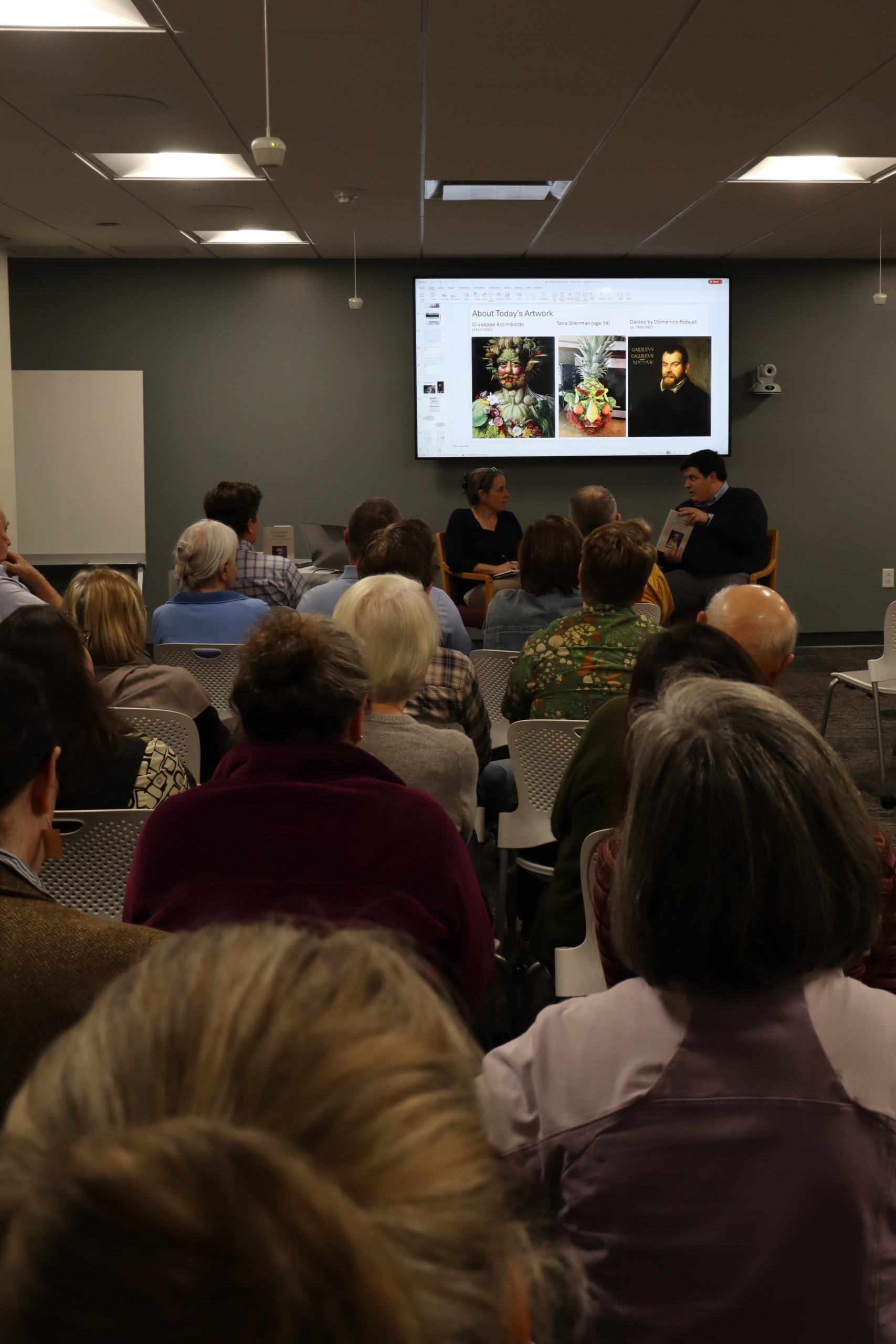
Early Thursday evening, students, faculty and community members gathered at the Hawthorne-Longfellow Library Special Collections Learning Lab to celebrate the launch of Professor of Digital and Computational Studies Crystal Hall’s latest book: “Galileo’s Library: Data, Methods, and the Humanities.” Assistant Professor of Romance Languages and Literatures Alejandro Cuadrado joined Hall to discuss Galileo’s personal library and how his collection, annotations and past omissions have reshaped our understanding of his life.
Published by Oxford University Press in September, the book reunites more than 800 manuscripts from Galileo and his family and uses data visualizations to trace how the collection was recorded and sold off over centuries. Hall also built a companion website featuring the datasets and interactive bookshelves.
Cuadrado said the book brushes past the lone-hero story of Galileo as the 17th-century astronomer taking on the church and single-handedly bringing about modern science.
“[It] doesn’t even for a minute give us the Galileo that we all grew up learning about,” Cuadrado said.
Hall said her approach grew out of a metaphor in her field. Digital humanists often describe computer analysis of large numbers of texts as a kind of telescope. Hall argues a real telescope does the opposite and focuses instead on one corner at a time.
“Hearing all of these digital humanists who are doing large-scale literary analysis talk about what they were doing as though it were a telescope was just wrong,” Hall said. “I also wanted to be thoughtful about which books to actually analyze. So I had to reconstruct that corpus to feel like I was working with the right documents.”
Up close, Hall said, Galileo’s annotations tell a different story.
“He’s very aggressive in his letters. He’s very cranky in his annotations. He was on a mission. That mission was about truth and observation. It wasn’t about defying the church,” Hall said. “Yes, he was exceptional, but he was also normal. He was an ordinary person in a lot of humbling ways.”
She showed one example from late in his life. When he was 70 and going blind, Galileo received a book that repeated claims he had spent decades disproving.
“His way of voicing his discontent is to draw testicles in the margin,” Hall said. “It’s one of the best demonstrations we have of his reading habits.”
Galileo was also a playwright. Hall described 37 comedies recorded in an early cataloging of his libraries that later lists ignored, a mistake scholars like Hall repeated. She discovered that Galileo had sent comedies back and forth to his daughter, who lived in a convent. Drafts of two comedies he authored survive.
“They’re based on 16th-century conventions. They’re zigzag patterns of characters interacting in disguise and trying to deceive their parents and get married behind the scenes,” Hall said.
Hall counts 837 titles currently in Galileo’s library, but this number keeps changing. New items keep surfacing, including an annotated copy of a work by Ptolemy recently discovered in Milan, and others are questioned as possible forgeries. Hall said she wonders whether even the manuscripts of Galileo’s lectures on Dante are forged. She also explained that it is hard to define what counts as a book, since Galileo sometimes received only chapters or sections at a time, or multiple in one volume.
“And this is why this will always be an open question of what counts and what fits,” Hall said.
After the discussion, attendees were invited to view and handle rare books from the authors Galileo studied, including those of Ludovico Aristoto and Dante Alighieri.
Post-Baccalaureate Fellow Sam Turrigiano ’26 read Hall’s book after publication and was surprised by how Hall graphically maps the collection’s physicality, rather than just its literary content.
“I am not really a digital humanities guy, so a lot of the technical aspects were surprising,” Turrigiano said. “It was interesting to see someone bridge the gap between what is in the books [in Galileo’s library] but also, how tall are the books? What is the average height of the books? I never thought to answer these questions.”
He said the book portrays Galileo beyond his typical representation as an astronomer.
“Galileo was engaged in more than just science,” Turrigiano said. “Science comes across as very insular, and Galileo is anything but insular. He was curious about everything around him, he just happened to think about astronomy as well.”
Comments
Before submitting a comment, please review our comment policy. Some key points from the policy: