
Photography, Capitalism and Death
September 18, 2026
 This
piece represents the opinion of the author
.
This
piece represents the opinion of the author
.
 Mia Lasic-Ellis
I love taking photos. While doing a research project in my Darkroom Photography class last year (shoutout Professor Kolster), I deeply resonated with Henri Cartier-Bresson’s philosophy of photography as a means to discover and capture decisive moments. For Bresson and me, photography is not about acquisition, but about observation, recognition and appreciation.
I take photos in order to capture moments I never would have noticed or remembered otherwise—moments that no one else is capturing, moments that show me something new about the human experience, moments that would have vanished, gone unnoticed or been lost in the vast expanse of the universe had it not been for the small miracle of me and my camera at the right place and at the right time. “The photograph itself doesn’t interest me,” Bresson said. “I want only to capture a minute part of reality.”
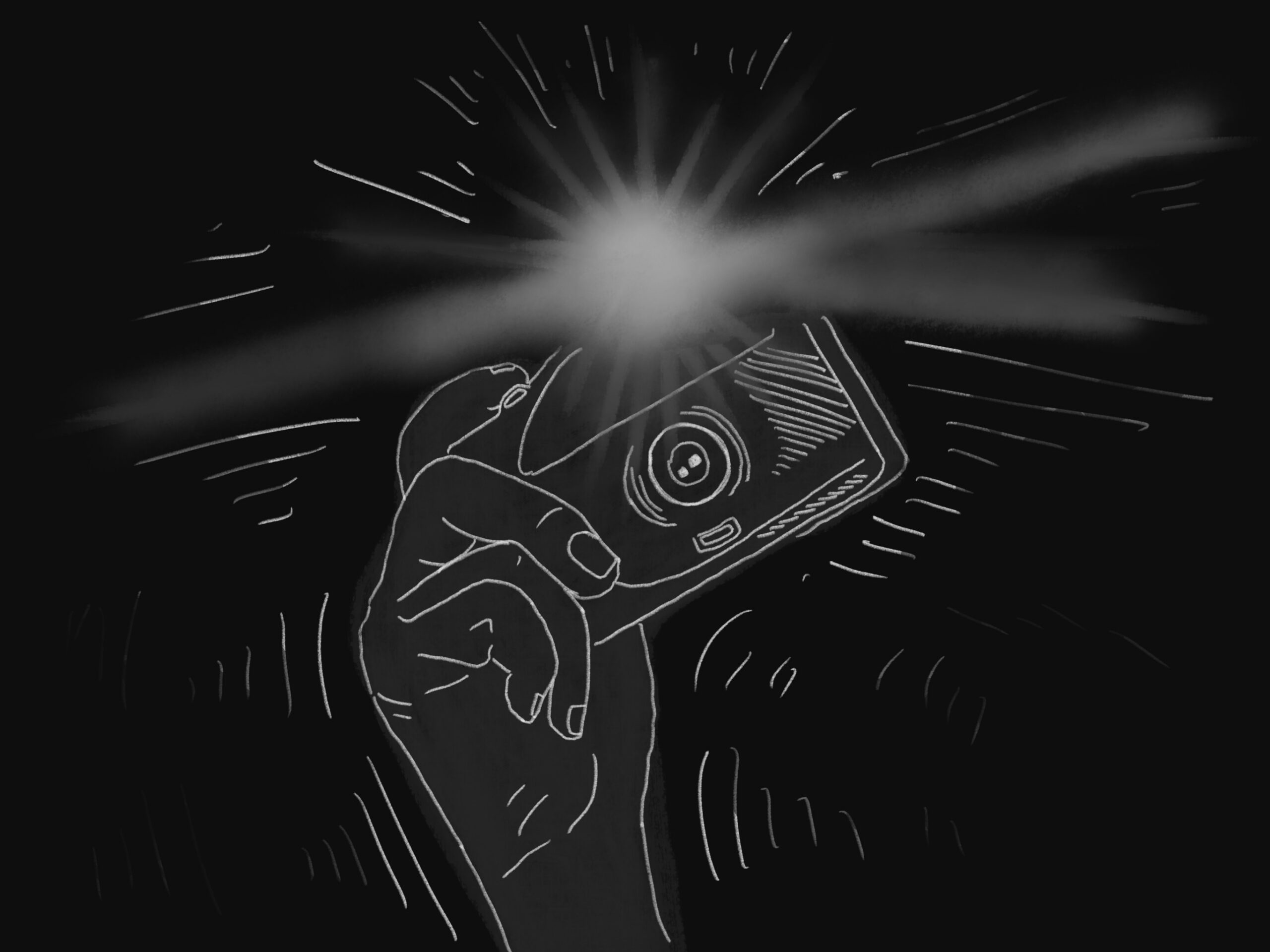
Sadly, modern smartphone photography has, in many ways, obscured and tainted the magic of photography. While traveling, it has amazed me how often I see people blocking their own view of the lush waterfall or gorgeous sunset by covering their eyes with their cameras and phones. It is dystopian to see people taking selfies rather than talking to their friends directly next to them, or recording entire concerts instead of dancing and letting the music take hold of their infinite souls.
The iPhone cameras have made us become consumers of our own lives, advertised as a means through which to participate—and win—in the never-ending capitalistic game of collection. By collecting tens of thousands of moments, all directly accessible on our high-storage clouds (but which we rarely return to except when posting on Instagram), we assure ourselves that we have lived a full, happy, aesthetic and worthwhile life. Just look at all that proof.
But then why do so many of us, if our camera rolls are filled with these vast inventories of memories, still feel unsatisfied? Shouldn’t this stockpile give us joy? Have we become so divorced from reality that the commodification and consumption of an experience has become infinitely more valuable than the experience itself?
When we photograph to collect, our purpose becomes collection. The thing itself, the subject of the photo, is not so important as the idea of the thing, the fact that the photo exists, that we own it, that it belongs to us, that we can access it at any time, that it is ours forever and ever.
Our efficiency-obsessed society is largely to blame. When there is never enough time to do everything, when there is always something more to be attained, experiencing something solely for the sake of the experience is a waste of time. Whether it be clothes, fast food, grades, AP classes, internships, LinkedIn badges, likes, followers, snaps, reels, friends, hookups or photos, amassing large quantities has become our ultimate goal, the only thing that can win us the rat race. It is almost as if, through this endless act of dopamine-fueled collection, we feel that we can manipulate the finite boundaries of time until we have overcome death itself.
Indeed, photography can be described as our way of fighting against our own mortality by immortalizing our experiences, ourselves and our loved ones. Because we can never truly die or be forgotten if pictures of us exist, right? But the moment we photograph something, by trying to preserve the subject exactly as it exists right in that moment, we are paradoxically acknowledging that even as the shutter has finished its click, the subject has already become older, that it will eventually die. To me, that impermanence is what makes the photo worth taking.
Photography, I think, is a fundamentally empathetic art. Taking photos should force you to notice the world, and make you want to reach out and touch it. Photography should not be a neat act of preservation, an endless pursuit to “own” slices of the world before time runs out, but rather a messy, meandering reception of life’s beauty.
If photography is making you think more about the photo than the subject, you’re missing out on what’s right in front of you. You’re missing raw life. So stop traveling to have traveled or photographing to have photographed, and start living to live.
Elan Cohen is a member of the Class of 2028.
Comments
Before submitting a comment, please review our comment policy. Some key points from the policy: