
Clinton Thompson’s Journey From Maine Marine Patrol to Schiller’s Boat Captain
September 18, 2026
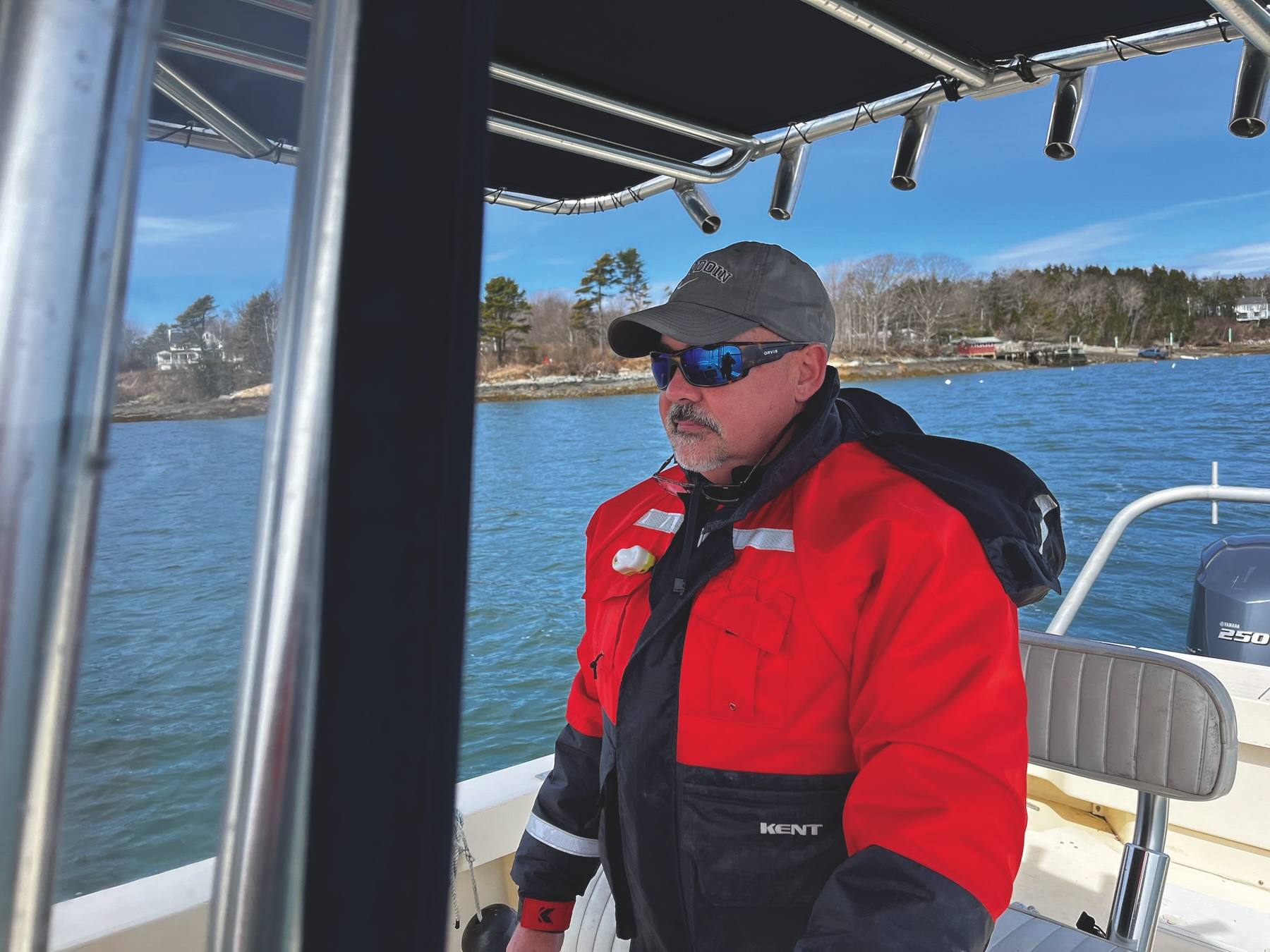 Courtesy of Communications
 Clinton Thompson has spent more time in Casco Bay than most people have spent in their backyard. For 25 years, the Maine coast was his patrol territory as a Marine Patrol officer for the state. Now it’s the water he drives Bowdoin students through to do research for classes.
As marine operations manager at the Schiller Coastal Studies Center since 2023, Thompson runs the boats that make most of Bowdoin’s hands-on coastal science possible, from eelgrass surveys to eider duck tracking. Students who spend a semester or a single lab period on his boats get to know him well, but few know what he did before Bowdoin.
Thompson grew up in Eastport, in the far eastern corner of Maine, in a house two blocks from the waterfront. A Coast Guard station sat within sight of his house, close enough that he could hear crews testing their boat alarms in the morning. He fished and explored the coastline as a kid, and the water has beckoned him ever since.
“I’m more comfortable driving to Portland by boat than by car,” Thompson said.
After high school, he left Eastport for Unity College in New Gloucester, majoring in environmental science with a concentration in conservation law. After graduating, he was hired by the Maine Department of Marine Resources. Uninterested in a conventional law enforcement job, the Marine Patrol offered something different: an outdoor beat driven by tides, seasons and a seasonal rotation of alluring fisheries: lobster and shellfishing in the fall, scallops and sea urchins in the winter, elver season, for glass eels, in the spring.
“There’s really no typical day,” he said. “It was very much driven by the seasons, the tide, the weather and what was present in your particular patrol area.”
Maine’s three largest law enforcement agencies—State Police, the Warden Service and Marine Patrol—offer a 25-year, no-age retirement, similar to a military pension. Wanting to keep working, Thompson had a plan: put in 25 years, retire from Marine Patrol and find something else. The timing worked out almost by coincidence. His predecessor as Schiller’s marine operations manager, also a former Marine Patrol supervisor, was leaving the College the same year Thompson was leaving the state.
The job’s rhythm is still seasonal, just with different peaks. Summer is Schiller’s busiest stretch, filled with faculty research and student internships that need boat time. Some highlights of this summer’s research include James Ingraham ’28’s study on the effects of urbanization on periwinkle snails as well as research on lobster populations impacted by fluctuating temperatures by Court Callis ’27, Henry Burke ’28 and Anna Feng ’28.
Fall brings the Coastal Studies Semester, whose benthic ecology and ocean acidification classes require regular trips out for sampling. By late November, docks come out and boats go into winter storage, shifting Thompson’s focus toward maintenance, safety gear replacement and Coast Guard inspections that Schiller’s fleet undergoes every other year to keep its research permit.
Coordinating it all falls on Thompson. Professors and student groups reach out by email to request a boat, and he works out logistics from there, sometimes juggling two trips at once. He also calls in two part-time boat captains when needed, and a single bad-weather day can upend a week’s schedule of trips.
The scale of Schiller’s marine operations has grown significantly. It ran its 115th boat trip of the year as of mid-September, 40 more than on the same date in 2025. The center operates three boats of varying size and horsepower, with a fourth expected to join the fleet this fall.
Thompson says his Marine Patrol years shape the job in ways that go beyond scheduling. Safety equipment that might read as just a box to check to someone else, like life jackets and engine cutoff switches, carries a different weight for him because he spent 25 years investigating boating accidents, search and rescue calls and missing persons cases along the Maine coast.
What’s changed most, Thompson says, is the emotional register of the work. As a state officer, he was frequently the one delivering bad news. At Bowdoin, that’s rarely true.
“Everything that I do here is positive, like taking a class out,” he said. “Generally, the students are excited to do this.”
One of the highlights of the job is seeing students have experiences on the water, many for the first time. He points to one trip last fall, a benthic ecology class returning from a snorkeling trip near Portland, as the clearest example. A full moon was rising in the east as the sun set in the west. He overheard one student turn to another and say, “How lucky are we to be out here right now?”
Thompson is also a registered Maine guide, and outside of work, he doesn’t stray far from the water. He’s a self-described wild brook trout fisherman, often found around Jackman, Maine, and keeps a collection of boats at home.
“When I’m not on the water working,” he said, “I’m on the water playing.”
Comments
Before submitting a comment, please review our comment policy. Some key points from the policy: