
Nature nurtures at Bowdoin Children’s Center
September 18, 2026
 Courtesy of Children's Center Instagram
 A philosophy imparted early at the Bowdoin Children’s Center, the Offer of the College invites students to “count Nature a familiar acquaintance.” Founded in 1988 to provide affordable, dependable childcare from infancy through preschool for the children of College employees, the Children’s Center has become both an employment benefit and a community that collaborates with the College. Bowdoin students are regular presences at the Center as both employees and volunteers, contributing to multilingual education and performing songs through the Mellow Music for Munchkins program.
The Center also functions as an informal “lab school” for students enrolled in education, psychology and English courses at the College, providing experiential insights into early childhood development and educational practices.
Beyond Bowdoin, the Center offers nature-based professional development workshops in partnership with the Maine Early Childhood Outdoors Network, serves as a training site for state licenses pertaining to outdoor play and participates in committees shaping regulations surrounding outdoor education.
The Center combines components of Montessori, Waldorf and Reggio Emilia pedagogies through what Executive Director Martha Eshoo described to the Orient as “attachment-based, child-led learning.”
Younger children at the Center have designated “primary caregivers” with whom they cultivate trusting relationships over the course of several years, while preschoolers are arranged in small “cohorts” of six to seven students. Caregivers help children with meals, naptime and changing clothes and diapers, becoming reliable figures associated with nurturing their cohorts.
Familiar routines supplement these consistent relationships and preserve children’s sense of stability as they navigate the transition from home to school.
“Those relationships are deep and intentional, and they involve … lots of language, singing together and rich, connecting time,” Eshoo said. “When the children are in deeply caring relationships, they feel very able to play freely without direction.”
Eshoo explained that during periods of uninterrupted playtime, educators complete their “teacher work” in close proximity to children but rarely intervene. Unlike some approaches associated with Reggio Emilia and Montessori classrooms, teachers generally do not alter children’s course of play, interrupt with open-ended questions or become the “subject of entertainment.”
Nevertheless, when children are eager to share their discoveries or creations, teachers respond enthusiastically, reinforcing their experimentation and curiosity.
“It’s the motif that adults are in the area, digging the trenches, arranging the yard, raking or digging holes, and children are playing around them,” Eshoo explained. “We see our role as modeling engagement and interest in being outside.”
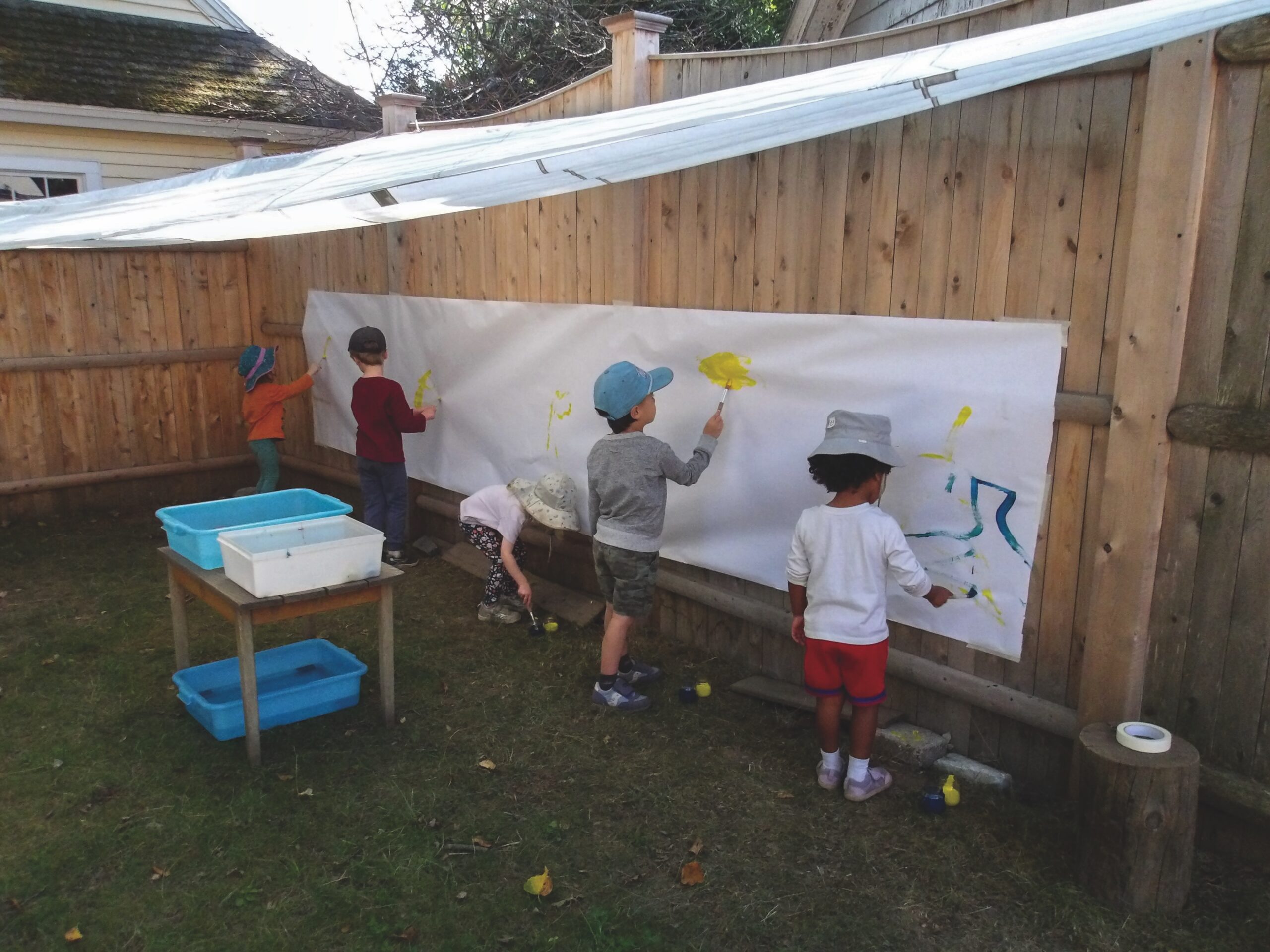
Exploration at the Center primarily takes place outdoors, and children play in a natural environment where they are encouraged to use their imaginations and experiment with their surroundings. Children often play with stones, sticks, trees and acorns, tend to their shared garden or play in the “mud kitchen.”
“I was thinking about my own preschool experience where I was told, ‘Do not touch this. Do not do that. Do not try this,’” Dila Çakir ’27, a summer employee, said. “At the Children’s Center, it’s allowed and encouraged to get dirty and to try.”
Play-based learning is a research-supported approach to early childhood education structures, although it is becoming increasingly rare. In kindergartens, and even preschools, children often spend hours in stimulating, resource-rich classrooms that are cognitively demanding for their energetic young bodies.
While many educators insist that children must transition rapidly through a series of quick activities to accommodate short attention spans, the Center’s philosophy proposes that children will immerse themselves in deep thinking when they have regular periods to move and expend their energy.
In contrast, preschools prioritizing “school readiness” often exchange much of children’s time outdoors and creative play opportunities for more intensive literacy and numeracy instruction. The Children’s Center, however, regards “school readiness” as more than a set of academic capabilities.
Outdoor play teaches children to regulate their emotions, think critically, practice conflict resolution and manage their boredom—skills that carry into kindergarten and first grade, where children must navigate both academic demands and the social dynamics of the classroom. By developing these skills early, children approach future academic tasks with focus and self-awareness.
“The children are very strong communicators,” Hannah Satran ’29, a volunteer, said. “They have an impressive vocabulary when it comes to advocating for themselves and they have such mature interactions, because not only are the teachers treating one another with respect, but the space they’ve created is so comfortable and quiet that … it allows children to flourish.”
Çakir also reflected on the nuanced combination of autonomy and security the Center offers children.
“You see how much the kids enjoy being outside and … how powerful they feel in that environment,” Cakir said. “And the kids know that no matter what they do, they’re always loved by their parents and caregivers, and they carry that love around.”
Dila Çakir is a member of The Bowdoin Orient.
Comments
Before submitting a comment, please review our comment policy. Some key points from the policy: