
Digging into the history of Bowdoin’s sculptures
September 11, 2026
 Abigail Hebert
From stone statues to futuristic mobiles, sculptures are scattered across Bowdoin’s campus. Ingrained in the campus landscape, these public artworks hold decades of personal stories, quietly shaping the identity and character of the spaces in which they reside.
The Walker Art Building lions
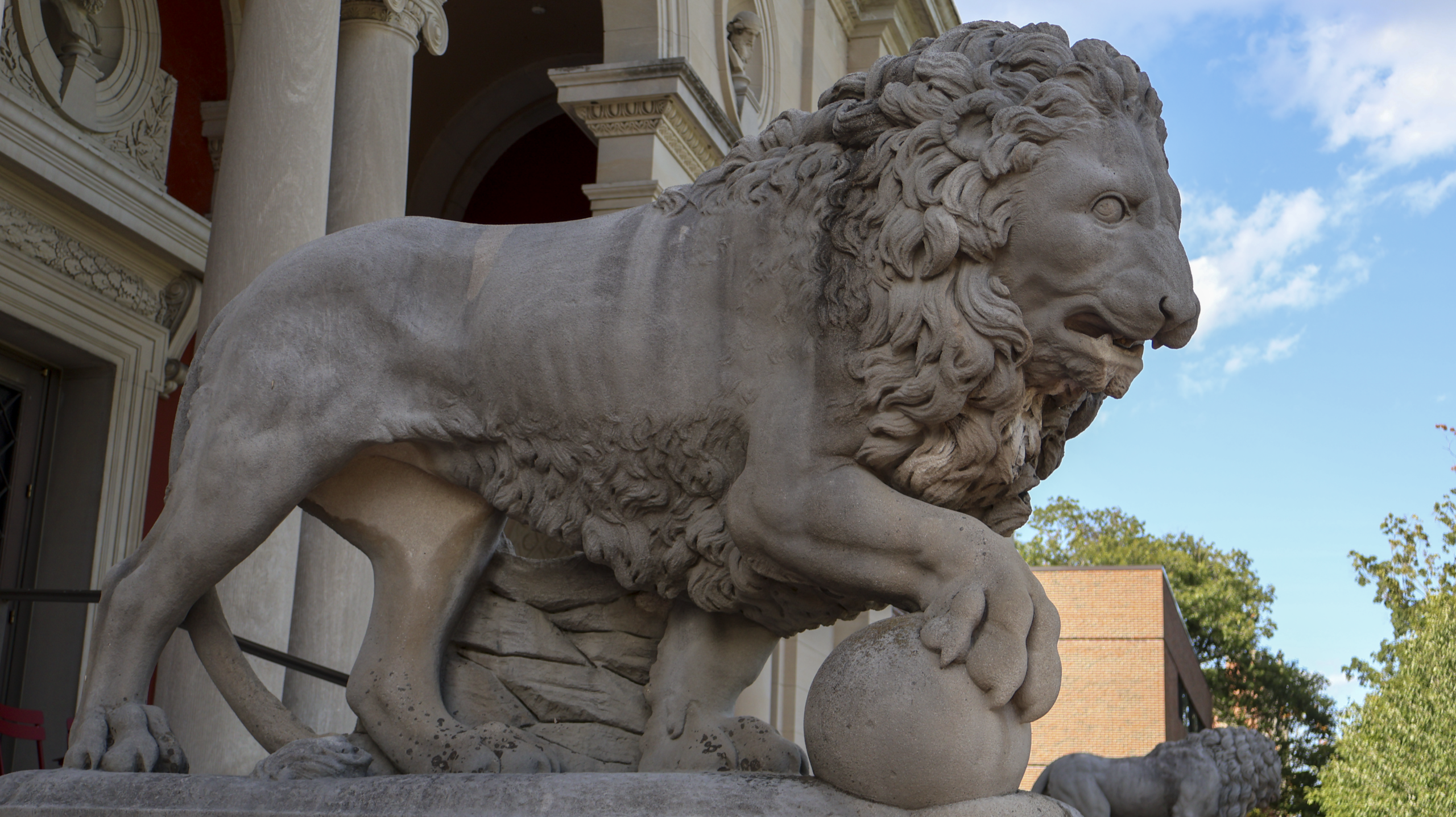
Sitting atop the steps of the Walker Art Building, two stone lions watch over passers-by and students sprawled across the Main Quad. Copies of the marble Medici lions at the Loggia dei Lanzi, the Walker lions were installed with the neoclassical building’s construction in 1894.
Since their installation, they have served as jungle gym fixtures and a photoshoot background for the children of many Bowdoin families. Curator Cassandra (Casey) Braun at the Bowdoin College Museum of Art (BCMA) shared her personal connection to the lions.
“I have photos of my daughter sitting on or around [the] lions from every season of every year that I’ve worked at Bowdoin, so they’ve been an emblem of how my personal and professional worlds combine,” Braun wrote in an email to the Orient. “I see many other people—whether Bowdoin students or visitors to campus—interacting with them in a similar way.”
Braun isn’t the only Bowdoin staff member with a connection to the lions. In the Spring of 2022, Senior Producer for Academic Media David Israel undertook a project to create a 3D scan and model of the lions. The model is composed of thousands of images and is accessible online.
Unlike their counterparts in Florence, Bowdoin’s lions face away from the Museum Steps. While their placement has generated much speculation over the years, the designer’s original intentions remain a mystery. Braun also noted her fascination with the statues.
“I intrinsically feel that they should be switched—so that their bodies face towards the doorway—but it’s become this great quirk to me.”
The Bowdoin Polar Bear
In front of Sargent Gymnasium, the College’s athletic mascot is memorialized in granite. The Bowdoin Polar Bear was installed in 1938 as a gift from the Class of 1912 to commemorate their 25th year reunion. While the polar bear would not be made the official school mascot until a year after the Class of 1912 graduated, the bear was significant to the donors as their freshman year coincided with explorer and noted Class of 1877 alum Robert E. Peary’s final expedition to the North Pole.
Where the Walker lions are recurring guests in childhood photos, the Bowdoin Polar Bear backgrounds an equally momentous stage of life for many students—the transition into college.
“[The] polar bear statue was one of the first things that stood out to me as a first-year,” Alex DelRegno ’29 remarked. “A fellow first-year took a picture of me and my parents standing in front of it.”
DelRegno reflected on the Polar Bear’s ubiquity in his student life.
“It is a landmark, a familiar symbol and the thing that greets me every time I leave the Smith Union front entrance,” DelRegno said.
“Red Fossils” by Alexander Calder in Hawthorne–Longfellow Library
Hanging between the first and second floors of Hawthorne–Longfellow Library, Alexander Calder’s “Red Fossils” oscillates in the breeze. Unlike the stony immutability of the previous statues, “Red Fossils” is in perpetual motion. The mobile, a Calder invention, is composed of 11 aluminum shapes, at once geometric and organic, connected by wire and painted in Calder’s signature red.
“Red Fossils” was purchased with funds from the family and friends of Class of 1974 student Charles B. Price III, who died in an accident while still a student. Price admired Calder, who, by the 1970s, received widespread acclaim for his mobiles and stabiles, which were monumental public sculptures.
Part of the sculpture’s visual appeal lies in the tension between the heaviness of the steel pieces and their delicate balancing. Yet, this equilibrium came to a crash on the day of the artist’s death in 1976, when a student threw a shoe off the second floor, sending the mobile falling.
The mobile’s innovative form contrasts with its sense of history and artifact, fitting for a space where generations of students delve into the past to understand the present and transform the future.
“Northern Sun” by Ben Butler ’00 in Barry Mills Hall
Hundreds of wooden pieces adorn the wall of the Mills Hall entryway in an installation recalling the Bowdoin seal. The art piece by Ben Butler ’00, a sculptor renowned for his public artworks, was installed in 2024.
The installation exemplifies how public art both shapes and is shaped by its environment. In an interview with Bowdoin News, Butler explained how the smooth wooden forms in “Northern Sun” recall the stones lining the Maine coast as well as the exposed mass timber beams supporting Mills Hall.
The impact of Butler’s work extends beyond the academic building where it resides. Professor of Art and Chair of the Visual Arts Department Jackie Brown shared how his sculptures make their way into her arts teaching.
“Each semester in Sculpture I, students learn about Ben Butler’s work and approach to process, which helps inform their own wood projects.” Brown said. “It’s exciting to share the work of a Bowdoin graduate who’s built a meaningful life as an artist.”
Comments
Before submitting a comment, please review our comment policy. Some key points from the policy: