
Portrait of an Artist: Katie Tran ’27
September 11, 2026
 Isa Cruz
Katie Tran ’27 has always been curious about artistic materials. She recalls learning how to make soap from scratch at ten years old in an attempt to understand the process of making it.
“My journey with art and creating has always been a process of creating something, and then wanting to understand how to create the material needed for that project. When I was ten, for example, my aunt showed me how to make melt-and-pour soap into fun shapes and colors…. I wanted to understand what made ‘real’ soap.… So I learned on YouTube how to make cold process soap,” Tran wrote in an email to the Orient.
Her material engagements drew her to different forms of sculpture, from origami to crochet to her current project.
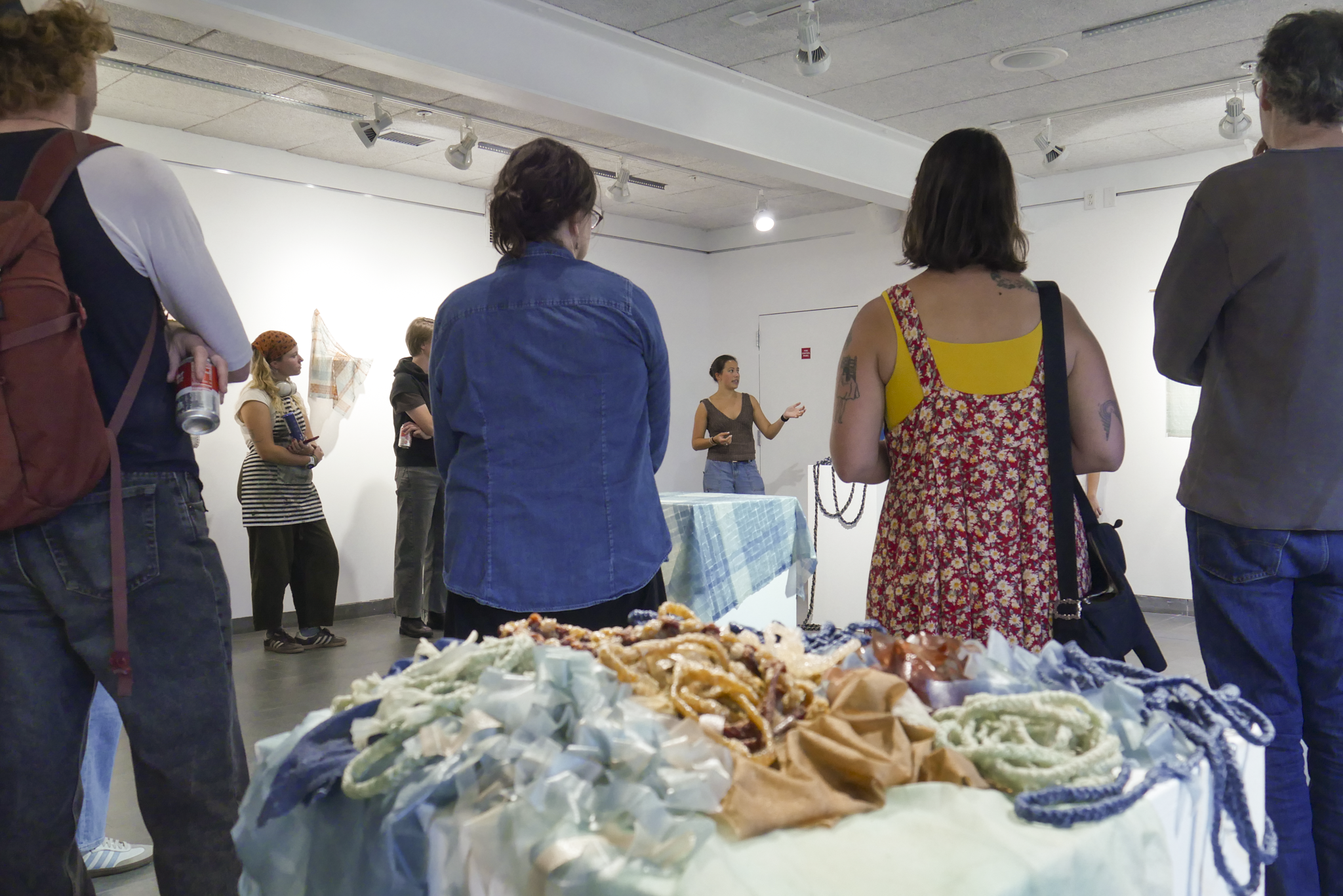
Last Thursday, Tran unveiled her exhibit “Ravel,” which featured a biodegradable material she created over the summer out of agar powder, glycerin and water. Her final pieces included drapings on pedestals and shelves, biomaterial stretched across wire frames and multicolored biomaterial woven into tapestries and winding ropes. She colored the material using food scraps, sawdust and paper pulp.
“[The] inspiration for this art came from my desire to understand this material,” Tran wrote. “I was initially drawn to the biomaterial from tutorials I found online and I wanted to understand how the material exists and how it would feel in my hands.”
Tran noted that the material was incredibly sensitive to any kind of change, whether that be physical pressure, heat or water. Because of this, working with it was a practice of patience. Though she enjoyed creating wire structures and ropes, Tran was most drawn to weaving the delicate material.
“I fell in love with the way the weaving complicated the material and made it seem like an actual object rather than a scrap of something like fabric. I love the way weaving shows the weight of the material itself and the pull of gravity on each of the horizontal strands.… Weaving the material allowed me to understand that what feels like its flaw is actually what makes it beautiful,” Tran wrote.
The exhibition also featured an area where viewers could engage with the material—stretching, holding and examining its translucency. Viewers could mimic Tran’s process of experimentation while seeing her final products.
“Sculpture is important to me because I have always identified as someone who learns through my hands. I am an extremely tactile thinker, and my hands are how I best engage with and understand the world,” Tran wrote.
Tran also found a range of themes within the sculptures. “Ravel” could serve as a mediation on impermanence, a theme she has often stumbled upon in her crochet or paper sculptures, but the biomaterial’s delicacy most made her think of histories of labor.
“In my weavings, for example, I had to lift each piece of material up, slide the next weft strand across and gently lay down the vertical weave piece,” Tran wrote. “I really love slowly working up to that point and pushing how long I can do a certain motion for before my body doesn’t let me anymore or before I get bored or feel like I have reached the point where any more starts to feel like less.”
Professor of Art Jackie Brown worked with Tran as her advisor along her journey with the biomaterial.
“Every time I walked in the studio, there was something new happening and things were changing,” Brown said. “It felt like a very alive and vibrant space. It was constantly changing and evolving because she was really experimenting.”
Students, professors, alumni and community members came to the installation’s opening.
“I met Katie at the beginning of the last school year. We spent three classes making art together, and so when I found out that she was having an opening for summer work, there was nothing that was gonna keep me from attending,” Daniel Hennelly ’26 said.
The exhibition will be on display in the Edwards Center for Art and Dance Front Gallery until September 23—after the installation ends, Tran plans to find a sustainable way to dispose of the biomaterial.
“Through installing, I realized I had truly learned how to let the material dictate my moves and my creating rather than trying to force it into being something it is not,” Tran said. “I have always felt inspired by and drawn to material as a starting point in all projects I take on, but after this summer, I learned what it means to respond fully to a material’s natural state and properties.”
Comments
Before submitting a comment, please review our comment policy. Some key points from the policy: