
BCMA to host tour and reception of “Currents” exhibition spotlighting special loan
September 4, 2026
 Addison Moore
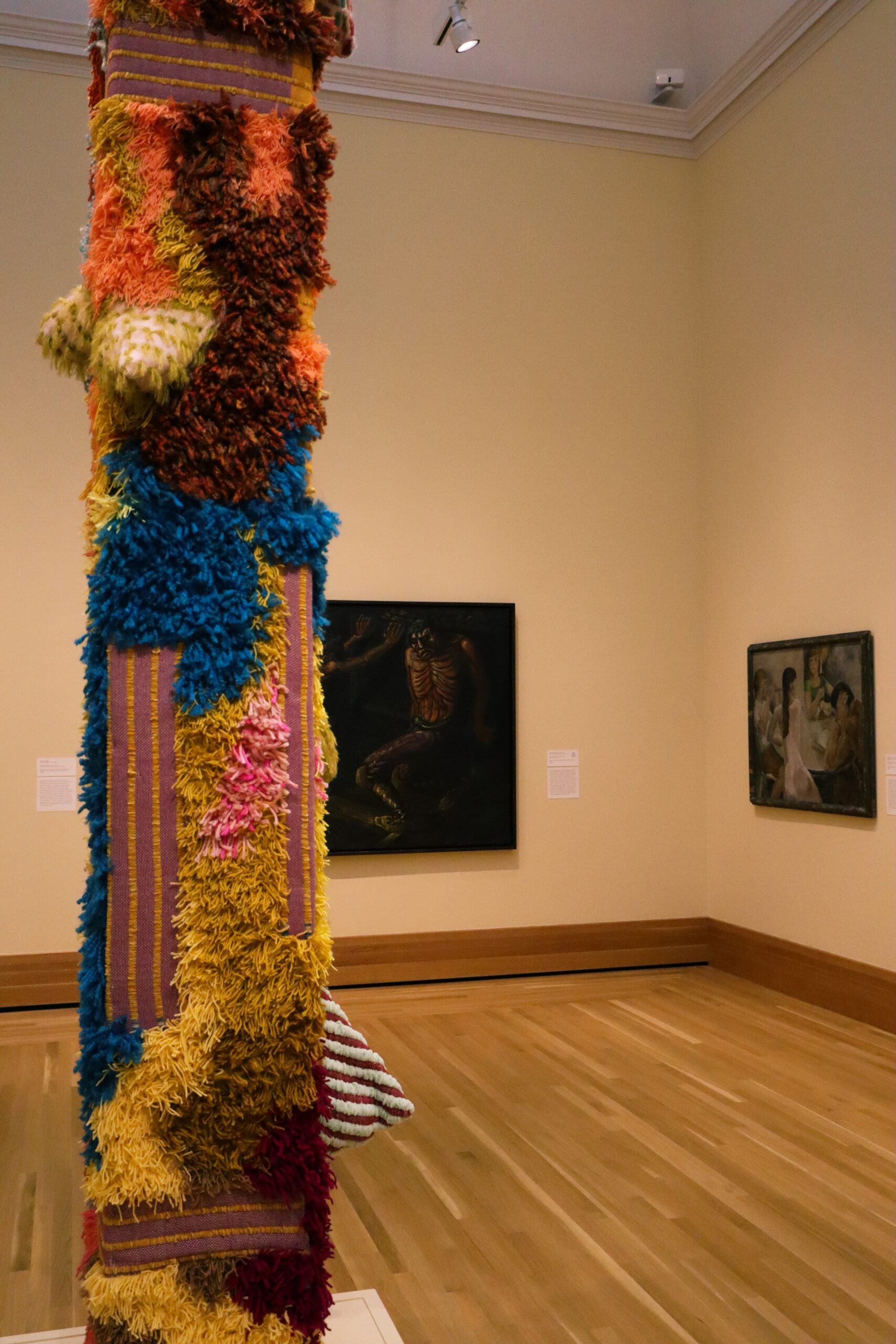
With the Bowdoin College Museum of Art (BCMA) relaunching “Currents: Art Since 1900” for the academic year, Curator Cassandra (Casey) Braun and Robert Bernheim—associate professor of history at the University of Maine at Augusta—will lead a tour and reception spotlighting the special loan of Andrew Dasburg’s “Portrait of Alfred” (1925). The rotating exhibition of modern and contemporary artworks is organized around three central themes: “Bodies / Representation,” “Languages / Citation” and “Environment / Materiality.”
“Portrait of Alfred” is featured in the exhibition’s first section, “Bodies and Representation,” which explores how artists of the 20th and 21st centuries portray themselves and others. Where Dasburg’s portrait takes a more conventional approach to depicting the human form, other works in the section challenge traditional conceptions of portraiture or spotlight bodies that are frequently erased from art history.
“It is a way to interrogate the various modes of representing people and bodies,” Braun said. “But then the other line of questioning and thought is, who does get to be represented in the art historical canon?”
While most of the works on view are drawn from the Museum’s permanent collection, “Portrait of Alfred” is one of the two paintings on loan. Bernheim reached out to Braun and former co-director Ann Collins Goodyear to share the family piece. Following a conversation between Braun, Goodyear and the Bernheim family, the Museum made arrangements to borrow the painting.
“When we were thinking about launching the exhibition officially this academic year, I thought it might be nice for visitors to be able to hear from someone who has a very different perspective on this particular portrait than I will have,” Braun said. “I’m coming at it from an art historical background, [and] he’s coming at it as someone [whose family] the artist had relationships with.… ”
Braun elaborated on the various functions of artwork loans, from preserving delicate artworks to building upon an exhibition’s central themes. While light-sensitive photographs or drawings from the Museum’s collection might speak to relevant ideas, extended exposure in a long-term exhibition like “Currents” would risk damage. Borrowing artworks can fill gaps in the BCMA collection to tell a more comprehensive story and support the Museum’s educational role.
“When we’re thinking about stories that we … might not be able to tell through certain media, oftentimes it’s stories … that are very much grounded in the curriculum here at Bowdoin,” Braun said. “So it’s, what do I see faculty and students coming to the art museum to engage [with] when they’re here with classes? … And if we are not able to address them using works from our collection, are there other opportunities, whether that is a loan from a private collector … or more commonly from other institutions?”
“Currents” has shifted in content and theme since its initial opening in the Fall of 2023, evolving to reflect changing conversations around topics of identity and artistic creation.
“There’s some overlap in the work, but it was also [an] opportunity for me to think more expansively,” Braun said. “Or to say, oh hey, there are actually some themes and topics that are becoming more common or more prevalent in our everyday dialogues that were not as present.”
Braun highlighted how the new section “Languages / Citation” builds on a previous section titled “Inspiration / Appropriation” to address the increasing prevalence of artificial intelligence and expand the conversations generated by the exhibition.
“It’s really asking us to grapple with what is creativity and what is authorship,” Braun said. “Right now, as we think about AI, for instance, the really dramatic questions that AI is posing in terms of its potential to do good in the world and its potential to destroy creativity or individuality.”
Over the past three years since “Currents” first opened, it has undergone multiple rotations which featured new acquisitions and revised thematic principles. Braun expressed her hopes that visitors will find something new to respond to with each iteration of the exhibition.
“Art can be so subjective,” Braun said. “Not only from person to person, but from moment to moment. Sometimes I want to enjoy art because I find it contemplative and peaceful and beautiful.… Sometimes I want to see art to be challenged, to learn new things. And so I really hope that people are able to visit and revisit the exhibition to get different things out of it each time.”
She also underscored the uniqueness of the upcoming tour and reception as one of the few instances of public programming for a long-term exhibition.
“I’m hoping that this will be the first of several opportunities where curatorial staff [and] members of the community will be able to speak about a specific work of art on view from a different perspective as a way to bring more voices into the museum,” Braun said.
The tour and reception for “Currents” will take place in the BCMA next Thursday, and will be followed by a bagel reception in the Museum Pavilion.
Comments
Before submitting a comment, please review our comment policy. Some key points from the policy: