
ASL Club builds connections beyond any spoken language
November 20, 2026
 Abigail Hebert
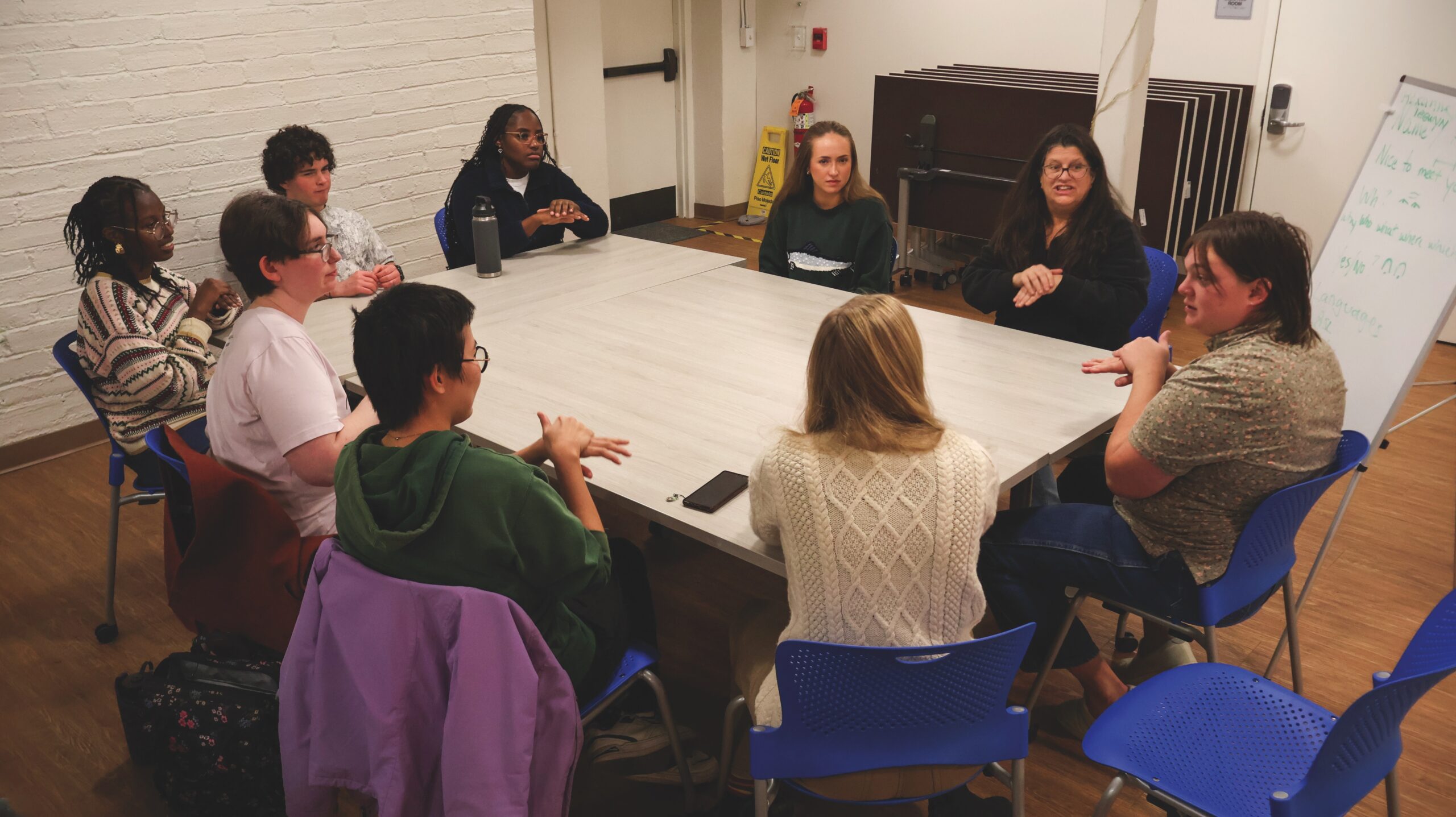
At Bowdoin’s American Sign Language (ASL) Club, conversation unfolds without the familiar sounds of spoken language. Hands move, facial expressions shift and students exchange ideas without speaking a word. What might initially seem like silence reveals a different way of communicating—one that challenges conventional understandings of language and connection.
Meeting every Tuesday from 6 to 7 p.m., the club brings together students of varying experience levels for immersive ASL instruction. Led by Angelina Lin ’27, Sophie Miller ’28 and Maggie Moore ’29, alongside Deaf ASL instructor Roxanne Baker, the club introduces students to a visual language while deepening their understanding of Deaf culture.
Baker, who has taught ASL and Deaf Studies for more than 35 years, including at the University of Southern Maine (USM) since 1995, considers immersion essential to learning the language.
“I believe one of the best ways to learn ASL is through immersion, interaction and practice,” Baker wrote in an email to the Orient.
Without English to rely on, students navigate unfamiliar vocabulary through gestures, fingerspelling and visual expression. Unlike a word-for-word translation of English, ASL has its own grammatical structure and relies on facial expressions, movement and visual storytelling.
“Even in ASL, there’s a lot of acting out,” Lin said. “When you’re telling a story, you don’t exactly have to sign in exact English.”
For Tegwyn Hearst ’30, who joined with little previous ASL experience, the club has offered a departure from conventional language instruction.
“Usually in beginner language courses, the instruction is in English, and then we slowly learn new things and say a sentence or two occasionally,” Hearst wrote in an email to the Orient. “But, in the ASL club, [Baker] is Deaf, so we have to use sign language, which makes it really immersive.”
Hearst has also discovered that communicating visually requires greater attention to others.
“An interesting drawback is that it’s so easy to accidentally ignore someone just by not looking at them because you have to see their hands to know what they are saying,” Hearst wrote. “I was surprised by the importance of facial expressions when signing. I always thought it was just with [one’s] hands.”
The club accommodates beginners through frequent review and practical vocabulary lessons, including time, fingerspelling and food. Its “Sign and Dine” gatherings allow students to apply their skills in everyday conversations over meals.
Despite the challenges of learning an unfamiliar language, Hearst has found encouragement among fellow members.
“Everyone in the club is so kind and understanding,” Hearst wrote. “People are very patient when you are struggling to get an idea across. Making a mistake is okay because we can just laugh about it and learn.”
Beyond language instruction, Lin and Miller emphasized the importance of learning from a Deaf instructor whose experiences offer insight into the community associated with ASL.
“There’s a very big difference when you are in the [Deaf] community and when you are a hearing person,” Miller said. “So it’s very important to come from [a] perspective that has been marginalized a lot of the time as well, just in society in general.”
For Baker, teaching ASL also means confronting misconceptions about Deaf identity and the social barriers that persist beyond the classroom. She hopes students develop not only linguistic proficiency, but also a greater understanding of the Deaf community.
“To me, ignorance is one of our greatest enemies,” Baker wrote. “By introducing students to ASL and Deaf culture, we can help break down misconceptions, reduce stigma and challenge the barriers Deaf people continue to face.”
The club’s leaders hope to strengthen connections with Maine’s Deaf community while expanding ASL education on campus. Following a professor’s expressed interest, they are also considering workshops to introduce faculty and staff to basic signing skills.
Hearst sees these opportunities as part of a broader commitment to inclusion.
“I also think that a way to make the world a more inclusive space is not just to have opportunities for Deaf people, but to be able to communicate with them in a casual setting, and learning ASL makes that a possibility,” Hearst wrote.
Beyond linguistic proficiency, Baker hopes students carry this openness to unfamiliar forms of communication into their interactions outside the club.
“After all, meaningful communication goes beyond words,” Baker wrote. “It begins with a willingness to connect, understand and embrace one another.”
Comments
Before submitting a comment, please review our comment policy. Some key points from the policy: