
Striking for social change: “Waiting for Lefty” connects protest movements through time
November 13, 2026
 Andrew Shi
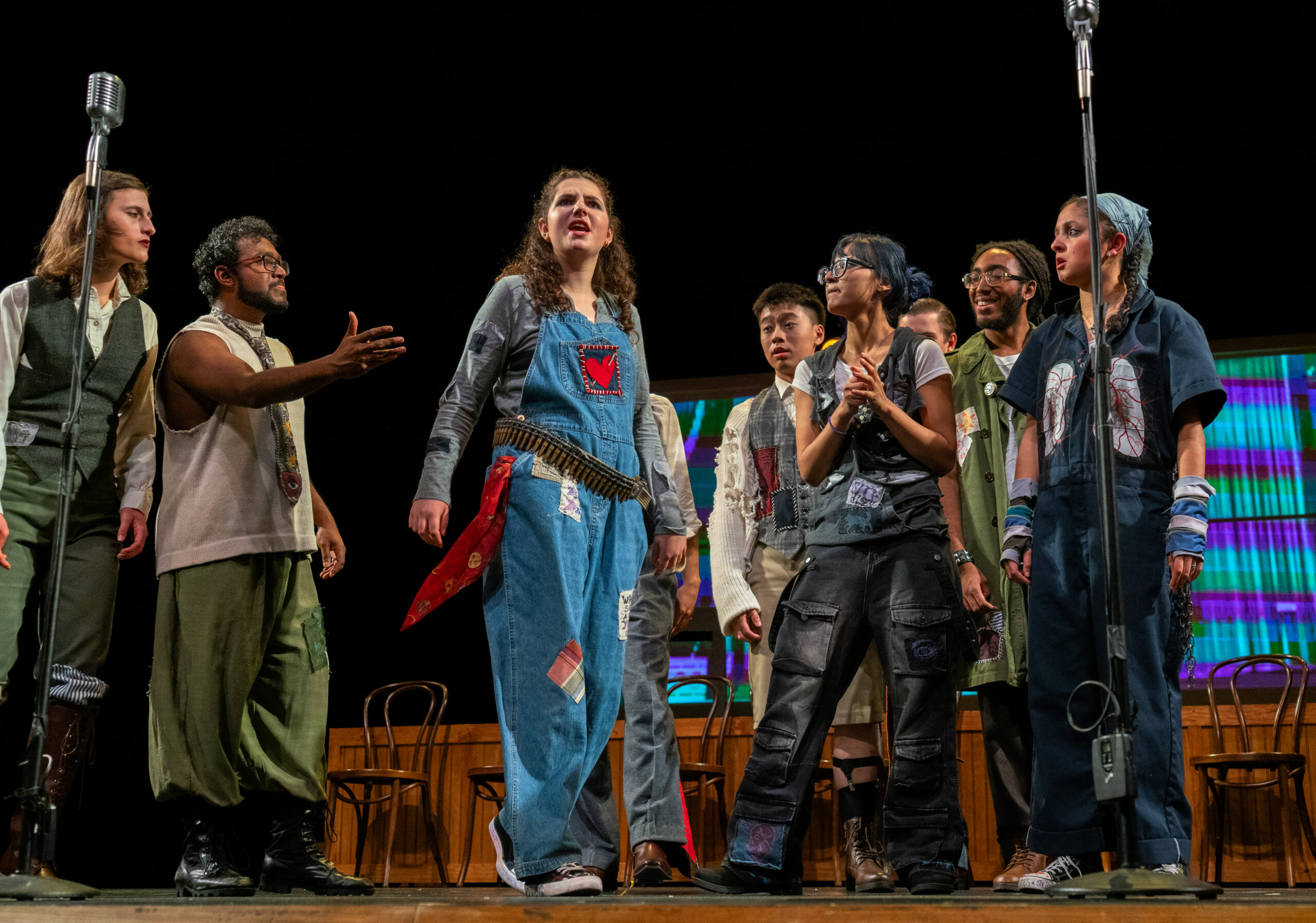
Last weekend, the Department of Theater and Dance staged a production of Clifford Odets’ 1935 play “Waiting for Lefty” in Pickard Theater. The production was directed by Professor of Theater Davis Robinson and featured musical numbers from the Bumpy Roads & The Stage Lefties, a band formed exclusively for the show.
Originally a one-act play, “Waiting for Lefty” is composed of a series of related vignettes depicting the events surrounding a taxi drivers’ strike. Robinson highlighted the play’s enduring political relevance as the reason behind his decision to stage a production.
“This time around, [with the] 2026 midterm, it felt like there was a lot more real anger in the country,” Robinson said. “I reread [the play] and I was amazed by how some of the same tactics are still being used, calling people socialists and reds and communists.”
Robinson was inspired to integrate music into the production after his experience at a rally last summer after the shooting of Johann Sebastián Durán Guerrero by an Immigration and Customs Enforcement (ICE) officer in Biddeford. He recalled how songs helped to uplift protestors when a counterprotestor threatened them with violence. Inspired by the experience, he asked Tom Keegan, a long-time collaborator, to be the production’s musical director and add numbers between scenes.
“[That choice] also gave us a chance to open the music up to the current day,” Robinson said. “There are some ’30s songs—union organizing songs—but we also went into the ’50s and the ’60s, and people noticed some of the lyrics were switched in old songs…. In that sense, we tried to draw a line between protests 100 years ago and protests now, which are still fighting for the same things.”
Beyond the overt political connotations of the featured songs, Evan Braude ’28, who played Edna #3 and played fiddle with the Stage Lefties, expressed how moving between acting and musical performance allowed her to explore different emotional facets.
“I also think [about] the way the music played into that idea of, ‘How can we, as a collective voice, make a change and make things that are powerful?’” Braude said. “There’s so many ways that art can speak to us.… I think the music brought to light some of that emotion that was especially important where this script lacked in narrative. I think sometimes a story can really hit an emotional string with someone. Instead, it was the strings of my instrument doing that.”
The directors and cast worked with a vocal arranger to add harmonies and solo parts into the musical numbers, but many creative decisions were made during the rehearsal process. Olivia Marseil ’30, who played both Edna #1 and Miller, a lab assistant, emphasized the actors’ creative autonomy.
“We basically took on the role of devising the show from the first few weeks,” Marseil said. “We had all of this experimental stuff, which I don’t think any of us expected was gonna end up in the show, and then it did.”
While the collaborative nature of the preparation process sometimes led to debates on the show’s direction, it also enabled members of the cast to expand the creative vision of the production. Rithmaka Karunadhara ’26, who played Fayette, an industrialist, and Dr. Barnes, an elderly and jaded doctor, shared how the cast’s shared dedication to the quality of the production carried them toward a show they could all take pride in.
“I think everyone was very hesitant and wary as to how these abstract ideas would play out, but it came together really well,” Karunadhara said. “I think the reason it came together was … [that] we were all really determined to put up a good show.… If you imagine the show without [the devised scenes], it would be really bare bones. And it really added all these layers of social commentary that … added a lot of color. That came as a group. It’s really cool that we get to enjoy the ownership of that.”
Although the play’s call to action resonates with the current political moment, its working class street-slang script places it firmly in the 1930s. Addressing his decision not to remove racial slurs, Robinson maintained the importance of confronting historical truths, particularly in a play about how people can create social change.
“There’s some offensive language and some offensive stereotypes, but it was also the culture of the time. And if we sanitize that, you’re not really showing people what the culture of the time was,” Robinson said. “We do want to hear what people went through and, are there tactics we can learn from? Are we in a better place now? Those things are really important corrections to the progress that’s being made, but at the same time, a lot of that progress just gets slammed backwards if you don’t learn how to fight, [or] what you’re up against.”
Comments
Before submitting a comment, please review our comment policy. Some key points from the policy: