
“In the Waiting Line” By Zero Seven
September 25, 2026
 This
piece represents the opinion of the author
.
This
piece represents the opinion of the author
.
 Genevieve Scales
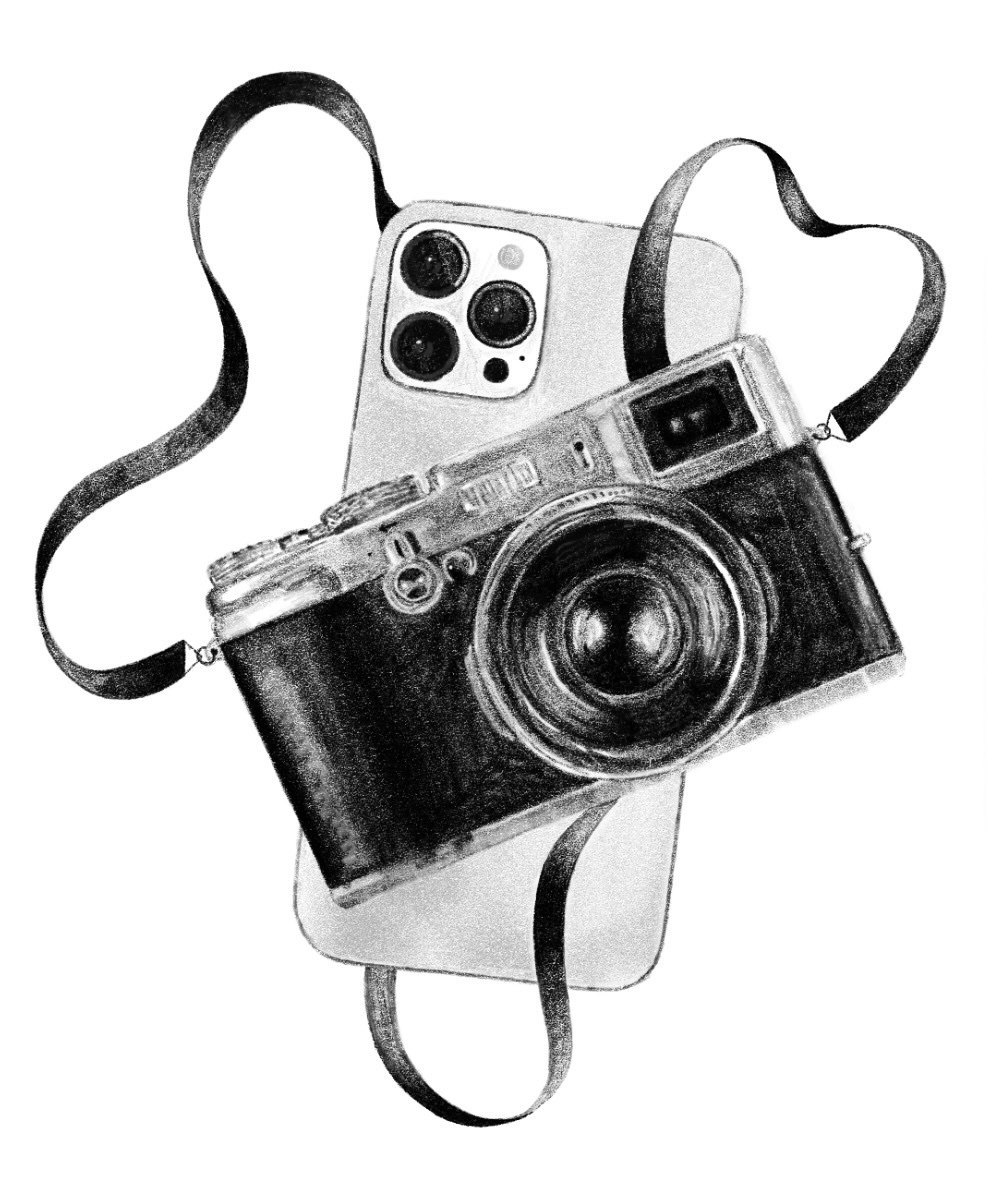
I assume if we were all to wake up with the notification that—due to nuclear warheads or artificial intelligence—life as we know it would cease to exist, no one would be too surprised. In the American context, weapons are a point of pride. They can ensure personal liberties, perpetuate an aura of self-defense or serve as an aesthetic deterrent in an otherwise frightening setting. There is, however, another weapon which I’ve seen become gradually more ubiquitous, one whose subversive presence inclines us to underestimate its destructive capabilities. I’m speaking of the camera. Of course, a camera isn’t capable of the same destruction that we’re used to seeing as a result of war. However, because of its capabilities to warp reality, inspire envy and create a society unconcerned with consent, I believe cameras sneakily contribute to an unbelievable amount of harm every day.
I’ll start off with news articles. Today, journalists like me are not recognized for thoughtfully crafting prose which mellifluously coaxes readers. Instead, individual contributors and organizations have shifted to using pictures and posting them on social media in order to draw attention to current events. Pictures are much more legible for a literate and (growing) illiterate audience; they don’t require much explanation (although context is always helpful) and, most importantly, they can quickly inspire emotion in the hearts and minds of the viewer.
Since ragebait sells, and news orgs are here to sell ads, it’s totally understandable why legacy media organizations are putting their energy into Instagram slides rather than long form media. The danger that cameras pose is how we understand them as objective messengers. When I see images of the destruction of the World Trade Center or Hiroshima, for example, the grief that I can feel within the images coupled with the anguish of the storytellers inclines me to empathize with them. I think this is one of the magical capabilities of cameras. I believe the danger starts to creep in when we become reliant on visuals.
Think about your upbringing. When I mention names and events like Nelson Mandela, Princess Diana and the Iraq War, the material realities of these events are secondary to the imagery that precedes them. By placing photos at the forefront of our learning, I think we open ourselves up to institutional manipulation which could lead us to being indifferent toward pressing issues, such as climate change, and too deeply invested in non-issues, such as trans-people in sports.
In my opinion, the most obvious reason cameras are the most dangerous weapon we have in circulation is that they have supercharged our envy. Two hundred years ago, we would only aspire for and covet the things we were exposed to, which was thankfully not too much. Today, thanks to Mark Zuckerberg, we can see everything all the time: all the trips, all the products, all the accolades and all the praise.
Rest assured, I’m not here to chide you for wanting nice things; however, I can’t even fathom how much ecological and interpersonal damage has been enacted due to the circulation of photographs. I believe we are at a certain tipping point, since millions of people know how photographs take us out of the present moment and contribute to overtourism and overconsumption. But that awareness isn’t making us stop—on the contrary, it seems to have contributed to a scramble to extract the last bits of essence from known places, people and destinations, while also searching for niche, new ones. I’m not here to hate the players; I’m just here to acknowledge the game. More importantly, I think we should all ask ourselves how much longer we’ll be able to play this game at our current rate of whatever this is.
Lastly, I recently realized how the proliferation of cameras has contributed to a culture which disregards consent. I’m sure we’ve all had embarrassing moments with our friends: either them being hazed, getting too drunk or doing something they’d rather forget. Hopefully for everyone, all of these moments are kept privately between you two. As the weapons become more and more available though, the chance of you being recorded by a stranger, company or the government is only increasing. We’ve seen how this can bring joy to some people’s lives, we can all laugh at funny videos, find lost items or learn something new. However, I’m sure we all know how cameras have also inspired a certain paranoia in our lives. What if we get caught? What if our actions are misunderstood? I think this sense of unease has contributed to more hedged language and caged conversations. Since consent to being on camera isn’t expected, we’ve all adapted by retreating inwards—be it into ourselves or familiar groups. Regardless, the whole point of global information sharing and open access seems to have been lost.
Per usual, I don’t have a solution. I certainly am not going to stop using my camera. I think the best part of raising challenging questions like “Are cameras weapons?” is the subsequent conversation they inspire. Ask yourself, do you ever wish someone didn’t take a picture of you? Did you feel awkward asking them to delete existing photos? I hope that we all loathe the companies which have spread these weapons like drugs within our communities. And while it can seem hopeless to close Pandora’s box, we must always remember that hope still remains. (Literally, hope was the only thing left in Pandora’s box.)
Neiman Mocombe is a member of the Class of 2026.
Comments
Before submitting a comment, please review our comment policy. Some key points from the policy:
- No hate speech, profanity, disrespectful or threatening comments.
- No personal attacks on reporters.
- Comments must be under 200 words.
- You are strongly encouraged to use a real name or identifier ("Class of '92").
- Any comments made with an email address that does not belong to you will get removed.
Sometimes technology isn’t the best for humanity. The old fashion camera, with out the computer tech behind it, or the ability to post online, is not so bad. It reminds me of our right to bear arms. Certainly the founding fathers could not imagine the sort of weapons we have today. And the fact that we have not learned how to get along without using these weapons to annilate our fellow humans and our beautiful animals. This mentality stops me in my tracks. I dont get it! I am hopeful that your generation will work on world peace and realize that a photo sometimes isn’t worth a thousand words. Sometimes it has just gone through a thousand minipulations.