
Behavioral scientist Julia Minson unpacks disagreement in Viewpoint Exchange talk
September 18, 2026
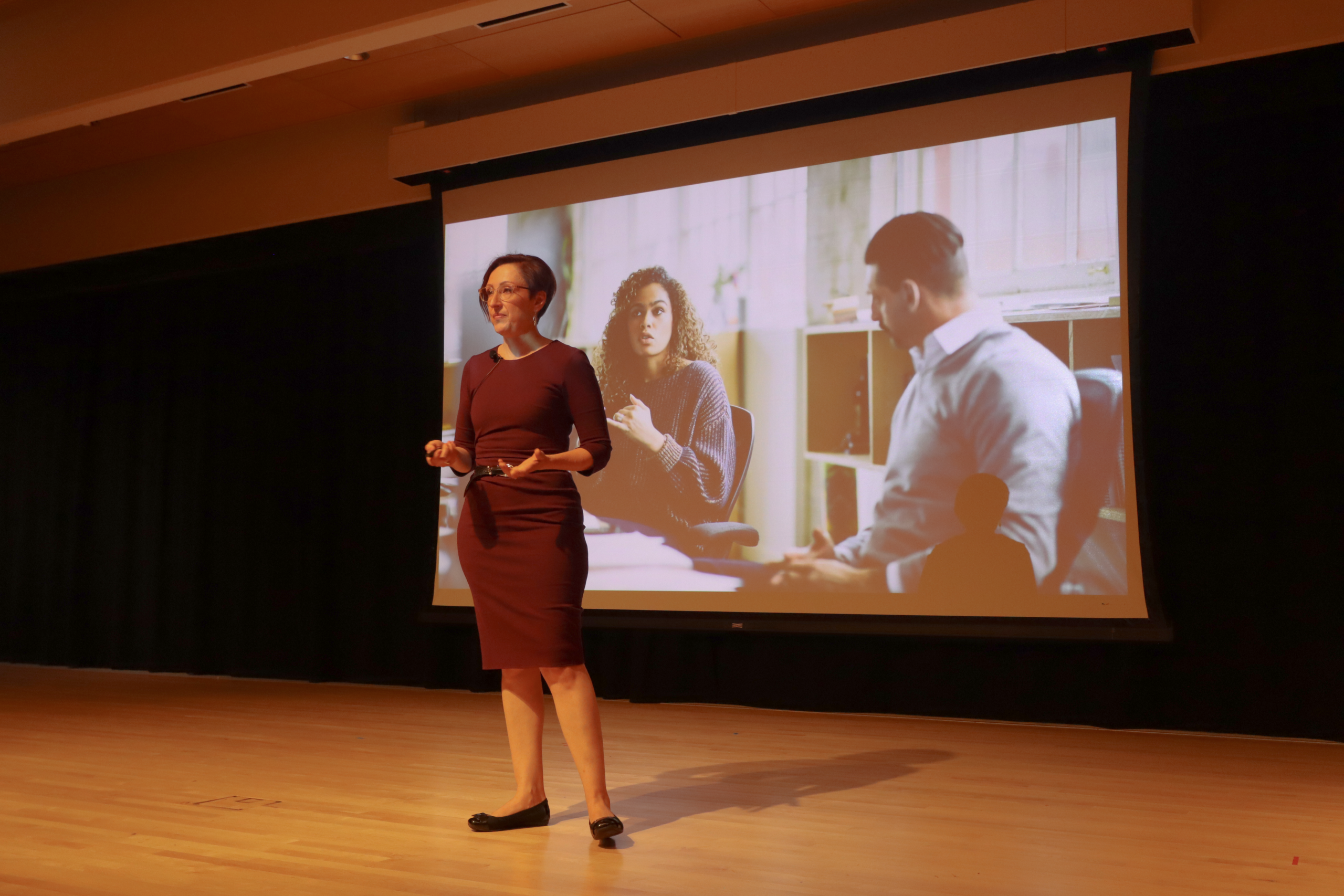 Addison Moore
On Tuesday evening, attendees assembled in Kresge Auditorium to hear behavioral scientist Julia Minson speak in the latest iteration of Bowdoin’s Viewpoint Exchange speaker series. Over the course of an hour and a half, Minson unpacked the psychology of disagreement and discussed how differences of opinion can often give way to conflict, but not always. As a professor at the Harvard Kennedy School of Government, Minson published the national bestseller “How to Disagree Better” earlier this year, and she shared her findings with attendees.
Introduced by Grace Munene ’29, Minson began her remarks by acknowledging today’s polarized environment, imploring attendees to consider their own encounters with disagreement with family and in the workplace. Minson told attendees that disagreement is generally a positive thing in the social sciences.
“‘When two men in business always agree, one of them is unnecessary,’” Minson said, quoting William Wrigley Jr. Arguing that disagreement is the root of most meaningful conversation, Minson encouraged attendees to consider a broader view of the concept.
“When we have people [coming] together to make a decision, it’s because we’re hoping that somebody will say something new. We’re hoping that somebody will contribute a new idea or a new perspective–we are hoping that they will disagree,” Minson said.
In establishing a more neutral definition of disagreement, Minson questioned its negative connotations.
“The problem is that people conflate disagreement with conflict,” she said.
Minson stressed that the two are different concepts, arguing that while conflict is caused by disagreement, not all disagreement results in conflict.
“You start with a difference in beliefs, preferences or expectations. And then you say to yourself, ‘there is no way that a thoughtful, reasonable, well-informed person could possibly believe this crazy thing you’re claiming,’” Minson said. “Conflict is disagreement plus these two other components: negative beliefs that you have formed about your counterpart as a function of them disagreeing with you, and the negative emotions you feel often because you have tried and failed to make them change their mind.”
Along with this distinction, Minson’s presentation demonstrated the importance of mindset, which she defined as comprising three main acts: accessing, considering and evaluating.
“Am I the kind of person that goes and finds information that I disagree with? Am I the kind of person that thinks hard about it once I’m physically exposed to it?” Minson said. “And am I the kind of person that evaluates it with the same type of yardstick as how I evaluate arguments that support my own belief?”
These three questions, Minson asserted, determine proficiency at the “intellectual habit” of building receptiveness to opposing views.
Beyond mindset, Minson also stressed the frequent dissonance between how we feel and the way we communicate, especially in charged conversations. This informed her final point of the evening: the role of “signal distortion” in disagreement.
Even when entering a disagreement with a receptive mindset, this intention must be expressed effectively and accurately interpreted by the other participant in a conversation. Minson explained that with each step in this process, there is potential for breakdowns in communication, resulting in what she termed “signal distortion.”
Minson offered the concept of conversational receptiveness as an antidote to signal distortion, dividing each step of the practice into the acronym “HEAR”: hedging your claims, emphasizing agreement, acknowledging other perspectives and reframing to the positive.
“Conversational reception is not sort of like the solution to all conflict in the world, obviously. But it is an example of how we can use language to behaviorally demonstrate our internal intentions,” Minson said. “A very common question I get around conversational receptiveness is, well, ‘What happens if I’m receptive to them and they won’t play?’ [It] turns out that doesn’t happen very often … if you are receptive to them, it’s incredibly hard for them to keep yelling at you.”
Mia Lewis ’29, who attended Minson’s talk, left with mixed opinions.
“I appreciate[d] [Minson’s] emphasis on maintaining relationships instead of just winning an argument, and also the idea that the point of conflict isn’t always to just reach appeasement or compromise,” Lewis said. “I will say that Bowdoin students had very high quality questions, and I do not think she actually answered them in a nuanced way. I was impressed by the questions that were asked.”
Comments
Before submitting a comment, please review our comment policy. Some key points from the policy: