
Mélanie Lamotte discusses new book on French colonial empire
May 1, 2026
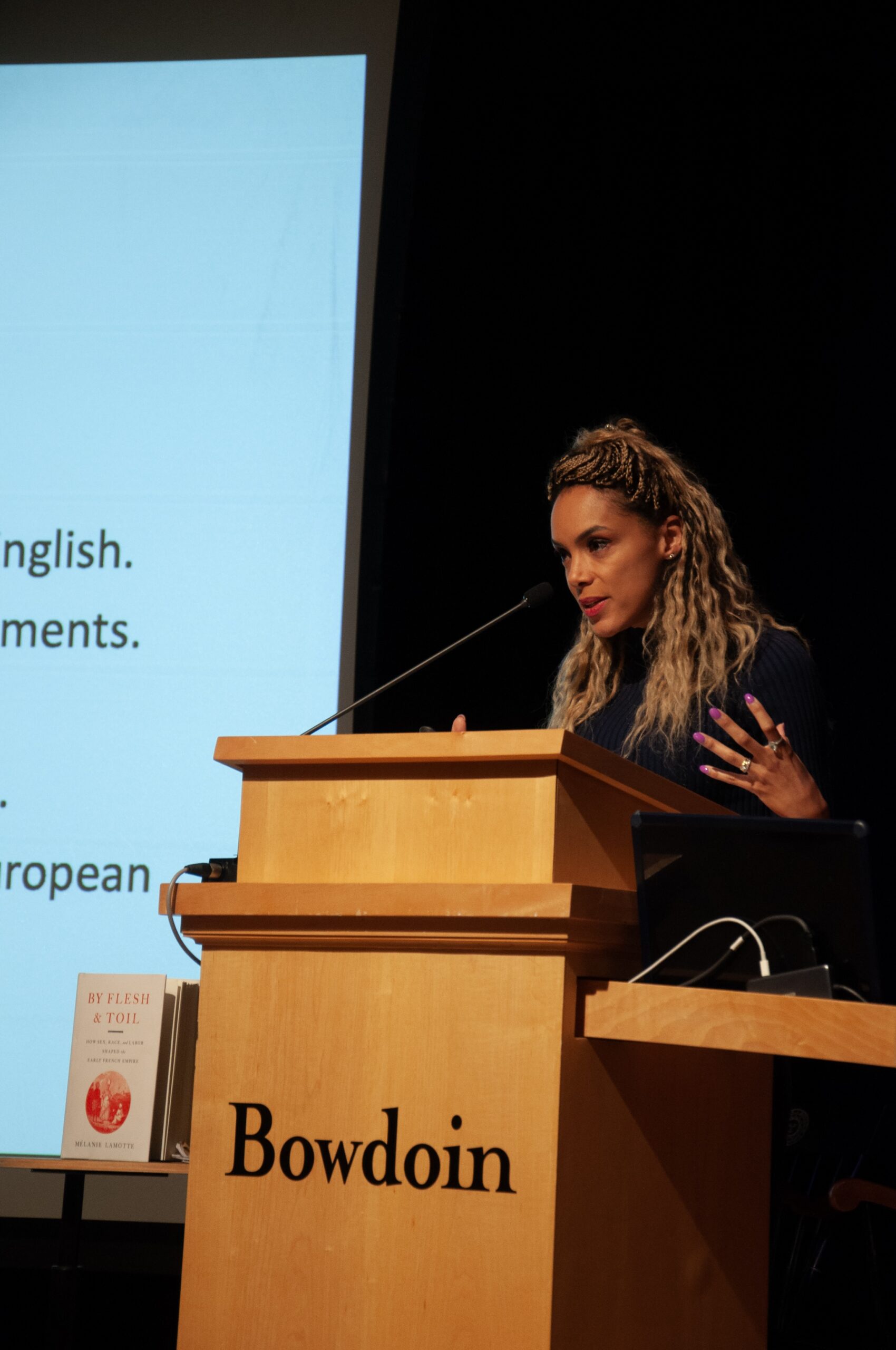 Addison Moore
On Monday evening, students, faculty and community members gathered in Kresge Auditorium to hear Mélanie Lamotte, assistant professor of history at Duke University, deliver a talk titled “By Flesh and Toil: How Sex, Race, and Labor Shaped the Early French Empire.” The lecture, named after her first book, covered the history of the French colonial empire.
Lamotte began by explaining her book’s two primary claims about the character of the French colonial empire in the early modern era.
“First as a result of trans-oceanic exchanges and legal standardization, French colonies and outposts across the Atlantic and Indian Oceans grew increasingly united through a coherent set of racial policies,” Lamotte said. “Despite such connections, the early French empire has often been portrayed as a fragmented conglomerate of isolated colonies and regions.”
Lamotte highlighted the important intersection of sex and race.
“Second, in addition to racial policies, ‘metissage,’ which I define as sexual relations across racial lines, and the labor of people of African Malagasy, South Asian and Native American ancestry, played a critical role in the development of the French empire,” Lamotte said.
Lamotte then explained how her book differs from previous scholarly works.
“My book is the first pan-imperial study of the early French empire in the English language, and it makes several contributions to the historiography,” Lamotte said. “My book demonstrates that the racial policies targeting Black [people] and Native Americans in the Atlantic world are actually influenced by developments which took place in the Indian Ocean and vice versa.”
She further explained how the book directly challenged other claims made in fields surrounding the nature of racial hierarchy at the time.
“Because interracial sex remained a widespread occurrence, despite intermarriage and interracial sex bans, many scholars have claimed that Black and Indigenous people in the French colonies were subject to a ‘lenient racial regime’ and faced ‘no rigid social racial hierarchy,’” Lamotte said. “My book really challenges these claims. It shows that widespread sexual coercion out of wedlock relationships and intermarriage with enslaved and free women of non-European ancestry actually acted as very powerful instruments of empire.”
Lamotte described the sexual politics of New Orleans while it was still a French colony, explaining statistics about the prevalence of interracial sex.
“Seeing these numbers right here gives us a sobering sense on the scale on which sexual coercion happened. My work really paints a very different picture from these numbers than the ones often portrayed in the historiography, which is that French Louisiana was home to a linear racial regime,” Lamotte said.
Specifically, Lamotte explored the number of mixed children as a result of sexual coercion.
“I actually counted the number of mixed children in several parishes across what used to be French colonial Louisiana, and in the parish registers of New Orleans, I found 123 baptized mixed children, or ‘mulâtres,’ during the short period between 1744 and 1759 as well as 115 other mixed children between 1759 and 1763,” Lamotte said. “These numbers are enormous in this particular context, because we know that only 656 white colonists lived in the city of New Orleans in 1732.”
As an advocate of the digital humanities, Lamotte presented a variety of tools that she developed to demonstrate her argument. She showed a website which had animated journeys of French Indies Company ships between Indian Ocean and Atlantic Ocean colonies and a table of passenger manifests sortable by race and profession.
Additionally Lamotte referenced a table which compared the language used in racial laws across Indian Ocean and Atlantic Ocean colonies and a table displaying Francophone Atlantic Ocean writers and Francophone Indian Ocean writers who used the same negative tropes about slaves and Indigenous people in their writings.
For Lamotte, her passion for digitizing colonial history is a collaborative endeavor.
“I’ve been working [with] my husband [who] is a software engineer, so we’re working on these projects together. It’s a lot of fun,” Lamotte said.
Their work provided strong evidence for Lamotte’s thesis of an interconnected French colonial empire.
“Out of the 946 voyages featured on this map, 490 included stops in both the Atlantic and Indian Ocean,” Lamotte said.
Lamotte’s interest in this history comes from her family heritage.
“I became particularly interested in the Black experience while investigating my family history on the Caribbean island of Guadeloupe. I managed to trace my family’s history back seven generations to my enslaved ancestor named Anne Rose, who worked on the sugarcane foundation in Guadeloupe in the late 18th century,” Lamotte said. “My desire to understand this past and stratifications really drives my approach to African and Afro-Caribbean history. It drives my commitment to uncover not only the perspectives and achievements of the intellectual and political elites, but also those of the silenced and underrepresented majority.”
Gabriel Tan ’29 attended the talk and praised Lamotte’s scholarship.
“Besides being the first history in the English language about the 16th-18th century French Empire, it also contradicts traditional narratives about a French empire not existing at the time,” Tan said. “It really draws a line through the French company of the Indies in the Atlantic and the Indian Ocean.”
Comments
Before submitting a comment, please review our comment policy. Some key points from the policy: