
A look into Ladd House, four years later
May 1, 2026
 Jared Scott
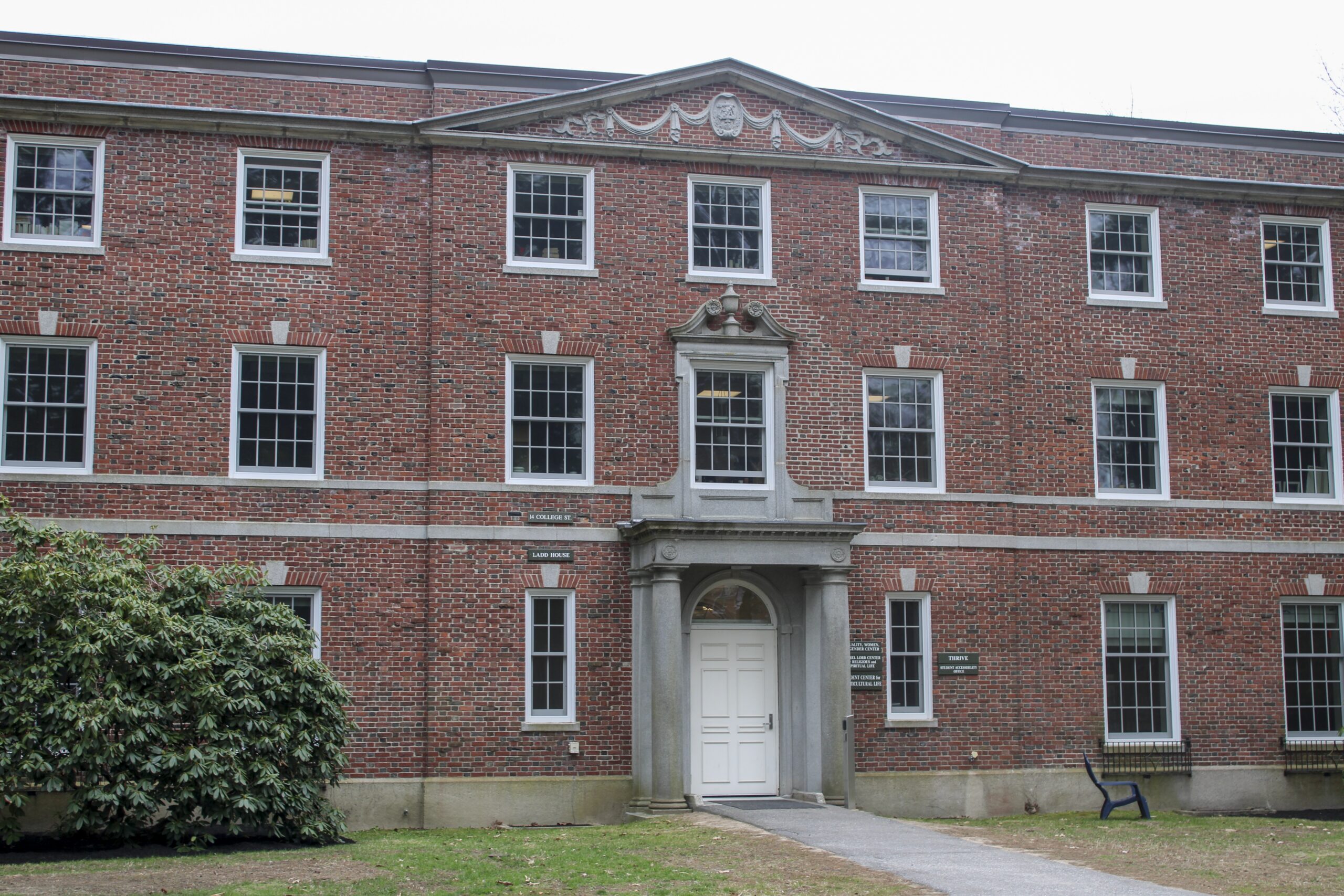
Ladd House, a space once regarded as a senior housing “social experiment” before the Covid-19 pandemic, completed its final year as part of the College House system in 2022, when the College announced its closure for renovations. This decision altered its role on campus from a College House to a building for offices championing diversity and inclusion. The idea, proposed by former Senior Vice President and Dean for Student Affairs Janet Lohmann in 2020, aimed to address spatial constraints on diversity-related offices. The vision was also born from student feedback regarding a lack of space to explore the intersections between multiple identities.
However, Ladd’s renovation was met with mixed emotions, with some students feeling that a space home to all aspects of diversity and inclusion work would belittle the complexities of those identities. For some, these emotions are still fresh as students and administrators consider Ladd’s role on campus moving forward. Notably, in the spring of 2025, Senior Vice President and Dean for Student Affairs Jim Hoppe gathered student perspectives on the topic by organizing two listening sessions.
“The reason why we did the [Ladd House] review last spring was because there was uncertainty [if] it was doing what it needed, and two of the primary people who had shepherded it were a part of the [administration], so it was a good time just to do a pulse check and get some feedback,” Hoppe said. “The staff over there started working really quickly on the recommendations.”
According to Hoppe, a consensus in the feedback was the loss of a communal space students previously used to connect with offices pertaining to their identity. The Center for Multicultural Life (CML) and the Rachel Lord Center for Religious and Spiritual Life resided at 30 College Street, the Sexuality Women and Gender (SWAG) Center at 24 College Street and THRIVE in Banister Hall. After moving these offices into Ladd, these separate spaces were repurposed to house other departments on campus.
“It was nice to have a specific place at 24 College that had its own history because for about 50 years, it was the Women’s Resource Center and then it combined with what was originally the sexuality and gender center, so it was kind of sad to not be in that space anymore,” Alena Lemeshova ’26, student director of SWAG, said.
Geoffrey Canada Scholar, THRIVE Peer Mentor and Black Student Union President Jickinson Louis ’26 thinks Ladd offers a level of support that other offices do not.
“I think it helps in terms of intersectionality. There’s a lot of different organizations on campus that have many identities that need to be supported, especially when I’m thinking about an affinity group perspective,” Louis said. “There’s specific needs that Student Activities doesn’t have the full capacity for, whereas having CML or SWAG as a resource is great because it gives affinity groups [resources] to better serve their communities on campus.”
In contrast, THRIVE Peer Mentor Dana Zhao ’26 believes Ladd falls short of its goal to create community among students, specifically due to the physical layout of the building.
“I don’t think Ladd House serves its purpose. In fact, I think it divides intersectionality more. The separation of spaces actually does worse for students because now we don’t actually see people coming together to create community. And I think that is very apparent through the way the building is structured itself,” Zhao said.
Since the listening sessions last spring, Hoppe noted that administrators and the directors of the offices have worked to make Ladd a student hub by adding new furniture and opening up the space to students as much as possible. Yet, Senior Associate Dean for Student Affairs and Dean of Student Engagement & Leadership Katie Toro-Ferrari acknowledges there’s still work to do in making students feel Ladd belongs to them.
“[It would be great] if we could figure out a way for this space to feel like this vibrant hub that celebrates all these different identities that’s not necessarily segmented in a way, but really just integrated while still creating space for people to lean into their identities and celebrate the uniqueness of their specific identities,” Toro-Ferrari said. “When I’ve talked to those students, I’m like, ‘Yeah, that’s the promise of Ladd.’ I don’t know if we’re there yet. But there’s a lot of people that have been working really hard to get us there.”
Katy Stern, the director of institutional inclusion and diversity programs and the former director of SWAG, shared that the concept of Ladd emerged from student feedback about the lack of integration between spaces for identity-based communities on campus.
“Over the years, I’d hear from students who were talking about how it felt funny to have to go to this place for this and that place for that, and then there were also students who wanted bigger spaces,” Stern said. “It was really important to us that throughout the building, there are still three rooms so there could be something happening at the same time, but bigger spaces for bigger programs were possible too.”
Although Toro-Ferrari credits the idea of repurposing Ladd to the Office of Student Affairs, largely through the efforts of Lohman and former Assistant Dean of Students and Director of the CML Eduardo Pazos, she said that students were involved in designing how they wanted the space to look and feel.
“There was a sense that we’ve had this model for a while; it’s now feeling like the needs of students are becoming more nuanced and interesting in terms of how they have multiple identities, and they’re showing up in some of these different spaces,” Toro-Ferrari said. “The idea was really ‘How do we have a space where students can feel like their identities are represented, but also they don’t have to pick and choose which identities they’re leaning into?’”
Ladd was not the first time where such student feedback led to the integration of separate identity-based offices on campus. Stern’s first role at the College was as a director of the Queer Center, which she merged with the Women’s Resource Center to create SWAG.
Stern also contributed to the formation of individual centers to support identity-based programming on campus, leading to the development of the CML in 2015 and the Rachel Lord Center for Religious and Spiritual Life in 2019. THRIVE was also created during this period with a donation in 2018 from Reed Hastings ’83.
Chief of Staff for Student Affairs and Senior Associate Dean of Student Affairs for Community Life Whitney Hogan explained that these newly formed offices bolstered preexisting student programming.
“Historically at Bowdoin, I think there have been years and years of really robust affinity programming, but these offices exist to anchor that and provide some extra support for that work,” Hogan said.
In the absence of a director for the Rachel Lord Center this year following Oliver Goodrich’s departure, Hogan has taken on new responsibilities to help with the center’s daily operations.
“We didn’t hire an interim director for the Rachel Lord center this year, and so I have worked hard to fill as many of those gaps as possible,” Hogan said. “Yet, there has definitely been an absence of a director this year, to which I’ve been very grateful to the student leaders of the religious affiliated affinity groups for stepping up and doing such good work.”
Hogan also pointed to support from the newly-hired Muslim and Jewish life advisors during the transition. As part of the hiring process for a new director, the College conducted an external review of the Rachel Lord Center to tailor the job description to the current needs of student leaders within the space.
“We had a leader from each of the four affinity groups be on the search committee…. Having those students in the room together helping us identify candidates and pick a final candidate was so crucial and was great for the person that we hired,” Hogan said.
While THRIVE, CML and now the Rachel Lord Center have undergone several changes in leadership over the past few years, Toro-Ferrari believes that these shifts come with creating centers that focus on student needs, not just in the present, but ten to 15 years into the future.
“[The offices are] trying to settle themselves. Bowdoin has changed so much in the last 15 years, so these centers came about at a time when the demographics were starting to really shift. And so it’s been like trying to build the boat while you’re sailing it at the same time,” Toro-Ferrari said.
Hogan proposed that due to gaps in leadership, these offices must increase their solicitation and integration of student feedback to fulfill changing needs.
“I think these offices always feel dynamic and sometimes feel extra dynamic when there is a change in leadership, but ideally, the people that we are hiring and onboarding are constantly kind of evolving and responding to the needs of current students,” Hogan said.
Toro-Ferrari explained how the turnover in leadership may be reflective of a tumultuous period for offices focused on diversity, equity and inclusion in higher education.
“It’s hard for me to be like, ‘This is the reason why [leadership turnover] is happening’ beyond just saying that if you look at other comparable departments across higher ed[ucation] in the country…. It can be harder to find people who really feel like they can stay around and implement their vision for a while,” Toro-Ferrari said.
While high turnover rates present challenges, they have also offered opportunities for new visions to be implemented.
Director of SWAG, Natalie Turrin, began her time at the College in 2023, the same year SWAG officially moved into Ladd House. Lemeshova also joined the office the same year as Turrin.
“The majority of my time here has been with [Turrin] and working very closely with her, but I can definitely say that she brought so much amazing energy to the center, and she’s just always brimming with enthusiasm for allowing for more opportunities, for more events,” Lemeshova said.
Turrin’s focus has been creating new programming like Pride Prom and Lavender Graduation for seniors as well as developing opportunities for student officers to instill their own ideas into SWAG.
“My main goal has been to introduce new traditions while honoring existing ones, and to offer a breadth of programming, events, and resources,” Turrin wrote in an email to the Orient. “A huge part of that has been building a student staff team who are genuinely at the center of the work; they bring energy and creativity that drives everything we do. Ladd has opened doors for collaboration, and I’m continuing to think about how we make the space feel fully like home for our students.”
Lemeshova credits Turrin for continuously shaping Ladd into what it is today and taking initiative to provide resources to students.
“I can also say that [Turrin] has been taking on a lot of the responsibilities in Ladd in general. I think all officers have been involved in revamping Ladd and adding to it to be more homey, but a lot of it has also been [Turrin]’s initiative,” Lemeshova said. “When we didn’t have a director for the Office of Gender Violence Prevention and Health Education, [Turrin] basically functioned as an interim director.”
THRIVE similarly has undergone leadership changes with Mo Nuñez serving as the director of THRIVE since Anthony Parker-Gills left his position in the beginning of 2025.
“I started last February, and since then, I’ve been able to develop some good relationships with partners on campus and link up with them to be able to show up at the table, to advocate for first generation students,” Nuñez said. “At a more granular level, I’m just really working on relationships with students.”
Assistant Director of the CML Arianna Rodriguez noted that the structure of Ladd has been helpful in her programming, especially as a new director.
“I love working on that third floor because I love just being able to bounce ideas off of [Turrin],” Rodriguez said.
Nuñez echoed this sentiment, emphasizing that every office in Ladd shares the same goal of building communities and finding areas where their work intersects.
“We try to find all the spots that we intersect, and we talk to our students about intersectionality as well…. That cross pollination piece is pretty prevalent, and that’s really neat, because it allows us to think strategically about how we capture and support the most number of students,” Nuñez said.
Collaboration with Ladd also underscores Lemeshova’s role as a student officer, both in terms of planning events and supporting individual student needs that require an intersectional approach.
“Being in Ladd helps a lot in terms of cooperation with other groups because as a student worker of SWAG, I also know the staff in CML and religious life. So in that way, it is easier for us to collaborate on events together,” Lemeshova said.
Hogan remarked that an important impact of Ladd’s consolidation has been creating more deliberate space for identities to be spotlighted.
“I think one outcome of Ladd is that we are seeing more opportunities for intersectional programming. I think perhaps even more critically, or more important than that, is the opportunity for these student leaders to be occupying the same space and creating coalitions and relationships among themselves and working toward an environment where we have a cohort of student leaders who all affiliate themselves with Ladd House,” Hogan said.
Toro-Ferrari explained how a diverse student body is a strength of the College and wants to create a campus community that can best serve and amplify student voices from all walks of life moving forward.
“I think the challenge continues to be … how do we really develop that as an asset for all of our students, for the students coming from more marginalized backgrounds, for students who are coming from more privileged backgrounds,” Toro-Ferrari said. “How does campus end up feeling truly like a space where everyone can capitalize on that diversity of human experience that we have here?”
Comments
Before submitting a comment, please review our comment policy. Some key points from the policy: