
Author Ayelet Tsabari discusses family and literature with Professor Brian Purnell
April 16, 2026
 Abigail Hebert
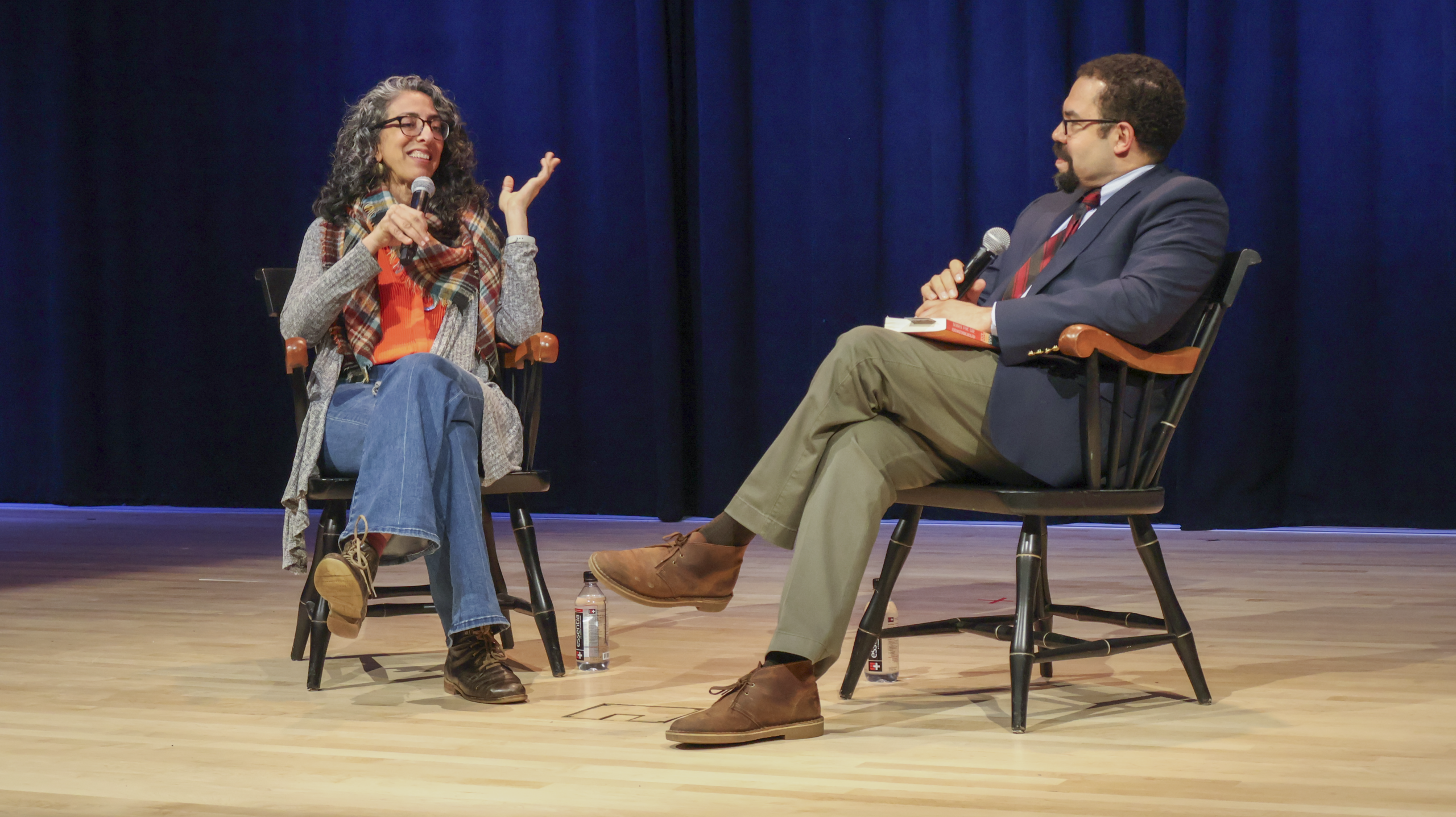
On Wednesday night in Kresge Auditorium, Professor of Africana Studies and History Brian Purnell joined writer Ayelet Tsabari in conversation about her debut novel, “Songs for the Brokenhearted,” and the power of communicating through fiction. Tsabari is an author of award-winning nonfiction essays and short stories, but her debut novel combines history and storytelling as it navigates a Yemeni-Israeli woman uncovering family events from the 1950s.
Many of the plot points in “Songs for the Brokenhearted” stem from real conversations in Tsabari’s life. As a Yemeni-Israeli Jewish woman, Tsabari studied her family history and public historical documents. When writing the novel, she interviewed women who immigrated from Yemen to Israel in the 1950s under Operation Magic Carpet. Many of these women also lost relatives to the Yemenite Children Affair, where over a thousand children of Yemeni immigrant families disappeared after moving to Israel.
“I sat with women and held their hands and cried with them when they told me stories. Stories that are in the book, like in some of the scenes there are stories of children that were missing. Every story that you read in the book is a story that was told to me by someone,” Tsabari said.
One scene in “Songs for the Brokenhearted” depicts a hospital telling an immigrant family their daughter has passed away. The girl’s father searches the building until he finds her hidden away and dressed in new clothing. Historically, many kidnapped children were put up for adoption. Tsabari revealed this as a story from her family, eliciting gasps from the audience.
“It was a way of honoring them, including the story. That is a story that happened in my own family,” Tsabari said.
The gravity of the novel’s historical events and Tsabari’s writerly approach also connected deeply with attendees. Elan Cohen ’28 shared that he loved the novel’s nuanced characters and interrogations of home. He highlighted how the novel’s immigrant women wrestle with their feelings towards a country that offered them security but also discrimination.
“The Jewish Yemeni women in the novel constantly wrestle with their emotions toward Israel, a place and culture which both gave them hope, security and greater freedom, while simultaneously overlooking and discriminating against their minority community, especially concerning the Yemenite Children Disappearance Affair. I loved [Tsabari’s] talk, in which she discussed the emotional difficulty and narrative complexity of writing this novel,” Cohen said.
Prior to “Songs for the Brokenhearted,” Tsabari won the Canadian Jewish Literary Award for her memoir in essays, titled “The Art of Leaving.” Considering her achievements in nonfiction, Purnell inquired why she chose to explore historical events through fiction.
“I think it reaches people in a different way. You watch the news and you see newscasters standing on a rooftop, and there’s a burning city in the background. Fiction zooms into a family’s home, and their stories, and their love stories, and their grief, and all of this. This is what makes them human to the reader,” Tsabari said.
Tsabari reflected on her time as a young girl reading novels in Israel before immigrating to Canada, where she seldom encountered characters that resembled her.
“I grew up never, ever, ever reading a Yemeni character in books. I’ve never seen a character like my grandmother. Never seen a character like me. I’m just writing my story, our story, with the hope that by doing that, I’m providing a bit of balance,” Tsabari said.
The audience resonated with Tsabari’s discussion around fiction’s ability to spotlight diverse perspectives. Jewish Life Advisor Connor Dedrick helped organize Tsabari’s campus visit and elaborated on how it is crucial to provide access to diverse stories.
“We rush to understand through very formal histories and data, while literature provides a lens to understand and relate to the human experiences across time and space,” Dedrick said.
Near the end of Tsabari’s talk, an audience member asked about the periodic Hebrew phrases throughout her novel and the weight of such phrases within a historical text. Tsabari explained she often wrote in her mother tongue of Hebrew when she was younger but now primarily writes in English. Yet, she explained that certain ideas are most resonant for her when tied to her mother tongue.
“I use Hebrew words when I feel like there are just no good equivalents,” Tsabari said. “I don’t italicize foreign words. Italicizing says, ‘Oh, look at me, I’m a foreign word.’ But they’re not really foreign to me or to the characters.”
Since “Songs for the Brokenhearted” was released in 2024, Tsabari has continued her work writing a new collection of nonfiction essays.
Comments
Before submitting a comment, please review our comment policy. Some key points from the policy: