
A conversation on chorus
April 16, 2026
 Mia Lasic-Ellis
One recent afternoon, I met with the lovely Nisi Tuitupou ’26 to talk about singing, particularly as it is done in collaboration with others. I was drawn to interviewing her on this topic since we frequently sing together, whether through a cappella or during our free time. By virtue of our musical relationship, we’ve learned how to communicate with each other in a distinct manner.
Recently, our a cappella group has been working on Nisi’s senior solo for our final concert in May. The style of the piece concentrates on both our choral sound and distinguishing the block from the soloist. Nisi’s song has also been a unique opportunity in its experimentation with gospel-like vocal arrangements, which we haven’t worked on much before. Since we’ve begun to work on her project, I’ve been inspired to search for more music that uses many voices. As a result, I’ve developed a desire to parse through Nisi’s thoughts on the value of communal singing.
Lorca: Hello, Nisi. I guess we could start off talking about the fact that we just listened to a bunch of different songs, like choral songs, gospel, all of that. What draws you to this music? Let’s start there.
Nisi: I think what draws me to gospel music is that there’s a different kind of spiritual tone to it. It just feels more incentivizing. It’s really uplifting, I would say. I think that growing up, my parents made us listen to only gospel music in the mornings because they wanted us to listen to something good when we woke up. I think that I kept it going when I went to college. I don’t listen to it all the time, like every morning, but my first and sophomore year, I always listened to gospel music in the morning. And then also before I have games, my pregame music is always gospel music because it just gets me into a better mindset.
L: What do you think goes into that uplifting?
N: I think part of the music is just how strong the voices are and how strong each part is. And I really love the harmonies. I think the harmonies are the best part. You’re all singing the same thing, but in a different way, but it’s still beautiful. You know what I mean? And you can be off. That’s why harmony’s so cool because you have to find the right pitch and the right note so that it sounds, so that it gives you a certain chord. And there are different chords that give you different feelings. And I feel like a lot of gospel songs are in tempo and in the same chord range that puts you in a good mood.
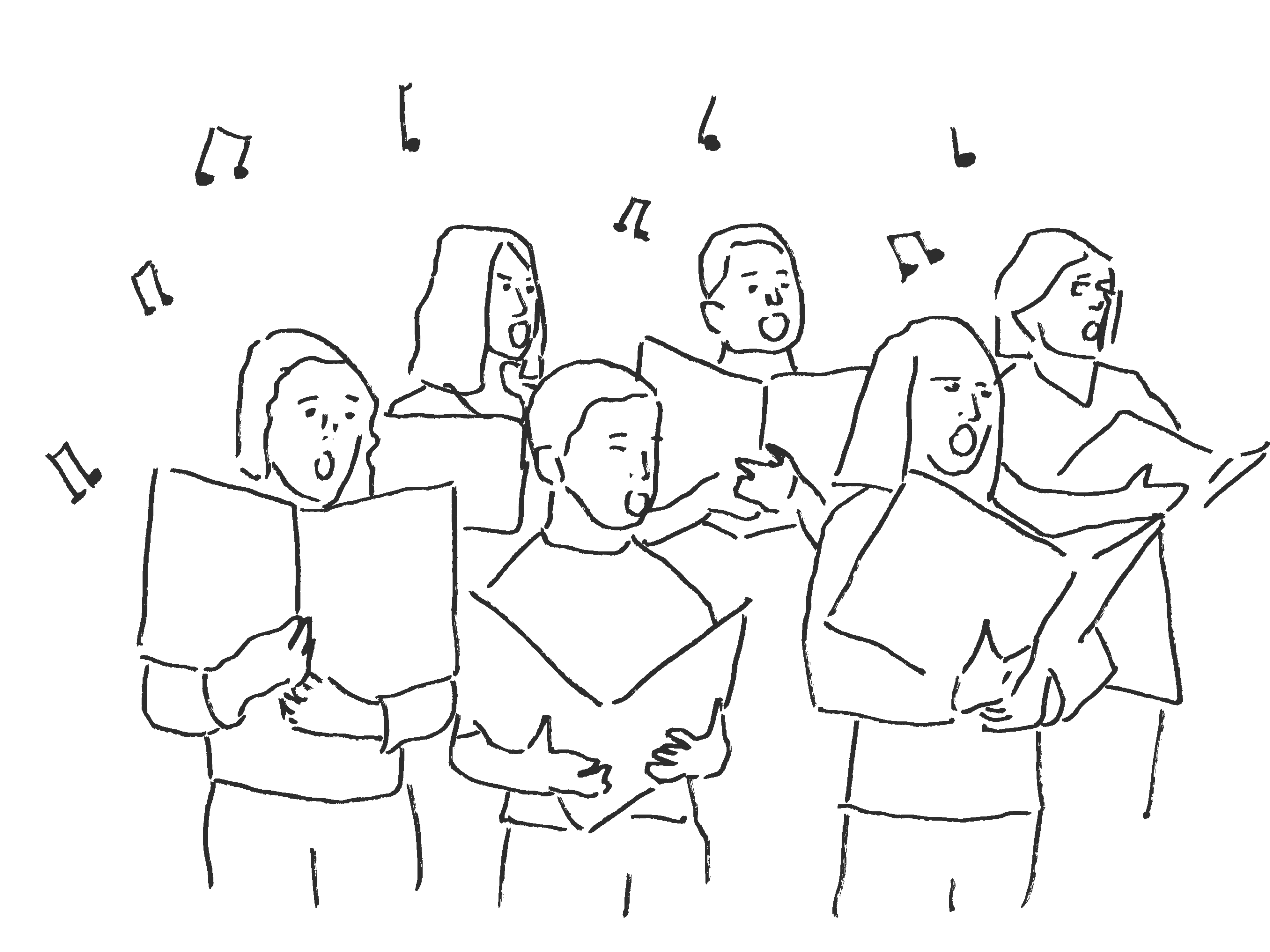
The musical elements Nisi prioritized in her dissection of gospel’s “uplifting” feeling are dependent on the body of a chorus. Harmonies require active listening and engagement to run smoothly, and chords are similarly dependent on connected notes. In this sense, songs performed by a choir exercise a form of human interaction that can be extremely gratifying.
While we talked, Nisi and I listened to a few gospel and choir songs: the Sunday Service Choir’s version of “Back to Life”; “Melodies from Heaven” by Kirk Franklin & The Family; “Like A Ship” by Pastor T.L. Barrett and the Youth for Christ Choir; and, for its fantastic intro, “How Great” by Chance the Rapper, Jay Electronica and My cousin Nicole.
Inevitably, we found ourselves in a good mood; as Nisi pointed out, the innate structure of most gospel songs is meant to generate a sense of uplift. In tandem with the maturing spring, this music intended for both worship and gratitude came through powerfully.
Towards the end of our session, I brought the conversation back to Nisi’s solo, wondering which elements of gospel music she hopes to emulate and express most through her work.
N: For my senior solo, what I thought about is my roots and thinking about where I came from and where I started singing, which is in the church. One of my gifts to Bowdoin leaving campus is giving this song, and I’m not singing with my siblings, but it’s also like a gift. It’s just gratitude, you know, being grateful for God putting me through here and also honoring the fact that I would not be here without my family, you know? And so it’s a lot of combined things, but that’s why I wanted to sing it.
Comments
Before submitting a comment, please review our comment policy. Some key points from the policy: