
Bowdoin hosts medieval conference at BCMA
April 16, 2026
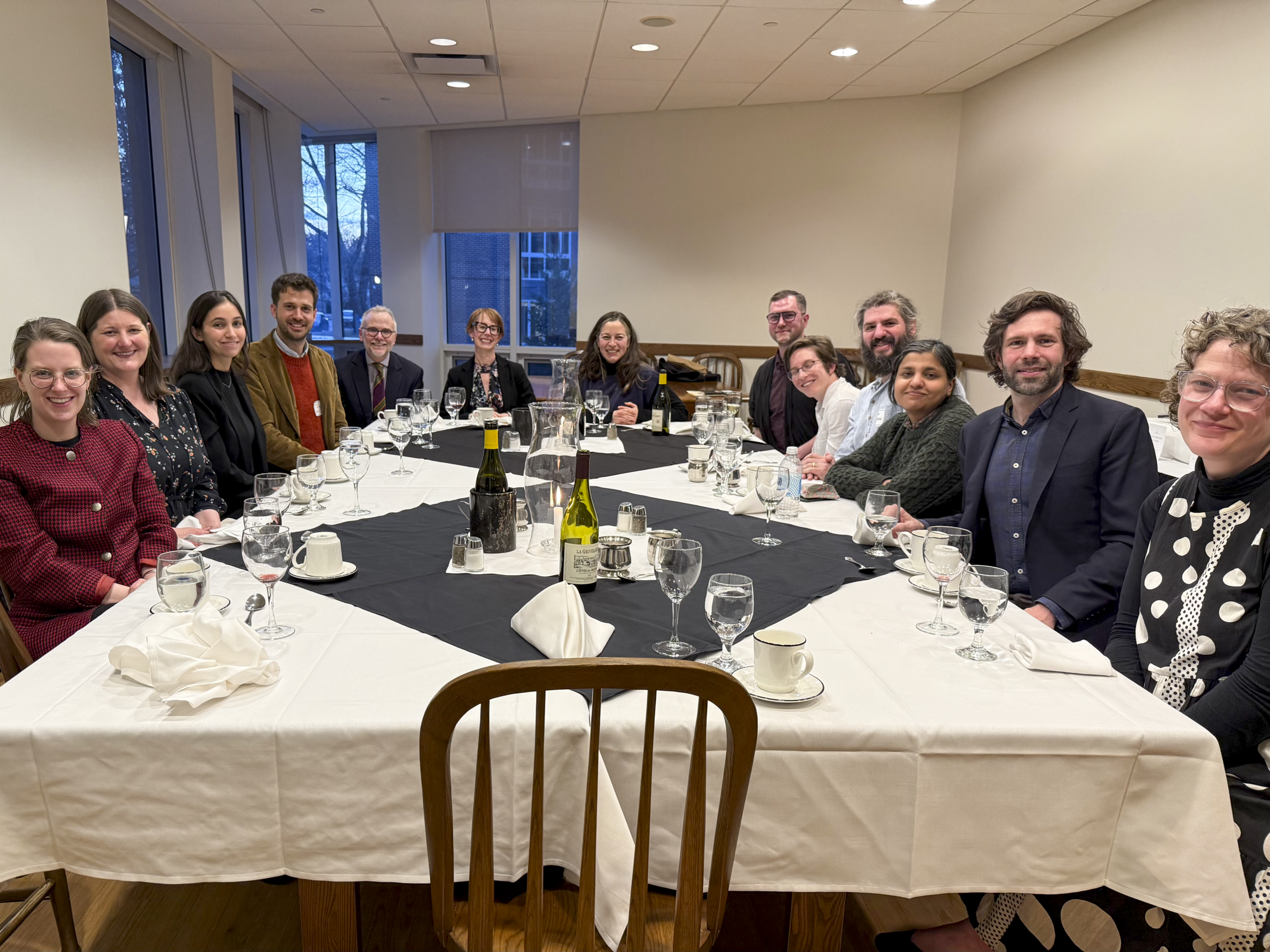 Courtesy of Stephen Perkinson
On Saturday, scholars from across New England gathered at the Bowdoin College Museum of Art (BCMA) for the annual conference of the New England Medieval Consortium, “Re-envisioning the Medieval World(s) in the 21st Century.” The daylong event brought together researchers from art history, literature, archaeology and theology to interrogate a deceptively simple question: What do we mean when we say “the Middle Ages”?
The conference was organized in conjunction with the museum’s current exhibition, “Medieval Art from the Wyvern Collection: Global Networks and Creative Connections,” an ongoing loan of objects from London’s Wyvern Collection that will remain on view through September 2027. In opening remarks, Casey Braun, one of the BCMA curators, situated the event within the museum’s broader ambitions for the loan.
“The museum and Bowdoin College are proud to host this year’s New England Medieval Consortium conference, which was inspired in large part by the current exhibition Medieval Art from the Wyvern Collection,” Braun said. “This loan has enabled the museum to share a diverse range of objects from the premodern world and has delighted visitors from the campus community and well beyond.”
Professor of Art History Stephen Perkinson, introduced the conference around what scholars have begun calling the “global turn” in medieval studies. This is a wave of emerging research that has complicated long-held assumptions about the period as an isolated, exclusively European moment in history. In an interview with the Orient, he described the exhibition’s organizing logic.
“What it allows us to do is set up an installation that is meant to raise questions, to get people thinking, to see objects from different parts of the world side by side and begin to notice the connections that become visible when you look at them together,” Perkinson said.
The evening keynote was delivered by Lloyd de Beer, a curator at the British Museum in London, who spoke about a single artifact: the Asante Ewer, a metalwork vessel made in England in the late 14th century and later plundered from West Africa by British colonial troops in 1896. In his lecture, de Beer described the object’s strange invisibility within the institution that currently holds it.
“This object is currently on display in the gallery of late medieval Europe, and it is completely invisible in the display now, even though it profoundly links Europe with West Africa,” de Beer said.
He told the audience he wanted to reorient how the Ewer is understood and presented.
“I wanted to foreground the West African history of this object, both in how we write about it, how we think about it and how we present it,” de Beer said.
His lecture also pushed back against romantic or speculative accounts of how such objects moved between continents. England, he argued, was a minor participant in the trade networks that actually mattered.
“In reality, England was a minor player in the complex trade links that connected the richer and far more powerful kingdoms of West Africa with those north of the Sahara and onwards,” de Beer said.
The central question his lecture left open was one the historical record cannot fully resolve.
“The question remains, how exactly and why did these luxury items travel so far from their places of production,” de Beer said. “There is no documentation to satisfactorily answer this question.”
Perkinson described the audience’s reaction to this kind of evidence as one of the most striking dimensions of the day.
“A number of them expressed to me how surprising and fascinating this was, that they had been told a story of the Middle Ages that was about the European Middle Ages and this idea that there was this isolated part of the world,” Perkinson said.
He also noted how the conference’s structure encouraged scholars to respond to one another in real time.
“The thing that was really most wonderful to me was the way in which the [presentations] that went late in the day really calibrated [participants’] delivery to respond to things that they had heard in the morning,” Perkinson said.
According to Perkinson, the stakes of revisiting the medieval period extend well into the present.
“The issues that the Middle Ages raise for us are often issues that we think about today. We think about globalization today. We think about world trade, we think about colonialism and we think about diplomacy. And all of these sorts of things were there in the Middle Ages,” Perkinson said.
The Wyvern exhibition runs through September 2027 and is free and open to the public.
Comments
Before submitting a comment, please review our comment policy. Some key points from the policy: