
Acclaimed songwriter Joe Henry shares stories and songs
April 3, 2026
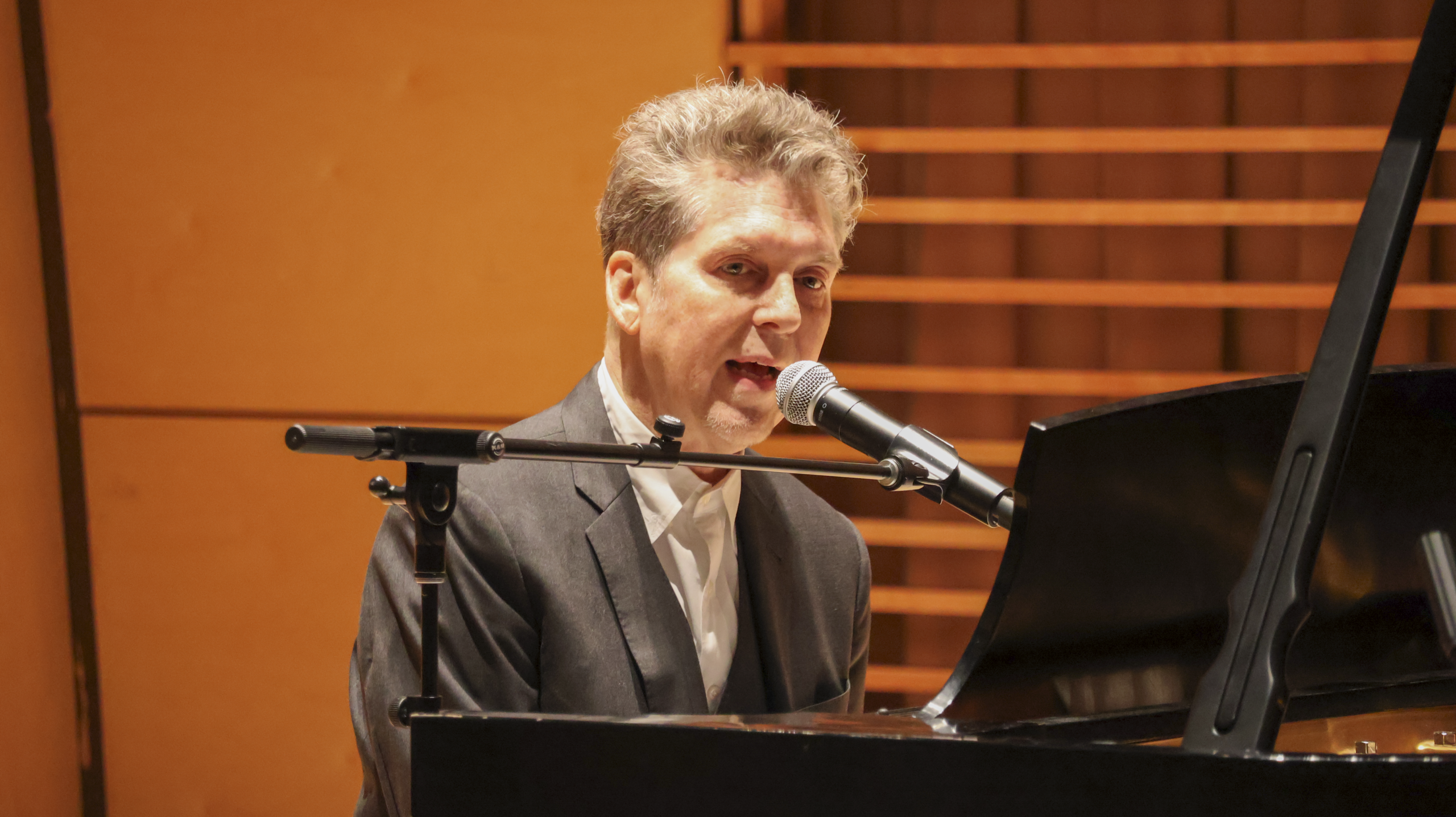 Abigail Hebert
On Monday night, three-time Grammy-award winning singer-songwriter Joe Henry performed in Studzinski Hall. The evening also included a conversational interview with Professor of English Brock Clarke and a Q&A session.
Over his 40-year career, Henry has written over 18 albums, produced several more, and helped Madonna write songs like “Don’t Tell Me” and “Jump.” Aside from songwriting, Henry is passionate about poetry, short stories and novels. He also co-wrote a biography of Richard Pryor with his brother, David Henry.
Early into the evening, Clarke prompted Henry with a question about the process of writing “Our Song,” one of the few songs Henry wrote with a political message, discussing ideas of patriotism and religion during the Iraq War. While most of Henry’s songs are written from a first-person perspective, they aren’t from his point of view. Instead, they are from a separate narrator that he embodies during the writing process.
The second song Henry played was called “Orson Welles,” a piece he wrote before his pancreatic cancer diagnosis. He believes all songs and their writing processes, are a discovery. Otherwise, they wouldn’t be living things. Henry shared a little more about his process, including how he doesn’t write a song with a set destination in mind.
“I write to kind of find out what I’m writing about, but I recognized after I had written [“Orson Welles”] that there were elements in it that were such a giveaway about my personal health journey that I had not really registered when I was writing it,” Henry said. “I try to stay out of the results business when I’m writing. I don’t wanna know what I’m writing about, and I certainly didn’t think that I was writing about cancer when I was writing that song.”
Growing up, Henry moved a lot but spent most of his childhood in North Carolina. He thinks that the constant change was the start of his storytelling career, especially through music.
“I was a very shy and sensitive kid, and that was really traumatic for me to be uprooted as often as I was. But the result was [that] it sent me into my room in front of a record player,” Henry said. “I disappeared into a world that I found endlessly seductive. [I would] disappear into songs and their stories, as they all [worked] like movies for me.”
Henry models his albums similar to a movie, with each song as its own scene. However, in this day and age of music streaming, Henry understands that listeners pick and choose which songs they listen to instead of experiencing the full narrative.
While Henry is awarded for his songwriting, he loves writing of all forms, including poetry and short stories. He noted how each genre and its greats has had an impact on his career.
“I’ve been influenced by a lot of artists who are not songwriters. I learned that it’s really limited to talk about songwriting all in terms of other songs,” Henry said. “I love short stories, and I probably learned as much about what I wanted to do with a song from reading Eudora Welty, Raymond Carver, Flannery O’Connor and [Gabriel] Garcia Marquez, as well as Bob Dylan.”
Lyn Keogh ’28 is a student in Clarke’s Introductory Fiction Workshop and was intrigued by Henry’s discussion of the connection between music and storytelling. Keogh mentioned how his ideas on the writing process will impact their writing moving forward.
“I think one of the things they talked about was how you don’t approach writing with a whole plan from start to finish. You can redraft it, you can work…. However that idea comes to you, you just need to stick with it, and part of the process is figuring out what you’re writing about,” Keogh said. “I can take that with me a little bit because I always get hung up on the details a lot, so that part was definitely helpful.”
At the end of the evening, Henry encouraged the students in the audience to think more critically about the music they listen to every day.
“I hope it will provoke some conversation between [students] about the way that songs are and about the way that writing works in general,” Henry said.
Comments
Before submitting a comment, please review our comment policy. Some key points from the policy: